
 Need help?
Do you have a question about the Cables to Go TruLink 35555 and is the answer not in the manual?
Lists the key capabilities and functionalities of the KVM switch, including multi-platform support and USB hub features.
Illustrates the front and back panels of the KVM switch, labeling key ports and indicators.
Lists all the items included in the product package, such as the KVM switch, cables, and power supply.
Details the general technical specifications of the KVM switch, including operating temperature, humidity, dimensions, and weight.
Explains the function and status of each LED indicator on the KVM switch, such as Power, PC Host, and HUB Switch LEDs.
Outlines the necessary hardware and software prerequisites for installing and operating the KVM switch.
Provides step-by-step instructions for physically connecting the KVM switch to computers and peripherals.
Guides users on the correct procedure for powering on connected computers after installation.
Explains the ability to connect and disconnect USB devices without shutting down the system.
Alerts Sun Micro system users about potential boot-time issues with USB 2.0 HUB feature.
Explains how to switch between connected computers using the physical push buttons on the KVM switch.
Details the procedure for switching computers using specific hotkey sequences on a PS/2 keyboard.
Describes how to use the OSD utility software for switching computers, specifically for Windows users.
Explains the Auto-Switch mode, where the KVM Switch shifts Host PC with the HUB automatically.
Details the Auto-Scan function, which cycles through connected ports at set intervals, disabling keyboard/mouse input.
Explains how to adjust the time interval for the Auto-Scan function using number keys.
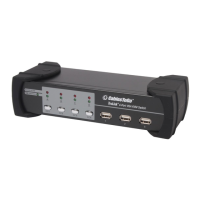
The TruLink 4-Port USB 2.0 and PS2 KVM Switch by Cables To Go allows users to control up to four computers using a single keyboard, mouse, and monitor. This KVM switch is designed for convenience, supporting both USB and PS/2 mice and keyboards. Additionally, it features a 3-port USB hub, enabling any of the four connected computers to share USB devices.
The primary function of the TruLink KVM Switch is to consolidate control of multiple computers (up to four) through a single console setup, consisting of one keyboard, one mouse, and one monitor. This eliminates the need for separate peripherals for each computer, saving space and simplifying the workspace.
The switch supports both PS/2 and USB keyboard/mouse connections, offering flexibility for various system configurations. It is fully compliant with the USB 2.0 specification, ensuring compatibility with a wide range of USB devices.
A key feature is the integrated 3-port USB hub located on the front panel. This hub allows the connected computers to share additional USB devices beyond the keyboard and mouse, such as mass storage devices, CCD cameras, scanners, card readers, or printers. The USB hub can operate in conjunction with the PC selection (Auto Switch mode) or independently, depending on user preference.
The KVM switch supports various operating systems, including Windows (98 or later), Linux (Kernel 2.3 or later), Mac OS9/OSX, and SunMicro Solaris 8. It also supports VGA resolutions up to 2048x1536 at 85Hz, ensuring high-quality video output.
The TruLink KVM Switch offers three distinct methods for switching between connected computers:
Hardware Push Button: Users can manually switch to any active USB host connection by simply pressing the corresponding switch button on the KVM Switch's front panel. An LED will illuminate to indicate the currently selected port.
Hot-Keys (PS/2 Keyboard Only): For users with a PS/2 keyboard, a two-step Hot-Key sequence can be used. Pressing the [Scroll Lock] key twice (Step 1) activates the Hot-Key function, followed by pressing a number key ([1] to [4]) (Step 2) within 3 seconds to switch to the desired port. The Scroll Lock LED on the keyboard will blink while waiting for the final command. This method is not supported for USB keyboards.
On-Screen-Display (OSD) Utility Software (Windows Only): The included CD contains OSD utility software for Windows users. This software provides a graphical interface to monitor the status of connected computers and switch between them. The OSD displays the power status of connected computers and the active host. It can indicate if a PC is not connected or powered off. Users can click on the port numbers in the OSD window to switch to an available host. The OSD function can be hidden in the Taskbar or completely shut off.
The device includes LED indicators for easy status monitoring:
Auto-Switch Function: This mode allows the KVM Switch to automatically shift the Host PC and the USB hub together at a set time interval. This is particularly useful for ensuring USB devices always follow the host. It can be activated by a Hot-Key sequence ([Scroll]+[Scroll][H]) or by pressing any Host push button for 3 seconds when Auto-Switch mode is OFF. When active, the HUB SWITCH LED will be static ON. To turn off Auto-Switch mode, the same Hot-Key sequence can be used, or any Host push button can be pressed for 3 seconds when Auto-Switch mode is ON. When off, the HUB SWITCH LED will flash.
Auto-Scan Function: When enabled (via Hot-Key [Scroll]+[Scroll]+[S]), the KVM Switch with its hub will cycle through all ports, displaying each on the monitor for a configurable interval (5, 10, 15, or 20 seconds). The interval time can be adjusted by pressing the normal numeric keys (1, 2, 3, 4). During Auto-Scan, the mouse and keyboard are disabled to prevent accidental input errors. To stop Auto-Scan, users can press the SPACE key to stay on the current scanning port or any other keyboard key to jump back to the original active PC.
Sun Micro System Function Key Emulation: For Sun Micro system users, the KVM Switch can emulate 16 special function keys via a PS/2 keyboard (not supported by USB keyboards). This is achieved by pressing the LEFT Window KEY followed by a second key as specified in the mapping table provided in the manual.
Installation and Powering Up: The installation process involves connecting USB and VGA cables from the computers to the KVM switch and then plugging in the power adapter. For optimal display performance, it is recommended to select a port and allow the PC to fully boot before switching to another port. This is particularly important for Sun Micro users.
Hot Plugging: The KVM switch supports USB plug & play technology, allowing USB devices to be added and removed from the front panel hub at any time without needing to shut down the system.
Driver Installation: For Windows 98/SE users, specific drivers for USB Keyboard/Mouse (HID driver) may need to be installed. The manual provides a step-by-step guide for this process, which involves using the Windows 98 CD.
Important Note for USB Keyboard/Mouse Users: If a USB keyboard and/or mouse are used as primary input, enabling the Auto Switch function is necessary for seamless operation.
Notice for Sun Micro System Users: Due to some Sun Micro systems not supporting the USB 2.0 HUB feature during boot, users might encounter a "keyboard not detected" error or a blank screen for a few minutes before the login screen appears.
USB Device Management: When using peripheral USB devices (other than a second keyboard and mouse) connected to the KVM's USB ports, it is crucial to disable or "Safely Remove" the device via Windows before switching computers. This is because switching computers is equivalent to disconnecting the device, and failing to do so can lead to system freezes or other issues.
 General
| Category | Switch |
|---|---|
| Model | 35555 |
| Ports | 5 |
| Switching Capacity | 1 Gbps |
| Power Supply | External |
| Type | Unmanaged |
| Port Type | 10/100Base-TX |

 To Next Page