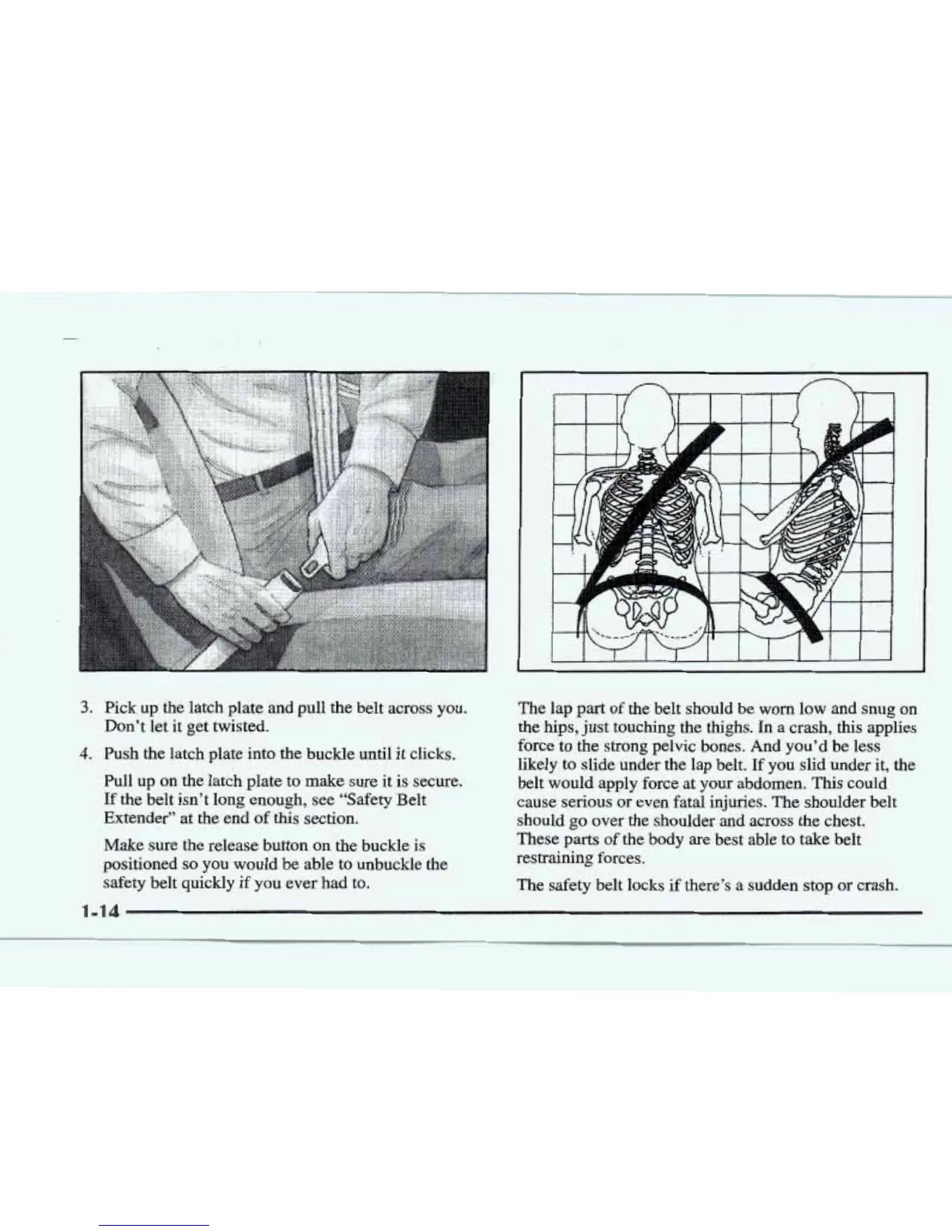
3.
Pick
up
the
latch plate and pull the belt across you.
Don’t let it get twisted.
4.
Push the latch plate into the buckle until it clicks.
Full
up
on the latch plate to make sure it is secure.
If
the belt isn’t long enough, see “Safety Belt
Extender’’ at the end
of
this
section.
Make sure the release button
on
the buckle
is
positioned
so
you would be able to unbuckle the
safety belt quickly if you ever had to.
The lap part
of
the belt should be worn low and snug
on
the hips, just touching the thighs.
In
a crash, this applies
force to the strong pelvic .bones. And you’d be less
likely to slide under the lap belt.
If
you slid under it, the
belt would apply force at your abdomen. This could
cause serious or even fatal injuries. The shoulder belt
should go over the shoulder and across the chest.
These parts
of
the body are best able
to
take belt
restraining forces.
The safety belt locks
if
there’s a sudden stop or crash.



 To Next Page