EasyManua.ls Logo

Caloritech CX Series - User Manual

Caloritech CX Series
12 pages
Print Icon
To Next Page IconTo Next Page
Loading...
THS3001-1020 Printed in Canada
CX Series
Special Notes
CAUTION
CAUTION. This document presents the minimum requirement pertaining
to the installation, operation, and maintenance of the respective
equipment as required by the manufacturer only. Any additional
considerations, including but not limited to any design consideration,
in-service inspection, and fitness-for-service assessment for all pressure
boundary components to meet any safety principles and local jurisdictional
regulatory requirements, shall be the responsibility of the user.
ELECTRIC SHOCK HAZARD. All electric heating equipment installations
must be performed by qualified personnel in accordance with the local
electrical codes and standards and must be effectively grounded to
eliminate shock hazard.
WARNING
FIREEXPLOSION HAZARD FOR EXPLOSIVE ATMOSPHERE HEATERS.
Thisheater shall be used with protection controls as follows:
Liquid Immersion Applications
a. Liquid level control to maintain all the heating elements totally
immersed at all times, in conjunction with temperature controls to limit
the liquid temperature below the maximum allowable process design
temperature.
b. Terminal box internal surface temperature control to limit the surface
temperature of the terminal box
c. Heater flange surface temperature control to limit the surface
temperature of the flange.
d. Heating elements sheath temperature controls to limit to the maximum
allowable sheath design temperature
e. Earth fault or earth leakage current protection device to protect against
arcing and sparking during an earth fault.
Gaseous and/or vapour phase immersion applications
a. Heating elements sheath temperature controls to limit to the maximum
allowable sheath design temperature.
b. Terminal box internal surface temperature control to limit the surface
temperature of the terminal box
c. Heater flange surface temperature control to limit the surface
temperature of the flange.
d. Earth fault or earth leakage current protection device to protect against
arcing and sparking during an earth fault.
CAUTION
Immersion Heaters
ISO 9001
Installation, Operation, & Maintenance Instructions
For CE/ATEX and IECEx Models. Models with
Increased Safety (Type eb) Protection Method
Question and Answer IconNeed help?

Do you have a question about the Caloritech CX Series and is the answer not in the manual?

Summary

Diagrams and Illustrations

Product Description and Specifications

CE and IECEx Certification Compliance

Details on CE and IECEx certifications and their implications for heater usage.

Installation Procedures and Safety

Explosive Atmosphere Installation Guidelines

Specific requirements for installing heaters in explosive atmospheres, including control systems.

Overtemperature Protection for T-Code Compliance

Ensuring T-Code compliance by using temperature sensors with overtemperature protection.

Operation and Performance Checks

Earth Fault and Leakage Current Protection

Mandatory protection devices for earth faults and leakage currents in TT and TN systems.

Overview

The Caloritech CX Series Immersion Heaters are designed for a variety of industrial heating applications, particularly in hazardous locations requiring increased safety (Type eb) protection. These heaters are engineered for the installation, operation, and maintenance of CE/ATEX and IECEx models, ensuring compliance with stringent safety standards.

Function Description

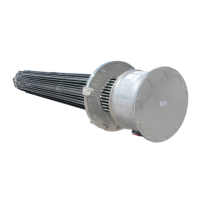
The primary function of the CX Series Immersion Heaters is to provide efficient and reliable heating for liquids, gases, and vapors. They are designed to be fully immersed in the medium they are heating, ensuring optimal heat transfer and preventing element exposure that could lead to failure. The heaters are available in various configurations, including round and square/rectangular terminal boxes, with different flange types (ANSI B16.5/16.47, DIN, JIS, custom) and materials (carbon steel, stainless steel, Incoloy, Inconel, others) to suit diverse process requirements.

Key components of the immersion heater include heating elements, an element support (keeper), a heater flange, and a terminal box. The heating elements are available in materials such as steel, stainless steel, Incoloy, and Inconel, chosen based on the process medium and temperature requirements. Temperature sensors, including terminal box temperature sensors (thermocouple or RTD), flange temperature sensors (thermocouple or RTD), and sheath temperature sensors (thermocouple or RTD), are integrated to monitor and control temperatures at critical points, ensuring safe operation and preventing overheating.

For hazardous atmospheres, these heaters incorporate increased safety terminal blocks and terminal boxes (rated IP66 for round boxes, IP64 for square/rectangular boxes) to contain electrical connections and prevent ignition of flammable substances. The stilted design of some terminal boxes helps reduce temperatures at electrical connections, further enhancing safety. Wiring connection hubs are provided in both metric and imperial sizes for flexible installation.

Usage Features

The CX Series Immersion Heaters are built with several features to ensure safe and effective use, especially in hazardous environments.

  • Safety Controls: For liquid immersion applications, the heaters require a liquid level control to ensure all heating elements remain fully immersed. This is coupled with temperature controls to limit the liquid temperature below the maximum allowable process design temperature. Additionally, terminal box internal surface temperature controls, heater flange surface temperature controls, and heating element sheath temperature controls are essential to limit surface and sheath temperatures to safe levels. Earth fault or earth leakage current protection devices are mandatory to protect against arcing and sparking during an earth fault, which is crucial in explosive atmospheres.
  • Gaseous and Vapour Phase Immersion: For gaseous and/or vapor phase immersion applications, heating element sheath temperature controls, terminal box internal surface temperature controls, heater flange surface temperature controls, and earth fault/leakage current protection devices are also required.
  • Explosion Protection: The heaters are marked for hazardous locations (IECEx Ex eb IIC Gb, T1 to T6; ATEX II 2 G Ex eb IIC T1 to T6 Gb), indicating their suitability for use in environments with combustible gases, vapors, dusts, or fibers. Explosion-proof terminal enclosures must be used in explosive atmospheres.
  • Temperature Management: The temperature classification of the heater is based on complete immersion of the elements. Depending on the application, a flow or liquid level device must be used to ensure continuous immersion. Overtemperature devices are critical for de-energizing the heater in case of system malfunction and must be installed according to local codes and standards. The setpoint for these devices should not exceed the value indicated on the heater nameplate.
  • Installation Guidelines: Heaters should be installed by qualified personnel, ensuring proper grounding and adherence to local electrical codes. Supply voltage must match the heater nameplate. For pressurized systems, a safety relief valve is necessary to prevent hazardous pressure buildup. Horizontal element support bundles may be required for longer immersed lengths. Proper bolting hardware and gaskets suitable for the operating pressures and temperatures must be used for flange heaters.
  • Material Compatibility: Users are cautioned to use the heater only in liquids and at pressures for which it was designed. Recommendations are provided for sheath materials (copper in water, steel/alloy in oil, appropriate alloy for chemical solutions) to ensure compatibility and prevent corrosion, which could lead to ground faults, fire, or explosion.
  • Insulation and Wiring: It is critical not to insulate over the heater flange, stilted area, or terminal enclosure. Terminals must be protected from moisture or vapor, and moisture-resistant housings are required for outdoor installations. A drip loop is recommended to prevent moisture entry into the terminal box. Creepage and clearance for electrical connections must comply with local codes for increased safety installations. Copper conductors with sufficient current-carrying capacity and appropriate temperature ratings must be used.

Maintenance Features

Regular maintenance is essential to ensure the continued safe and efficient operation of the CX Series Immersion Heaters.

  • Pre-Operation Checks: Before initial operation, an insulation resistance (IR) check must be performed using a 500V DC megger. Readings above 500,000 ohms to ground are generally acceptable. If lower readings are observed, a drying process may be required, and the factory should be consulted. All terminal connections must be checked for tightness.
  • Periodic Inspections: Electrical connections should be periodically checked for tightness, and wire insulation should be inspected for any damage. Any damaged insulation must be replaced.
  • Heater Cleaning: Immersion heaters should be periodically removed to inspect for corrosion, sludge buildup, and scale. These deposits can lead to overheating and reduced life expectancy. Heaters showing visible signs of damage should not be used.
  • Thermostat Verification: If a thermostat is provided, its proper operation should be verified by cycling it and checking for cutout.
  • System Controls: When operating heaters in a closed system, designers must ensure that proper controls are used to maintain temperature and pressure at normal levels.
  • Earth Fault Protection: Heaters must be protected against abnormal earth fault and earth leakage current. For TT and TN systems, a residual current protection device with a trip setting not exceeding 100mA is required to disconnect power when residual current exceeds the trip setting. For IT systems, an insulation monitoring device designed to trip when insulation between any phase of the electrical power supply to ground is less than 50Ω/V is necessary.
  • Storage: Heaters stored for prolonged periods may absorb moisture, necessitating an IR check before re-energization.

These features collectively ensure that the Caloritech CX Series Immersion Heaters provide a robust, safe, and reliable heating solution for demanding industrial applications, particularly in environments where explosion protection and increased safety are paramount. Adherence to the installation, operation, and maintenance instructions is critical for ensuring safety and validating warranty provisions.

Caloritech CX Series Specifications

General IconGeneral
Frequency50/60 Hz
Voltage120V, 208V, 240V, 480V
ConstructionStainless steel or aluminum
FinsFinned tubular heating elements for efficient heat transfer
Power Output0.5 kW to 20 kW (various models)
Heating ElementFinned tubular heating elements, typically Incoloy or stainless steel
ThermostatOptional, explosion-proof thermostat available
Safety FeaturesOverheat protection, thermal cut-off
DimensionsVaries depending on model
WeightVaries depending on model