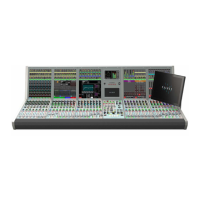
Need help?
Do you have a question about the Calrec Zeta and is the answer not in the manual?
Warnings about unauthorized modifications invalidating warranty and affecting safety features.
Guidelines for protecting sensitive components from electrostatic discharge and warranty.
Recommends anti-static screen cleaner for front panels, applied to a soft cloth.
Explains the meaning of triangular warning symbols with black symbols on a yellow background.
Advises against removing blanking plates on PSU units due to high potential voltage.
Contact details for technical assistance, support hours, warranty, and repair procedures.
Highlights Calrec's global customer base, focus on broadcast products, and ISO 9001 registration.
Details capabilities for channels, groups, EQ, dynamics, inserts, and routing.
Describes main stereo/surround outputs, auxiliary outputs, and multi-track feeds.
Covers fader count, screen interface, memory, networking, and GPIO capabilities.
Outlines console independence from PC, DSP operation, fast boot times, and hot-swappable cards.
Explains dual-path control (A/B) per fader for managing signals efficiently.
Describes how assign buttons link faders to central control panels for efficient access.
Defines 'paths' as channels/groups/mains and 'ports' as inputs/outputs in the digital system.
Outlines rules for labeling input/output ports, including character limits and uniqueness.
Details grouping ports into lists for easier selection and sorting on screens.
Details assign button LEDs, AFL, indicative LEDs, bargraph, and specific function LEDs.
Describes assignable rotary controls (Wild controls) per fader and their assignment.
Details the optional push-switch for controlling ON/OFF or IN/OUT status of certain Wild controls.
Explains primary and secondary VCA masters and their hierarchical control relationships.
Describes how to identify VCA group assignments by holding down assign buttons.
Explains assigning auto-faders, fade times, operation, and visual indication of auto-fades.
Details assigning input ports, selection settings, and gain adjustments.
Covers gain linking, balance/width, input delay, and moving paths/strips.
Explains direct outputs, mix-minus feeds, and their configuration.
Details stereo and surround panning capabilities, including L-C-R and L-R panning.
Explains the divergence control for mono and stereo channels to adjust centre signal contribution.
Covers assigning delay, interrogation, format selection, and wild control usage.
Details path type selection, clearing paths, moving paths/strips, and fader bargraph assignment.
Explains assigning controls to multiple faders and the push-switch option.
Details the frequency ranges and types (shelf, bell, HPF, LPF) for LF, LMF, HMF, and HF controls.
Covers EQ level, switching, alternate EQ, flat setting, and the EQ/DYN screen.
Describes parameters for Compressor, Expander, and Gate functions.
Explains linking dynamics between channels and using the EQ/DYN screen for adjustments.
Details routing buttons, track output control, tone/talkback, ALL function, and panning.
Explains how to use Interrogate mode to discover and modify fader path routing to buses.
Allows routing channels/spills to mains, groups, tracks, and auxiliaries via a selection table.
Describes controlling track output levels using virtual faders and a master fader.
Covers setup of auxiliary sends, direct inputs, and outputs, including stereo pairing.
Explains Interrogate mode for auxiliaries and accessing auxiliary controls via panel screens.
Details which settings are copied for different functions (I/Ps, EQ, DYN, PAN, FDR, RTG, AUX, WILDS, ALL).
Describes main faders (M1, M2), routing, inserts, and All A/All B layer switching.
Details defining width of main, group, and auxiliary busses, including stereo pairing.
Explains options for cutting pre-send signals based on fader status or the 'bird beater' function.
Covers condition switching (TX/Rehearse), console, and rack resets.
Details PSU monitoring, fail indicators, and rack reset functionality.
Explains buttons for clearing channel, aux, default, and global console settings.
Details patching talkback/reverse talkback inputs and controlling gain levels.
Covers monitor selectors, listening modes, PFL options, and LS control.
Details main/ancillary meters, their types (PPM, VU, Bargraph), and phase displays.
Explains setting up user-definable monitor LS and selector buttons via screens.
Covers frequency, level, tone interrupt, clearing routes, enable indicator, and external input.
Explains live/selected memories, choosing, saving, previewing, and stacked memories.
Details managing stacked memories, saving sessions, and scene labels.
Explains saving and recalling specific components of console settings.
Describes isolating ports from memory recall to prevent overwrites.
Details setting bar colours, signal order, and screen brightness globally.
Explains controlling rows, columns, and block height for TFT meter panel layout.
Details allocating sources to meters, clearing all meters, and displaying tracks on TFTs.
Covers saving/loading configurations to/from files and active config.
Emphasizes saving meter setup options separately for persistence.
Explains source lists, viewing options for ports, and input views.
Details patching sources, fader views, and multiple patching capabilities.
Allows isolating port connections from memory recall to prevent overwrites.
Explains network source ownership and how to grab control.
Details output port lists, viewing options, and categories of console output signals.
Covers patching output signals, removing patches, moving connections, and multiple patching.
Explains removing ports and isolating them from memory recall.
Details the system for locking output ports to prevent accidental removal.
Explains patching and switching the LS monitor insert.
Explains grouping ports into lists, managing lists, and accessing them via selection controls.
Covers assigning port descriptions and configuring mic open bus allocation.
Details how network configurations link with list configurations.
Describes grouping ports within lists into sets and managing their order.
Covers saving/loading configurations to/from files and active config.
Emphasizes saving meter setup options separately for persistence.
Details the purpose of TECH screens for diagnostics, system info, and modes.
Describes the Tech-Info screen, system info display, and saving default memory.
Covers mic headroom, impedance, assign panel controls, reverse faders, and A/B actions.
Details wild control push-switch options and saving general system options.
Explains assigning sync sources, priority lists, and resetting to the first source.
Emphasizes saving synchronization options to disk and flash.
Details patching talkback/tone sources, lists, and the patching process.
Covers gain, phantom power, SRC controls, and saving options for talkback/tone.
Details LS monitor insert, PFL options, VCA group editing, and gain linking.
Covers channel screen scrolling and setting the move path button mode.
Explains assigning functions or fader open events to GPO outputs.
Details patching GPO outputs, latch/pulse modes, and saving options.
Covers assigning GPI inputs to functions or channels and locking opto assignments.
Details serial port setup, function allocation, and saving options.
Covers PC specs, remote/local network access, Hydra connection, and software.
Details default user accounts for the PC, with different permission levels.
Describes the network fabric, topology, and cabling for Hydra systems.
Emphasizes private network use and the functions of the Network Editor.
Details physical dimensions, module extraction, and external connections.
Covers mounting, fan operation, earthing, and optional AC power supply units.
Explains the optional Dolby E decoder module and its patching for SDI streams.
Details adding/removing devices, saving/loading configurations, and opening active configs.
Stresses the importance of saving network options separately for persistence.
Explains viewing Hydra sources, their location, type, and allocating them to lists.
Explains network source ownership, force ownership, and grabbing control.
Guides on launching the utility, enabling uploads, and kernel mode entry.
Details transferring files, sending options, and important notes on data transfer.
Provides steps to manually force a processor into kernel mode if it fails automatically.
Explains globally flipping faders and setting the aux clear function.
Allows user to set mixer operating levels for analogue and digital audio.
Details Calrec meter setup, connector labeling, and selectable scales.
Configures main and small loudspeaker outputs, including surround formats and PFL options.
Allows adjustment of width for miscellaneous output speakers, similar to main/small LS.
Explains labeling input ports, configuring stereo/mono, and retrieving labels from files.
Guides on creating the editor installer from the console PC.
Explains the need for console-specific bundle files for accurate emulation.
Details the steps for unpacking and installing the offline editor application.
Describes selecting and loading memories from bundles to the console PC.
Explains the final steps of loading files and restoring memories.
Details AFL, indicative LEDs, fader bargraph, PFL, and VCA interrogation on fader strips.
 General
| Type | Digital |
|---|---|
| EQ | 4-band |
| Dynamics | Compressor, Limiter |
| Aux Sends | Multiple |
| Processing | DSP |
| Connectivity | MADI |
| Power Supply | Redundant |


 To Next Page