Need help?
Do you have a question about the Camp Chef BS40C and is the answer not in the manual?
Procedures to follow immediately if a gas odor is detected.
Guidelines for outdoor use and proper fuel cylinder storage.
Information on fuel type, cylinder placement, and combustible material clearance.
Step-by-step instructions for connecting the regulator and ensuring leak-free operation.
Guidance on lighting burners, adjusting temperature, and troubleshooting ignition issues.
Solutions for yellow flame, small flame, and low-flow mode resets.
Exploded view and part identification for the BS40C stove.
Exploded view and part identification for the BS60C stove.
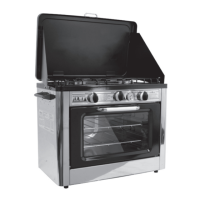
This manual describes the Camp Chef Blind Stove, available in two models: the BS40C (2-burner) and the BS60C (3-burner), designed for outdoor cooking. These stoves are intended for use with propane fuel only and are equipped with cast burners, appliance-style temperature controls, and built-in ignitors within the control knobs for ease of use.
The Camp Chef Blind Stove serves as a portable outdoor cooking appliance, providing a stable and controlled heat source for preparing meals in various outdoor settings. Its primary function is to efficiently cook food using propane gas, offering a versatile solution for camping, tailgating, and other outdoor culinary needs. The stove's design prioritizes safety and convenience, ensuring reliable operation when used according to the provided instructions.
The stove is designed for straightforward operation, starting with the connection of the regulator to the stove and then to a propane tank. Users should ensure all valves are in the OFF position before connecting the regulator and tighten all fittings securely with an adjustable or 3/4" wrench, being careful not to over-tighten. A crucial safety step involves checking for leaks after connecting the regulator to the tank by applying a soapy water solution to all fittings and connections. The appearance of small bubbles indicates a leak, which must be tightened before proceeding.
To ignite the stove, the tank valve should be turned on slowly, followed by slowly turning the desired control valve to the High position. The built-in ignitor in the control knob will then ignite the burner. If ignition does not occur within 5 seconds, the burner control(s) should be turned off, and the user should wait 5 minutes before repeating the lighting procedure. In cases where the built-in ignitor fails, a long-nose ignitor can be used to light the stove after turning the controls to high.
The stove features appliance-style temperature controls, allowing users to adjust the flame to their desired cooking temperature. The burners are designed to produce a blue flame with a hint of yellow for optimal performance. If a predominantly yellow flame is observed, the air shutter can be adjusted to achieve a bluer flame. Persistent yellow flames may indicate obstructions in the venturi (burner neck), such as cobwebs, dirt, or bugs, which should be cleaned.
A safety feature of the new low-pressure regulator is its ability to detect a sudden surge in gas use, automatically entering a "low flow" mode, which results in a small flame that does not adjust in size. To reset this, all valves at the stove and tank must be turned off, and all fittings should be checked for tightness and good repair. After ensuring no leaks, the lighting procedure (steps 2, 3, and 4) should be repeated, remembering to open the tank valve slowly.
The stove is designed for outdoor use only. It is imperative to maintain proper clearance from combustible materials around the top, sides, and back of the cooking appliance. It should not be used near flammable walls or under eaves or overhangs of homes or garages. The stove should never be left unattended while hot or in use and must be allowed to cool completely before being taken down and stored.
Regular maintenance ensures the safe and efficient operation of the Camp Chef Blind Stove. One key aspect of maintenance involves checking for leaks, which should be performed periodically, especially after connecting the regulator to the tank or if any fittings have been adjusted. The soapy water solution method is effective for identifying leaks.
Cleaning the venturi (burner neck) is important if the flame appears predominantly yellow, indicating potential obstructions. Users should shut off all valves at the stove and fuel tank before cleaning the venturi through the air shutter opening, removing any cobwebs, dirt, or bugs.
Proper storage is also a critical maintenance consideration. When storing the stove indoors, the hoses must be detached, and the fuel cylinder should be left outdoors with its valve closed and plugged. The propane tank itself must always be stored outdoors in a well-ventilated space, following the manufacturer's recommendations for proper use and storage. Users should never place propane cylinders directly under any part of the burners.
Additionally, the manual emphasizes general safety practices, such as ensuring all fittings are tight and in good repair. Following all safety, set-up, lighting, and cooking instructions is crucial for preventing accidents. The stove should not be stored or used near gasoline or other flammable vapors and liquids.
The stove's construction, with cast burners and durable components, is designed for longevity, but regular inspection for wear and tear on hoses, fittings, and other parts is recommended to ensure continued safe operation. In case of a gas smell, immediate action is required: disconnect gas to the appliance, extinguish any open flames, and if the odor persists, evacuate the premises and contact the gas supplier or local fire department.
 General
| Burners | 2 |
|---|---|
| Total BTUs | 60, 000 |
| Material | Steel |
| Burner Material | Cast Aluminum |
| Fuel Type | Propane |
| Type | Portable Stove |
| Burner Type | High-pressure |
| Ignition | Match |

 To Next Page