4 5
ASSEMBLY INSTRUCTIONS
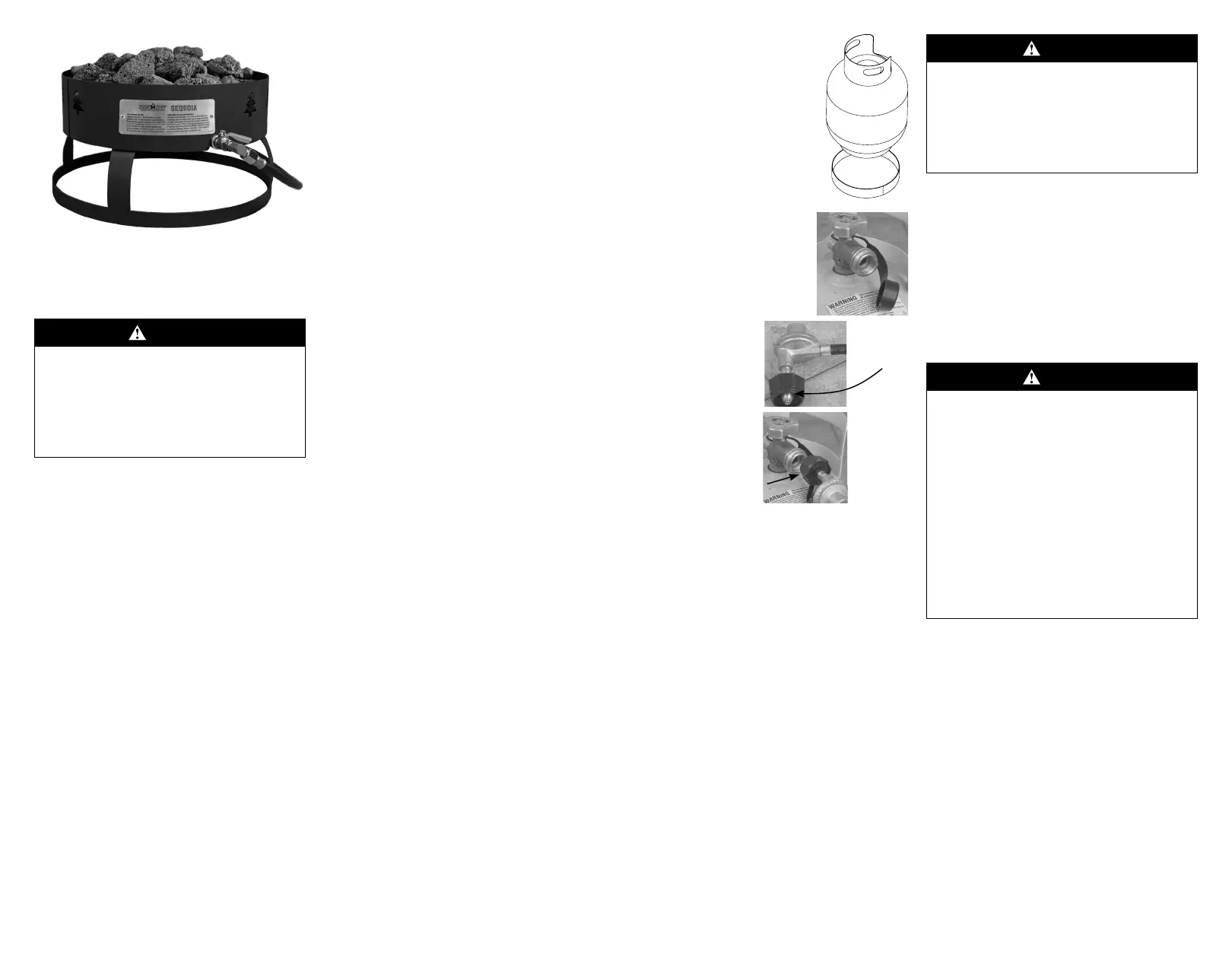
1. Arrange the 12 pounds of lava rock around the burner. For a
more realistic looking flame arrange the rock to cover most of
the tube burner.
WARNING
DO NOT use this fire pit in a manner other than its intended
purpose. Not intended for commercial use. Not intended to
be installed or used in or on a recreational vehicle or boat.
Keep a fire extinguisher accessible at all times. The use of
alcohol, prescription or nonprescription drugs may impair the
consumer’s ability to properly assemble or safely operate this
fire pit. Solid fuels shall not be burned in this gas fireplace.
FOR OUTDOOR USE ONLY!
Do not operate the fire pit indoors, in a garage, or in any other
enclosed area or under overhead construction. Do not operate fire
pit near flammable materials such as decks, fences, porches or
carports. A minimum clearance range of 72" is recommended. Do
not use the fire pit near gasoline or other combustible liquids or
where combustible vapors may be present.
Children and adults should be alerted to the hazards of high
surface temperatures and should stay away to avoid burns or
clothing ignition. Young children should be carefully supervised
when they are in the area of the appliance. Clothing or other
flammable materials should not be hung from the appliance, or
placed on or near the appliance. Any guard or other protective
device removed for servicing the appliance must be replaced
prior to operating the appliance.
Installation and repair should be done by a qualified service
person The appliance should be inspected before use and at
least annually by a qualified service person. More frequent
cleaning may be required as necessary. It is imperative that
control compartment, burners and circulating air passageways
of the appliance be kept clean.
Use caution when assembling and operating fire pit to avoid
cuts and scrapes from rough or sharp edges.
DO NOT move the fire pit while it is in use. Allow the fire pit to
cool completely before moving or storing.
When in use, the fire pit must be on a level, stable surface
in an area clear of combustible material. An asphalt surface
(blacktop) may not be acceptable for this purpose. Do not
operate fire pit on flammable material such as carpet or a wood
deck. Store the fire pit in a dry, protected location.
This fire pit is not intended for and should never be used as a heater.
DO NOT leave fire pit unattended while in use. Operate the fire
pit with close supervision.
DO NOT operate around children or animals.
DO NOT bump or tip fire pit. If fire pit becomes extremely hot,
allow fire pit to cool completely before handling. If you must
handle the fire pit while it is hot, always wear protective oven
mitts or heat resistant gloves when handling the fire pit or its
components.
DO NOT obstruct flow of combustion air and/or ventilation air
for fire pit.
DO NOT wear loose clothing while operating the fire pit. Tie
back long hair while operating the fire pit. ALWAYS wear fully
covering shoes while operating the fire pit.
Allow fire pit and its components to cool completely before
conducting any routine cleaning or maintenance. Do not move
the fire pit when in use. Allow the fire pit to cool before moving
or storing.
DO NOT use this appliance if any part has been under water.
Immediately call a qualified service technician to inspect the
appliance and to replace any part of the control system and any
gas control which has been under water.
An LP cylinder not connected for use should not be stored in
the vicinity of fire pit or any other fire pit. Do not store spare LP
cylinders within 10 feet of fire pit. LP cylinders must be stored
outdoors, out of reach of children. Do not store a spare LP-gas
cylinder under or near this fire pit. Never fill the cylinder beyond
80 percent full. Failure to follow these instructions exactly could
result in a fire causing death or serious injury.
While the fire pit is not in use, the gas must be turned off at the
supply cylinder. The fire pit should be shut off and all supply
valves (on piping or on fuel cylinders) should be closed in the
event that the odor of unburned gas is detected. Do not attempt
to use the unit until any gas leaks are fixed. Do not use the fire
pit if the burner fails to light or fails to remain lit. Under such
conditions, gas should be shut off and fuel cylinders should be
disconnected. Do not operate under high wind conditions. All
installations are to conform to local codes. In the absence of
local codes, installation should conform to the National Fuel
Gas Code, ANSIZ223.1/NFPA 54
Fire pit should be installed with the hose regulator assembly
extended at full length of hose directly away from the burner.
When so configured, placement results in maximum tank to fire
pit distance. When fire pit is operated, the hose/regulator and
gas tank should be on a line perpendicular to wind direction.
Placing tank closer than 48" to the
fire pit can overheat the tank and
cause release of propane through
relief openings and can result in tank
fire or explosion.
Propane tank must be set inside of
the included tank support ring. Do not
use the fire pit if tank is not inside of
the support ring or with the tank in
the incorrect position.
CONNECTING THE LP TANK
1. The knob on the LP tank must be
closed. See that the knob is turned
clockwise to a full stop.
2. Check that the control knob on the fire
pit is turned off.
3. Remove the protective cap from the LP
tank valve and coupling
nut, if present.
4. Hold the regulator in
one hand and insert the
nipple into the valve
outlet. Be sure the nipple
is centered in the valve
outlet. The coupler
connects to the large
outside threads on the
valve outlet
5. Hand tighten the coupler
clockwise until it comes
to a full stop. Firmly
tighten by hand only.
6. Place the tank to the side or rear of the fire pit. Make sure the
hose does not touch any part of the burner drum housing.
The fire pit is to be used only with the 20 pound, vertical
standing vapor withdrawal type tank. This fire pit is designed
to operate on LP (Liquefied Propane) gas only. The 20 lb LP
cylinder used with this fire pit must conform to the following
requirements:
• Type 1 Connections
• Diameter - 12" (30.5cm)
• Height - 18" (45.7cm)
• Maximum capacity of 20 pounds
The gas cylinder used must include a collar to protect the
cylinder valve. The cylinder supply system must be arranged for
vapor withdrawal.
Follow the instructions stated on gas cylinder tanks when
filling or transporting tanks. Failure to do so could result in
problems relating to overfilling, excessive venting release of
gas and to regulator freezing. Never fill the cylinder more than
80 percent full.
CAUTION
In the connection process, the HVR side of the connection
will seal on the back check in the valve, resulting in a slight
resistance. The connection requires about one-half to three
quarters additional turn to complete connection. Any fuel
supply cylinder used must be constructed and marked in
accordance with specifications for propane cylinders of the U.S.
Department of Transportation (DOT)CFR 49 or CAN/CSA B339.
Do not allow dirt or foreign material to get into or onto tank
connection when it is not attached to the fuel supply system.
Use the protective cap provided. Place dust cap on cylinder
valve outlet whenever the cylinder is not in use. Only install the
type of dust cap on the cylinder valve outlet that is provided
with the cylinder valve. Other types of caps or plugs may
result in leakage of propane. Cylinders must be filled before
initial use. All handling, transport, filling and storage of LP
gas cylinders must be in accordance with NFPA 58 Storage
and Handling of Liquid Petroleum Gasses, or CAN/CSA b149.2
Propane Installation Code.
CAUTION
The gas pressure regulator provided with this appliance must
be used. This regulator is set for an outlet pressure of 11" H20.
Replacement pressure regulators and hose assemblies must
be those specified by the fire pit manufacturer. See rating
sticker on side of fire pit for regulator model number. The
regulator/hose assembly should be handled carefully to prevent
contamination by foreign objects and dirt. The assembly should
be inspected before use and any dirt or contamination should
be wiped off. The hose assembly must be replaced prior to
the appliance being used if there is any evidence of excessive
abrasion or wear, or if the hose is damaged. In order to insure
proper operation, any replacement of the regulator assembly
must be with parts authorized by manufacturer. Valve/pressure
regulators are factory set to the correct operating pressures. No
attempts should be made to adjust these settings.
Cylinders must be suitably tied down during transport. Do not
place any other items on top of cylinders at any time.
Cylinders are not to be exposed to excessive temperatures or
high heat. Refer to the data plate for model identification.
Units are factory equipped for use on only one type of fuel.
These units cannot be, and should not be used on other types
of fuels. Doing so can cause severe damage to the unit and
the installation area and the added risk of serious injury. Any
attempt to operate this product on fuels for which it is not
designed voids the manufacturer’s warranty.
This unit is not to be utilized with a non-self-contained LP-gas
supply system.
(B) Nipple has
to be centered
into the LP
tank valve
(C) Hold
coupling nut
and regulator
as shown
for proper
connection to
LP tank valve


 To Next Page
 Loading...