12 13
USING YOUR GRIDDLE
Follow these basic instructions to get up and cooking your new griddle:
PREUSE INSPECTION
Choose Your Location:
Use your new grill ONLY on a level, stable non-
combustible surface like bricks, concrete or dirt.
Do NOT use this appliance on any surface that will
burn or melt like wood, asphalt, vinyl, or plastic.
Keep the area clear of all combustible material and
flammable liquids, including wood, dry plants and
grass, brush, paper, and canvas.
Keep children and pets away from burner at
all times.
Do NOT use in a building, garage or any other
enclosed area.
Never use this appliance as a heater.
Installation must conform with local codes, or in
their absence with National Fuel Gas Code, NFPA
54/ANSI Z223.1, or Natural gas and propane
installation code CSA B149.1 or propane storage
and handling code B149.2. Handling and storage
of LP cylinders must conform to LP Gas Code
NFPA/ANSI 58. Appliance is not for use in or on
recreational vehicle and/or boats.
Apartment Dwellers: Check with management
to learn the requirements and fire codes for using
an LP Gas appliance at an apartment. If allowed,
use outside on the ground floor with a 10 foot
clearance from walls or rails. Do NOT use appliance
on or under any apartment, condominium balcony
or deck.
Level Your Griddle:
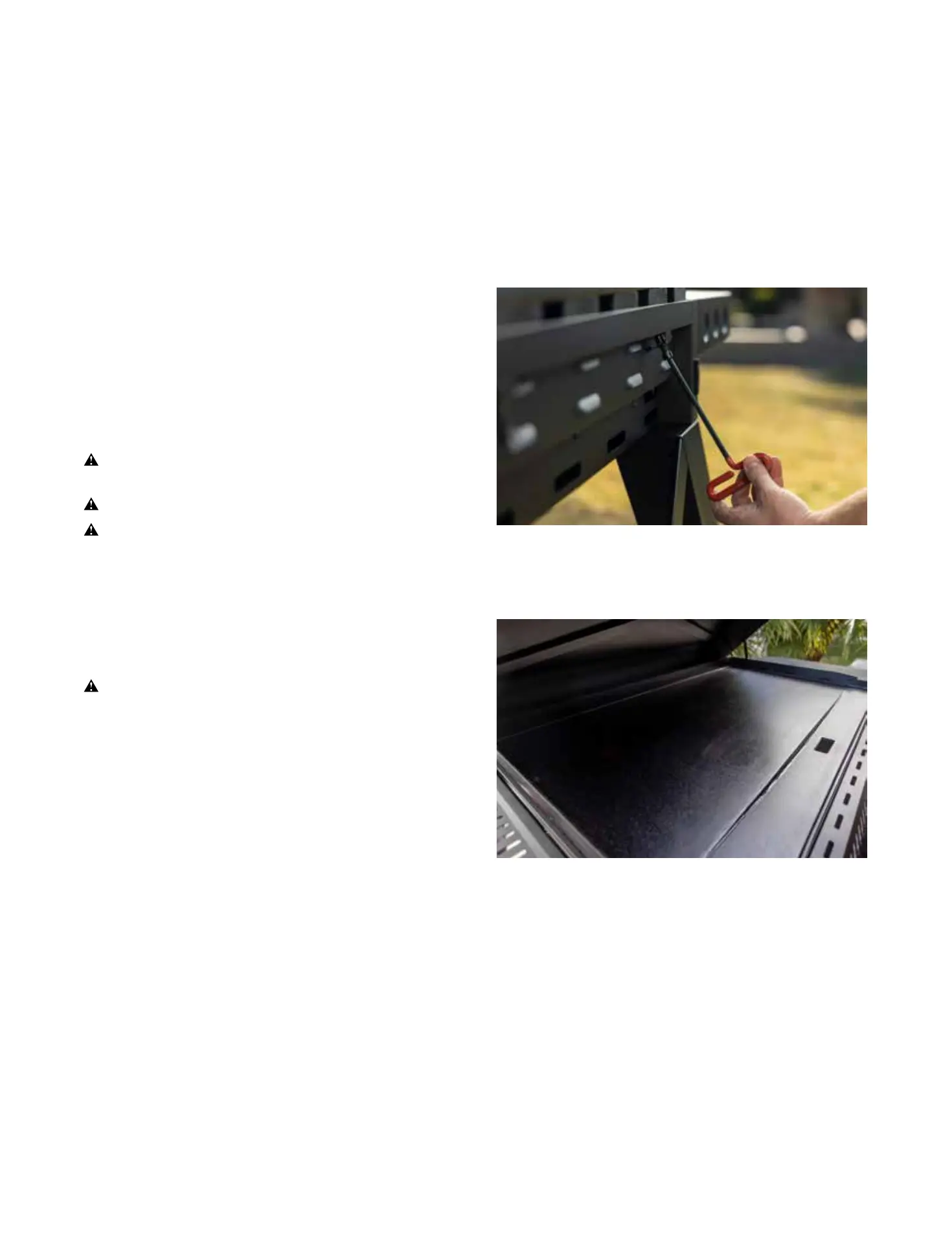
Use the provided wrench, level your griddle by
adjusting the bolts on the back of your griddle as
shown below.
You want the grease to freely run toward the front
of the grill where the grease management system
is located.
Your griddle comes pre-seasoned and has a
natural non-stick surface.
Your griddle may have a light oily coating due to the
manufacturing process. Before using, wash, rinse
and dry thoroughly. Use mild, soapy warm water
(never use abrasive detergent) and a stiff brush.
LP GAS
LIQUEFIED PETROLEUM GAS
Use appliance only with LP (propane) gas
and the regulator/valve assembly supplied with
the appliance.
Never use LP tank if visibly rusted, damaged, or
out of date.
Installing the LP Gas Cylinder Onto the Grill:
1. Check that the cylinder valve is closed by
turning the knob clockwise.
2. Hang the cylinder from the tank hook while
aligning the cylinder ring into the tank holder
at the bottom of legs.
3. Orient the cylinder such that the valve opening
faces the right side or the front of the grill, and
so that the hose is not kinked or damaged.
Never operate appliance with LP tanks out of
correct position specified in Assembly Instructions.
4. Attach or detach regulator to the LP gas cylinder
only when cylinder is at rest in tank holder.
Always close LP tank valve and remove coupling
nut before moving LP tank from specified
operating position.
5. Remove the protective cap from LP tank valve.
Always use cap and strap supplied with valve.
Do not use a POL transport plug (plastic part
with external threads). It will defeat the safety
feature of the valve.
6. Hold regulator, insert nipple (A) into LP tank
valve. Hand tighten coupling nut, holding
regulator in a straight line (B) with LP tank
valve so as not to cross thread the connection.
7. Turn the coupling nut clockwise to tighten
to a full solid stop. The regulator will seal
on the back-check feature in LP tank valve,
resulting in some resistance. An additional
one-half to three quarters turn is required to
complete connection. Tighten by hand only –
do not use tools.
(A) Nipple has to be
centered into the LP
tank valve
(B) Hold coupling nut and
regulator as shown for
proper connection to LP
tank valve
If you cannot complete connection, disconnect
regulator and repeat steps 6 and 7. If you are still
unable to complete the connection, do not use
this regulator!
If you see, smell, or hear escaping gas,
immediately get away from the LP tank/appliance
and call your fire department.
Do not insert any foreign objects into the valve
outlet. You may damage the valve and cause a
leak. Leaking propane may result in explosion,
fire, severe personal injury, or death.
Never attempt to attach this appliance to the
self-contained LP gas system of a camper or
trailer or motor home.
Overtime the seal in your LP Tank can be
marked, damaged or deteriorate that might cause
a leak even when connection is tightened. After
every exchange, replace or fill, inspect the seal.
Look for signs of damage, cracks, pitting, or other
deterioration as seen below. If damage is found
return tank unused to seller.


 To Next Page
 Loading...