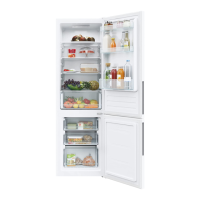
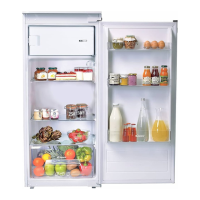
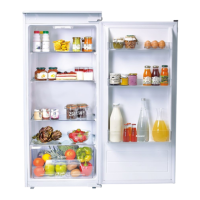
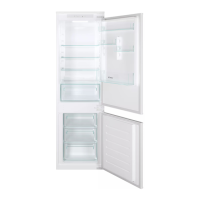
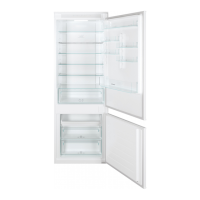
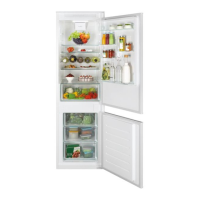
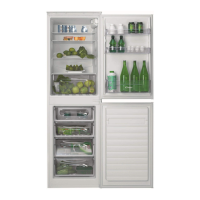
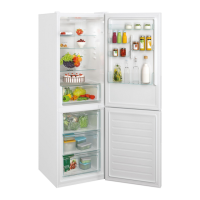
This document is a user manual for a Candy CITY COMBI E. refrigerator.
Function Description
The Candy CITY COMBI E. is a refrigerating appliance designed for household use or similar applications, such as kitchen areas in shops, offices, hotels, motels, bed and breakfasts, and catering services. Its primary function is the storage of food. The appliance features a refrigerator compartment and, for some models, a freezer compartment. It uses a freon-free refrigerant (R600a) and cyclopentane as an insulating gas, both of which are environmentally friendly.
Important Technical Specifications
- Power Supply: 220-240 VAC/50 Hz.
- Refrigerant: R600a (flammable, environmentally friendly).
- Insulating Gas: Cyclopentane.
- Climate Range: The appliance is designed to operate optimally within specific ambient temperature ranges, indicated on the rating plate. These ranges can include:
- SN: from +10°C to +32°C
- N: from +16°C to +32°C
- ST: from +16°C to +38°C
- T: from +16°C to +43°C
- Temperature Control: Electronic temperature control, with settings ranging from 2°C to 8°C for the refrigerator compartment.
- Water Dispenser (if available): Includes a 2.0-liter water tank.
- Reversible Door: The door swing can be reversed.
- Refrigerant Charge Amount: Must be less than 8 g/M³ of the total room space where the refrigerator is installed.
Usage Features
- Temperature Setting: The refrigerator temperature is controlled via a panel in the fridge compartment. Recommended settings are 5°C for spring and autumn, 5-6°C for summer, and 4-5°C for winter to optimize performance and energy consumption.
- Fast Cool Function: This function rapidly reduces both fridge and freezer temperatures to preserve food freshness. It runs for a maximum of 26 hours before reverting to the previous setting.
- Food Storage:
- Refrigerator Compartment: Suitable for foods that do not need freezing, such as cooked food, beer, eggs, condiments, milk, fruit juice, and fresh fruits and vegetables (in the crisper box).
- Freezer Compartment: Suitable for long-term preservation of ice cream, frozen food, and making ice cubes. For models with a freezer compartment, it is recommended to set the temperature at -18°C. Bottled or canned liquids, especially carbonated drinks, should not be stored in the freezer compartment as they may burst. Frozen food should not be consumed directly from the freezer to avoid low-temperature burns.
- Water Dispenser: If equipped, the water dispenser allows for easy access to cold water. The tank should be filled slowly to prevent spills. After filling, setting the thermostat to the lowest or Fast Cool mode for an hour is recommended before dispensing water.
- Installation: The appliance should be placed on a solid, flat, well-ventilated surface, away from direct sunlight, heat sources (cookers, boilers), and damp areas. Adequate clearance (at least 300 mm at the top, 100 mm on sides, and 50 mm at the back) is required for heat dissipation. After installation, the refrigerator should stand for at least 4 hours before being switched on to allow compressor oil to settle.
- Door Reversibility: The door swing can be changed from right to left or vice versa, requiring specific steps involving removing hinges, shafts, and door stops.
Maintenance Features
- Cleaning: Regular cleaning is essential to prevent bad odors and maintain hygiene.
- Internal Cleaning: Shelves, crisper box, bottle racks, and cover boards should be cleaned with a soft towel or sponge dipped in warm water and neutral detergent, typically once a month.
- External Cleaning: Dust accumulated on the rear panel and side plates should be cleared often.
- Door Gasket: Wipe dry and clean the groove with a wooden chopstick wrapped with cotton string.
- Prohibited Cleaning Agents: Do not use bristled brushes, steel wire brushes, detergent, soap powder, alkaline detergent, benzene, gasoline, acid, hot water, or other corrosive/soluble items on the cabinet surface, door gasket, or plastic parts.
- Defrosting: A thin layer of frost (exceeding 5mm) on the freezer compartment inner wall can affect refrigeration. Frost should be gently scraped off with an ice scraper (not metal or sharp hardware). For faster defrosting, a bowl of hot water can be placed inside the compartment. Defrosting should be done every 3 months or when frosting affects drawer use.
- Lamp Replacement: The LED lamp used for lighting is energy-efficient and long-lasting. In case of abnormality, contact customer service as the lamps can only be replaced by the manufacturer.
- Power Outage: In case of a power outage, keep the refrigerator door closed as much as possible. If a power outage is anticipated, setting the thermostat to the high mode an hour in advance can help freeze foods more thoroughly. Making ice with a watertight container and placing it in the upper part of the freezer can extend storage time.
- Long Periods of Non-Use: If the appliance will not be used for several months, turn it off, unplug it, remove all food, clean it, and leave the door ajar to prevent mold.
- Safety Checks: Regularly check the power cord and plug for damage or overheating. Ensure the plug is firmly inserted into the socket. Do not attempt to repair, disassemble, or modify the appliance yourself; contact customer service for repairs.
- Do not connect to electricity until all packaging and transit protectors are removed.
- Keep children away from packaging materials to prevent suffocation.
- Allow the appliance to stand for at least 4 hours after horizontal transport before switching on.
- Do not damage the refrigerant circuit.
- Keep ventilation openings clear.
- Do not wash the compressor position with water; wipe with a dry cloth to prevent rust.
- Handle the appliance with at least two persons due to its weight.
- Ensure the electrical information on the rating plate matches the power supply.
- Do not install in humid, oily, dusty places, or near direct sunlight/water.
- Avoid installing near heaters or flammable materials.
- In case of power failure for appliances with a freezer compartment, do not open the lid. Check food if the failure lasts longer than the indicated temperature rise time.
- Do not store medicines, bacteria, or chemical agents.
- Do not pull/fold the power cord or touch the plug with wet hands.
- Do not store flammable propellants or explosive substances.
- Do not place unstable or heavy objects on top of the refrigerator.
- Do not use electrical appliances inside food storage compartments unless recommended by the manufacturer.
- Do not touch internal cooling elements with wet hands.
- Children aged 8 and above may use the appliance under supervision. Children aged 3 to 8 years are allowed to load and unload.
- Keep plastic parts and door seals free of oil/grease.
- Unplug before maintenance.
- Do not use mechanical devices or other means to accelerate defrosting other than those recommended by the manufacturer.
- Do not use pointed/sharp-edged objects to remove frost.
- Do not use hairdryers or electrical heaters for defrosting.
- Keep the plug clean to prevent fire.
- Do not clean cold glass shelves with hot water.
- If the refrigerant circuit is damaged, switch off, unplug, ventilate the room, and inform customer service.
- Do not use multiple portable socket-outlets or extension leads.
- Do not sit or stand on the appliance.
- The product is for domestic household use only.
- Only original parts supplied by the manufacturer may be used.
- Opening the door for long periods increases internal temperature.
- Clean surfaces in contact with food and drainage systems regularly.
- Clean water tanks if not used for 48h; flush water system if not drawn for 5 days.
- Store raw meat and fish in suitable containers to avoid contact with other food.
- One-, two-, and three-star compartments are not suitable for freezing fresh food.
- If the appliance is left empty for long periods, switch off, defrost, clean, dry, and leave the door open to prevent mold.
- For wine coolers, this appliance is exclusively for wine storage.
- This refrigerating appliance is not intended to be used as a built-in appliance.
- Appliances without a 4-star compartment are not suitable for freezing foodstuffs.

 Need help?
 General

 To Next Page