
 Need help?
Do you have a question about the Candy CMW20MSS-UK and is the answer not in the manual?
This document serves as the owner's manual for a microwave oven, model CMW20MSS-UK, providing essential information for its safe installation, operation, and maintenance. It emphasizes the importance of reading all instructions carefully before use to ensure proper functioning and to prevent potential hazards. The manual begins with a declaration of compliance, indicating that the product meets relevant European safety, health, and environmental requirements, as evidenced by the CE mark. It also addresses waste management and environmental protection, explaining that the appliance is labeled in accordance with European Directive 201/19/EU (WEEE) and should be disposed of properly at dedicated collection areas, not as domestic waste.
The core of the manual focuses on precautions to avoid excessive microwave energy exposure, outlining critical safety measures such as not operating the oven with an open door, avoiding placing objects between the door and the oven front face, and refraining from operating a damaged oven. It specifically warns against attempting to repair or adjust the oven by anyone other than properly qualified service personnel.
The "Important Safety Instructions" section is comprehensive, detailing numerous precautions to reduce the risk of burns, electric shock, fire, injury, or exposure to excessive microwave energy. Users are advised to read all instructions before using the appliance and to use it only for its intended purpose of heating, cooking, or drying food, not for industrial or laboratory use. Operating an empty oven is discouraged, as is using the appliance with a damaged cord or plug. A crucial warning highlights the need for adult supervision when children use the oven, ensuring they understand safe operation and potential hazards. To prevent fire in the oven cavity, users are instructed to frequently check food heated in plastic or paper containers, remove wire twist-ties from bags, and, if smoke is observed, switch off or unplug the appliance and keep the door closed to stifle flames. The manual also advises against using the cavity for storage and leaving paper products, cooking utensils, or food inside when not in use.
Further safety instructions include warnings against heating liquids or other food in sealed containers due to explosion risk, and noting that microwave heating of beverages can result in delayed eruptive boiling, requiring caution when handling containers. Frying food in the oven is prohibited as hot oil can damage parts and cause burns. Eggs in their shell and whole hard-boiled eggs should not be heated in microwave ovens due to explosion risk. Foods with heavy skins, such as potatoes, squashes, apples, and chestnuts, must be pierced before cooking. The contents of feeding bottles and baby jars should be stirred or shaken, and their temperature checked before serving to avoid burns. Users are reminded that cooking utensils can become hot from heat transferred from food, necessitating potholders. Finally, all utensils must be checked for suitability for microwave oven use. The manual also includes a warning about the hazards of anyone other than trained personnel removing covers that protect against microwave energy exposure. It classifies the product as Group 2 Class B ISM equipment, suitable for domestic use. It also states that the appliance is not intended for use by persons with reduced physical, sensory, or mental capabilities, or lack of experience and knowledge, unless supervised or instructed by a responsible person, and that children should be supervised to ensure they do not play with the appliance.
Installation guidelines emphasize removing all packing materials, checking for damage (such as a misaligned door or damaged seals), and ensuring the oven is placed on a flat, stable surface away from heat, moisture, high humidity, or combustible materials. Adequate airflow is crucial, with specific clearances recommended: 20cm above, 10cm at the back, and 5cm on both sides. Users are warned not to cover or block openings or remove the feet. The oven should not be operated without the glass tray, roller support, and shaft in their proper positions. The power supply cord must be undamaged and not run under the oven or over hot/sharp surfaces. The socket must be readily accessible for emergency unplugging, and outdoor use is prohibited.
The manual also addresses radio interference, explaining that microwave oven operation can interfere with radio, TV, or similar equipment. It provides measures to reduce or eliminate interference, such as cleaning the door and sealing surface, reorienting antennas, relocating the oven, moving it away from the receiver, and plugging it into a different branch circuit.
Microwave cooking principles are outlined to help users achieve optimal results. These include arranging food carefully with thicker areas towards the outside of the dish, watching cooking time to avoid overcooking, covering foods to prevent spattering and ensure even cooking, turning foods over during cooking (especially large items), and rearranging foods like meatballs halfway through the cooking process.
Grounding instructions are provided, stating that the appliance must be grounded with a cord having a grounding wire and plug. It should be plugged into a properly installed and grounded wall receptacle to reduce electric shock risk. A separate circuit for the oven is recommended. The manual warns against improper use of the grounding plug and advises consulting a qualified electrician for any questions. It also clarifies the wire colors: Green and Yellow for EARTH, and Blue for NEUTRAL.
The "Before You Call For Service" section offers troubleshooting steps if the oven fails to operate, such as checking if it's securely plugged in, verifying circuit fuses or breakers, ensuring the control panel is programmed correctly, and confirming the door is securely closed. If these steps don't resolve the issue, users are advised to contact a qualified technician and not attempt repairs themselves.
A "Utensils Guide" helps users select appropriate cookware for microwave cooking. It states that ideal utensils are transparent to microwaves, allowing energy to pass through and heat food. Metal utensils or dishes with metallic trim are unsuitable as microwaves cannot penetrate metal. Recycled paper products are discouraged due to potential metal fragments causing sparks or fires. Round or oval dishes are recommended over square/oblong ones to prevent overcooking in corners. Narrow strips of aluminum foil can be used to prevent overcooking exposed areas, but caution is advised to avoid using too much and to maintain a 1-inch distance from the cavity. A table categorizes various cookware types (Heat-Resistant Glass, Non Heat-Resistant Glass, Heat-Resistant Ceramics, Microwave-Safe Plastic Dish, Kitchen Paper, Metal Tray, Metal Rack, Aluminum Foil & Foil Containers) as suitable ("Yes") or unsuitable ("No") for microwave use.
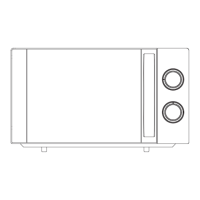
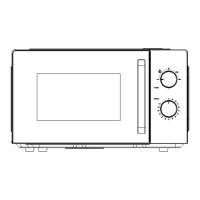
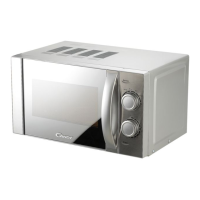
The "Part Names" section provides a diagram of the microwave oven with numbered labels for key components: Door Safety Lock System, Oven Window, Roller Ring, Control Panel, Wave Guide (with a note not to remove the mica plate), and Glass Tray.
The "Control Panel" section describes the two main function operators: a timer knob and a power knob. The "Power Level/Action Selector" knob is used to choose a cooking power level and is the first step to start cooking. The "Timer Knob" allows users to select a desired cooking time up to 30 minutes per session. For pure microwave cooking, there are six power levels, which increase clockwise. A table lists these power levels (1-6) with their corresponding power output percentages (100%, 85%, 66%, 48%, 40%, 17%) and descriptions (HIGH, M.HIGH, MED, M.LOW, DEFROST, LOW).
Finally, the "Operation" section details how to start a cooking session: place food in the oven, close the door, turn the Power Level Selector to choose a power level, and then set the cooking time using the Timer knob. It notes that the oven starts cooking as soon as the timer is turned. For times less than 2 minutes, the timer should be turned past 2 minutes and then back to the correct time. A caution advises always returning the timer to the ZERO POSITION if food is removed before the set time is complete or when the oven is not in use. To stop cooking, users can push the door release button or open the door by the handle.
The "Cleaning and Care" section provides instructions for maintaining the oven. Users should turn off and unplug the oven before cleaning. The inside of the oven should be cleaned with a damp cloth and mild detergent for stubborn dirt, avoiding harsh cleaners. Outside surfaces should also be cleaned with a damp cloth, ensuring water does not seep into ventilation openings. The door, window, seals, and adjacent parts should be wiped frequently with a damp cloth, avoiding abrasive cleaners. The control panel should be cleaned with a soft, damp cloth, keeping the oven door open to prevent accidental activation. Accumulated steam should be wiped with a soft cloth. The glass tray should be removed and washed in warm sudsy water or a dishwasher. The roller ring and oven floor should be cleaned regularly to prevent noise, using mild detergent or a dishwasher, and ensuring proper replacement of the roller ring after cleaning. Odors can be removed by microwaving a cup of water with lemon juice and skin for 5 minutes, then wiping and drying thoroughly. For oven light replacement, users should consult a dealer. Regular cleaning is emphasized to prevent food deposits from deteriorating the surface, which could adversely affect the appliance's life and pose hazards. Lastly, the manual reiterates that the appliance should not be disposed of in domestic rubbish bins but at designated disposal centers.
 General
| Power Output | 800 W |
|---|---|
| Microwave Power | 800 W |
| Control Type | Mechanical |
| Cooking Levels | 5 |
| Defrost Function | Yes |
| Timer | 35 minutes |
| Turntable Diameter | 24.5 cm |
| Weight | 10.5 kg |
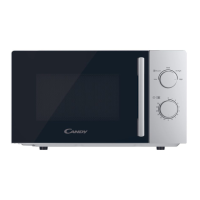
| Color | Silver |
| Colour | Silver |
| Type | Microwave |
| Capacity | 20 liters |
| Door Opening | Side |

 To Next Page