
 Need help?
Do you have a question about the Cannondale RIZE Series and is the answer not in the manual?
Provides an overview of the manual's purpose and scope, including supplemental information.
Explains the nature of carbon fiber composite materials and their behavior under stress.
Defines the bike's intended riding conditions and specifies maximum weight capacities.
Guidance on selecting compatible components and considerations for building a bike.
Warns against improper use of bike stands that can damage the frame.
Advises on storing and transporting the bike to prevent damage from extreme heat.
Details how to inspect the frame for damage after a crash or impact.
Warns against refinishing or painting that can weaken composite frame bonds.
Explains how to select compatible tire sizes and ensure adequate clearance.
Guides on selecting compatible rear shocks and forks for the bike.
Specifies the maximum allowable fork length for frame safety.
Provides technical specifications including frame dimensions, angles, and measurements.
Details shock specifications like stroke, eye-to-eye length, and recommended sag.
Lists part numbers and descriptions for replaceable frame components.
Explains the integrated headtube design and compatible headset components.
Details protective materials for downtube, cables, and chainstay.
Discusses compatibility with BB30 bottom brackets and bearing maintenance.
Details specific tools and adapters for SI BB30 bottom bracket systems.
Illustrates and lists parts for the swingarm, shock link, and seatstay assemblies.
Lists specific torque values for critical fasteners in Nm, InLbs, and Loctite numbers.
Outlines routine maintenance tasks and recommended service intervals.
This document is an owner's manual supplement for the Cannondale Rize bicycle, model 122174.PDF. It provides crucial safety, maintenance, and technical information specific to this model, designed to be read in conjunction with the general Cannondale Bicycle Owner's Manual.
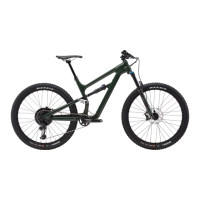
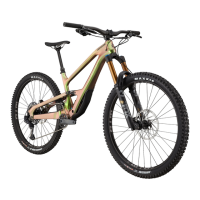
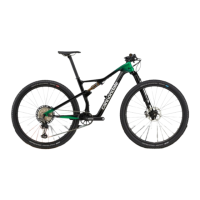
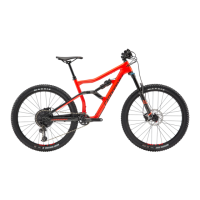
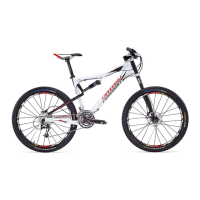
The Cannondale Rize is an all-mountain bicycle, categorized for Condition 4 riding. This means it is designed for use on rough trails with medium obstacles, including moderately sized obstacles and small jumps. It is suitable for trail and uphill riding. All-mountain bikes, like the Rize, are more heavy-duty than cross-country bikes but less so than freeride bikes. They are also lighter and more nimble than freeride bikes, making them easier to ride uphill. The Rize features more suspension travel than a cross-country bike, enabling it to handle more difficult terrain, larger obstacles, and moderate jumps. The components used are selected to fit this intermediate intended use.
The manual explicitly states that the Rize is not intended for hardcore freeriding, extreme downhill, dirt jumping, slopestyle, or very aggressive or extreme riding. Using the bike outside its intended use is dangerous and can lead to severe injury, paralysis, or death.
The manual emphasizes the importance of understanding the bike's intended use and limitations. Riders are advised to consult their Cannondale Dealer about their specific needs and how they intend to use the bike.
When building up a frameset, riders should consult with their Cannondale Dealer and component manufacturers to ensure compatibility with their riding style, ability, weight, and maintenance preferences. Lighter-weight components, while offering higher performance, generally have shorter lives and require more frequent inspection. Heavier riders or those with a rough riding style are advised to choose heavy-duty components.
The Rize features composite materials, also known as "carbon fiber," in its construction. Riders must understand that while strong and light, composite materials do not bend but break when crashed or overloaded. Therefore, proper service, maintenance, and inspection of all composite components (frame, stem, fork, handlebar, seat post, etc.) are crucial for safety.
The bike has a maximum weight limit for the rider and luggage. For the rider, it is 300 lbs (136 kg), and for luggage (seat bag only), it is 5 lbs (2.3 kg), totaling 305 lbs (138 kg).
Tire size is a critical usage feature. Riders must observe the maximum tire width specified in the manual to prevent tires from hitting the fork or frame, which can lead to loss of control or a stopped wheel. Oversized tires, those with too little clearance, or those that can hit the fork or frame when suspension is compressed, must not be mounted. The U.S. Consumer Product Safety Commission (CPSC) requires at least 1/16" (1.6 mm) tire clearance from any part of the bike. Riders are advised to ask their Cannondale Dealer for the right tires for their bike and its particular components.
The maximum fork length is an important frame safety testing specification. When installing headset parts, headset adapters, or a fork, or selecting replacement forks, riders must observe the 530 mm limit. Exceeding this limit can overload the frame, causing it to fail while riding, leading to severe injury, paralysis, or death. The manual provides instructions on how to measure the fork length correctly, from the bottom of the head tube to the center of the wheel axle.
The Rize also features an integrated head tube, with Cannondale SI bearing cups. In alloy frames, these cups are machined into the head tube, while in carbon models, they are permanently bonded. Cannondale Headshok System Integration bearings are accepted directly into both types. An adapter cup kit is available for 1 1/8" steering tubes and headsets.
The BB shell is compatible with the BB30 Standard, allowing for the use of Cannondale Hollowgram SL Cranksets. An adapter kit is available to convert the BB30 bottom bracket cranksets for use with 68mm bottom brackets, but this is not a repair part and should only be used with undamaged frames.
The manual outlines a comprehensive set of maintenance items, emphasizing that these are supplemental to the general Cannondale Bicycle Owner's Manual. Riders are encouraged to consult their Cannondale Dealer to develop a complete maintenance program tailored to their riding style, components, and conditions of use, and to follow component manufacturers' recommendations.
Key maintenance items include:
The manual also provides warnings against repainting or refinishing the frame or fork, as paint stripping or refinishing chemicals can attack or weaken the bonding chemicals of the carbon fiber composites, leading to severe damage and potential accident. Abrasives or sanding can also remove frame material or weaken it.
Regarding bike stands, the manual cautions against clamping the frame directly, as this can cause crushing damage. Instead, the bike should be secured by extending the seat post and clamping the stand on the extended post, ensuring not to extend beyond the MINIMUM INSERT line. For carbon seat posts, the clamp force should be adjusted to the minimum needed. Using an old seat post for mounting is recommended.
Protection from extreme temperatures is also advised. Carbon bikes should be protected from extreme temperatures during storage or transport, and allowed to cool down or warm up before riding. Storage in temperatures exceeding 66.5°C (150°F) should be avoided.
 General
| Suspension | Full Suspension |
|---|---|
| Type | Mountain Bike |
| Pedals | Not included |
| Frame Material | Aluminum |
| Fork | Fox Float |
| Seatpost | Cannondale Alloy |
| Handlebar | Cannondale Alloy |
| Stem | Cannondale Alloy |
| Grips | Cannondale |


 To Next Page