Cinema EOS for 2K and HD Origination
Introduction
Canon began a rollout of a family of Cinema EOS cameras in the Fall of 2011. The EOS C300 made its
debut in November 2011 as an HD-only camera that captured digital HD in-camera to Compact Flash
cards. It employed an innovative new Super 35mm 4K image sensor to originate that HD. The EOS C500
followed in 2012 as a digital cine camera having a far broader capability in the digital image formats it
originated. It delivers a choice of 4K, 2K, or HD uncompressed files for external recording. It is intended
for very high-end origination of movies or television production. Finally, the EOS C100 flanks the family
– at the lower-budget end – it too, being an HD-only camera.
This paper is intended to focus on the important differences between the EOS C500 and the EOS C300 –
purely in the context of HD or 2K digital origination. The 4K capabilities of the C500 will be addressed in
a separate paper.
Imaging Section of EOS C500 and EOS C300
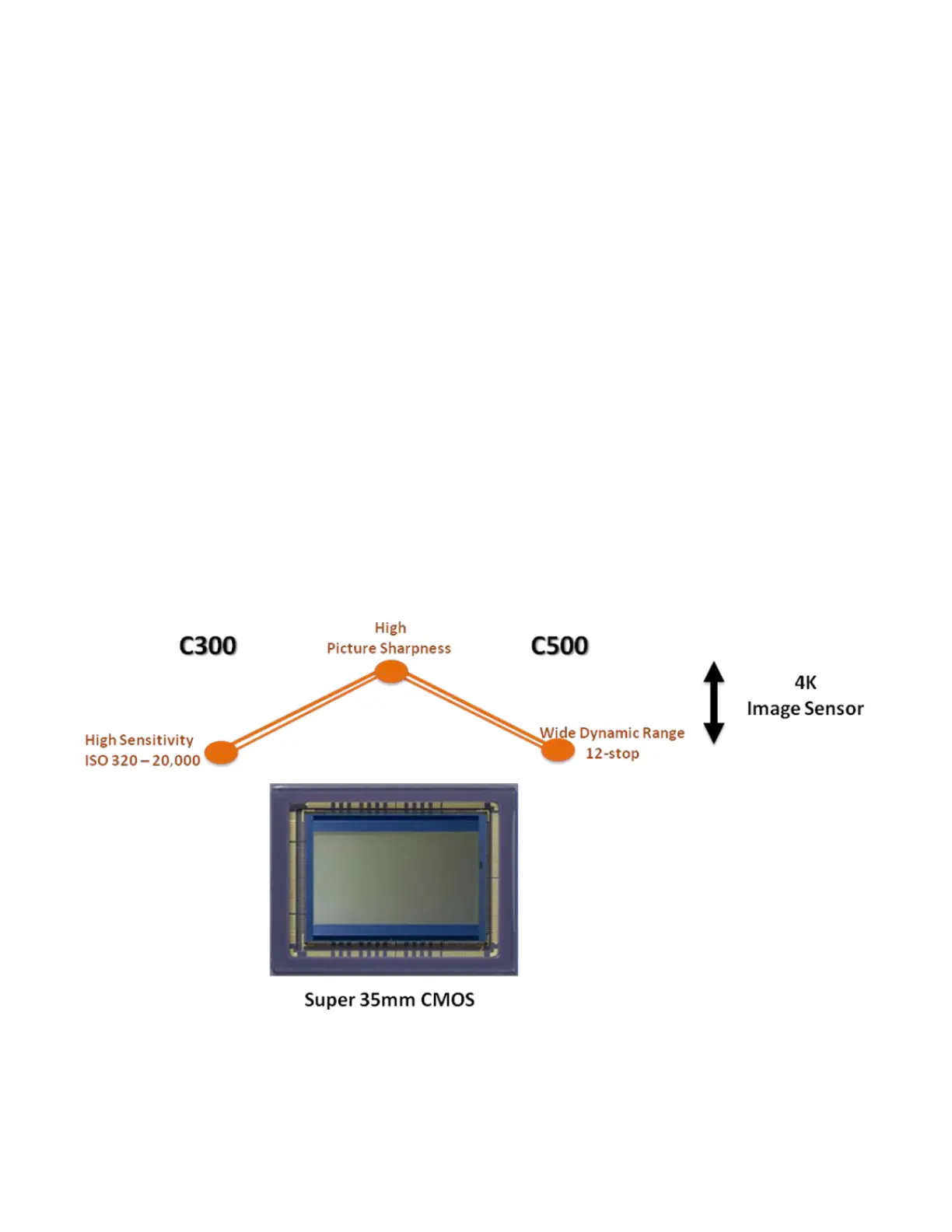
These two cameras share identical imaging sections – in terms of deployment of the Super 35mm 4K
CMOS image sensor specially developed by Canon for digital motion imaging. Accordingly, the two
cameras share in common the exceptional high sensitivity , wide dynamic range, and high picture
sharpness produced by this image sensor.
Figure 1 The same 4K CMOS image sensor is used in both the C500 and the C300 digital
cine cameras
1



 To Next Page