
 Need help?
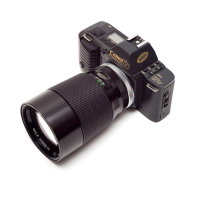
Do you have a question about the Canon T90 and is the answer not in the manual?
Step-by-step guide for mounting camera lenses correctly onto the T90 body.
Instructions for setting camera lenses for automatic exposure (AE) photography.
Detailed steps for inserting and securing the four AA batteries into the camera.
Guide on activating the camera using the main switch and checking the initial display.
Method for verifying battery power levels and important notes on battery usage.
Instructions on how to load film into the camera and confirm proper loading.
How to select between single frame and continuous shooting modes.
Guide to choosing various automatic exposure (AE) shooting modes available.
Explanation of the different metering sensitivity patterns available on the T90.
Practical guidance on utilizing center-weighted, partial, and spot metering modes.
Techniques for achieving sharp focus using the viewfinder and rangefinder.
Steps for taking a photograph, checking exposure, and turning off the camera.
Process of automatic film rewinding at the end of the roll.
Detailed uses of spot metering: one-point, multi-spot, and H/S control.
Measuring multiple points in the scene for an average exposure reading.
Using Highlight/Shadow control for exposure compensation in difficult lighting.
Full manual control of shutter speed and aperture for creative exposure.
AE metering with lenses that require stop-down measurement.
Manual metering where aperture is fixed, requiring manual adjustments.
Performing long exposures using the Bulb mode for specific photographic situations.
Using the self-timer for delayed shutter release, including 2 or 10-second intervals.
Adjusting exposure for high-key or low-key effects and backlit subjects.
Techniques for taking multiple shots on a single frame for creative effects.
Special focusing techniques required when using infrared film.
Features and usage of the Canon Speedlite 300TL flash unit.
Synchronization of flash with the second shutter curtain for natural motion blur.
Information and usage notes for other Canon Speedlite flash models.
Functionality and data storage capabilities of the Data Memory Back 90.
Details about the Macro Ring Lite ML-2 for close-up flash photography.
Using the wireless controller for remote camera operation via infrared.
Importance and proper use of lens hoods to prevent flare and protect the lens.
Proper procedures for storing the camera when not in use to maintain condition.
Additional important notes covering LCD display and back-up battery.
Display information shown for the Manual exposure mode.
Display information shown for the Stopped-down AE mode.
Display information for Stopped-down (fixed index) metering.
Display information shown for the Bulb (long exposure) mode.
Solutions for various exposure warning indicators and error messages.
 General
| Type | 35mm SLR |
|---|---|
| Lens Mount | Canon FD |
| Viewfinder Coverage | 94% |
| Shutter | Focal-plane |
| Shutter Speed | 30 sec. to 1/4000 sec., B |
| ISO Range | 6 - 6400 |
| Exposure Modes | Program, Shutter-priority, Aperture-priority, Manual |
| Metering | Center-weighted average |
| Flash Sync Speed | 1/250 sec |
| Battery | 4x AA |
| Film Advance | Motorized |




 To Next Page
