7
ENG
"osmosi inversa" +0300017IE rel. 1.3 - 12.10.2016
1. GENERAL FEATURES AND MODELS
1.1 Description of the unit
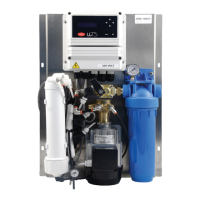
The reverse osmosis systems described in this manual are purpose-
built for treating water used in technological processes. These units can
resolve the problem of excessive mineral salts in the feed water. Reverse
osmosis systems are made up of the following main components:
•
micron fi lter;
•
high pressure pump;
•
desalination module
(osmotic membranes)
;
•
electrical control panel;
•
expansion vessel.
Carel code Description
ROC025500N
Reverse osmosis system, 25 l/h, with pump and 15 l
expansion vessel
ROC040500N
Reverse osmosis system, 40 l/h, with pump and 15 l
expansion vessel
ROC0605000
Reverse osmosis system, 60 l/h, with pump and 15 l
expansion vessel
Tab. 1.a
1.2 General principle of reverse osmosis
Osmosis is a natural process whereby diluted or lighter solutions
spontaneously pass through semipermeable membranes into more
concentrated solutions.
When a solution passes through a semipermeable membrane, the
pressure on the side with the lower concentration decreases and at the
same time the pressure of the more concentrated solution increases,
until reaching a point of equilibrium, at which point the solution stops
fl owing. The pressure diff erence between the two solutions, in conditions
of equilibrium, is called the “osmotic pressure”.
Reverse osmosis, on the other hand, is a scientifi c process that reverses
this natural process. It involves applying a pressure exceeding osmotic
pressure to the more concentrated solution, so as to reverse the fl ow
through the semipermeable membrane and separate the salts dissolved
in the water.
This principle can be applied to water desalination, for both drinking and
technological uses.
Reverse osmosis has several advantages:
•
water desalination regardless of salt content;
•
no chemicals that need to be drained after use, so no pollution
problems;
•
relatively low running costs compared to ion-exchange resin systems,
above all with high salinity of the water being treated;
•
easy operation.
1.3 ROC operating principle
The feed water enters the cartridge fi lter that guarantees dechlorination
and fi nal fi ltering at 5 m. In this way, the required degree of limpidity for
the water entering the permeators is guaranteed. The supply pressure,
during standard operation, must be at least 1.5 bar, to guarantee the
correct pressure quantity at the pump inlet.
When the pressure exiting the cartridge fi lter is below 0.8 bar, the pressure
switch PS1 sends a dedicated signal to the board, stopping the machine.
Water is then returned from pump P1 so that the membranes can have
the pressure required for the demineralization process. Pressure switch
PS2 is adjusted so that it sends a signal should the permeator pressure
exceed 10 bar.
Treated water fl ows out the system through the permeate pipe supplied
as standard; the system starting and switching off are operated with the
aid of pressure switches PS2 and PS3.
Example: on a 25 l/h machine (ROC025500N) of standard production,
the following approximate values should be found: osmotised water
production 25 l/h, discharge 60 l/h, pressure at the permeators 7-8 bar
(PI1). These values are theoretical ones, because they can change when
the feed water temperature varies and depending on its chemical-
physical specifi cations. These values were taken into account for a
recovery of 30% (TDS 250 ppm and feed water temperature 16°C); for
calculating it, the following operation is required:
RECOVERY (%) =
PERMEATE
x 100
(PERMEATE+DISCHARGE)
To adjust the supply pressure to the permeators, you can act on the
by-pass screw on the pump. The feed water temperature remarkably
infl uences both productivity and quality of the permeate. As temperature
increases, even only a few degrees, a higher productivity will be achieved
(with an improved recovery) with a worse conductivity value.
1.4 End of production of desalinated water
The end of production of desalinated water is automatically managed
by the electronic control through the pressure switches installed on the
permeate piping. The max. pressure switch stops its operation when the
pressure on the downstream circuit exceeds a given value (default 4.0
bar).
The pressure on the downstream circuit is kept through the expansion
vessel (included in the ROC% code).
The min. pressure switch restarts the system when the pressure on the
downstream circuit drops below 2.0 bar (close to an emptying of the
expansion vessel).
Note: WTS Compact systems cannot operate if not coupled with the
expansion vessel.


 To Next Page
 Loading...