
 Need help?
Do you have a question about the Caroma SPA000252 and is the answer not in the manual?
Steps for attaching the kickstand.
Instructions for mounting the handlebar assembly.
Guide for attaching the saddle and seat post.
Steps for securely mounting the luggage basket.
Fine-tuning handlebar components like brakes and accelerator.
Explains the LCD display, speed modes, and settings.
Details how to use buttons for startup, mode switching, and settings.
How to operate the lamp, battery charging, and startup.
Details on power assist, electric drive, and combined modes.
Instructions for adjusting and using the scooter's brakes.
Essential safety guidelines for charging the scooter's battery.
Guidelines for safe riding, checks, and environmental factors.
Safety measures to follow while charging the scooter.
Instructions for environmentally friendly battery disposal.
Regular checks for screws, tires, brakes, and lubrication.
How to clean the scooter without damaging electronics.
Tips for maintaining battery health and lifespan.
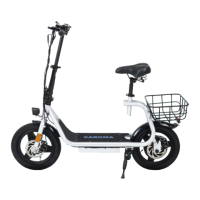
This document outlines the features, usage, and maintenance of the CAROMA electric scooter, a personal transportation tool designed for green and healthy travel. The scooter is developed with advanced and reliable technology, focusing on user safety and convenience.
The CAROMA electric scooter is a means of transportation with a limited speed, designed for individual use. It features an electric safety system that automatically cuts off power when braking, adhering to EU laws with a rated speed of 25KM/H. The scooter is equipped with a mechanical bell and a motor whose sound does not exceed 70dB(A) at the workplace. It offers both power assist drive and electric drive modes, with the option for coexistence of both. The scooter can be started by pressing and holding a button on the instrument panel for 2 seconds.
The scooter's three-dimensional body structure is designed according to ergonomics, mechanics of materials, and aesthetics, aiming for the best riding effect. It boasts a light and stylish appearance with excellent part materials that safeguard riding and facilitate operation.
Users are advised to take personal protective measures, including wearing a helmet and special protective equipment, and clothes with fluorescent and reflective stripes when riding at night. Tinted spectacles are recommended for riding under the sun. It is crucial to observe local laws and regulations on electric scooters and traffic rules. The scooter should not be ridden in a humid environment, on highways, motorways, or any other inappropriate places. Riding overspeed is discouraged as it is a primary cause of traffic accidents.
Before riding, the scooter should be fully charged, and the battery should be locked with the attached key, which should then be removed. Users should avoid foreign matters around the charging port and connect the charger to the scooter before connecting it to AC power supply to prevent sparks. If the scooter is left idle for a long time, the general switch should be turned off, and the battery charged periodically (every two months) and stored fully charged to prevent serious power loss. The battery should be discharged and charged at least once a month.
The instrument panel provides information such as current speed, total mileage, single mileage, current voltage, running time, and fault codes. It also allows for adjustment of backlight brightness, mileage unit (km/mile), voltage grade (24V, 36V, 48V), and sleep time. The scooter offers three boost gear levels, with Gear 3 indicating maximum electric and pedal assistance. The crank can be used to adjust motor rotating speed, increasing it by moving from top to bottom and returning to zero upon release.
Braking should be practiced gently without blocking the wheel, a technique known as progressive brake modulation. The lock lever should be pushed towards the handlebar to gradually increase braking force. If wheels get stuck, braking force should be reduced to allow them to spin.
For optimal endurance mileage, users should adopt a low-speed mode, avoid frequent braking (while ensuring safety), and prevent overloading. Tire pressure should be checked before riding, with recommended pressure generally between 35PSI-65PSI (280KPA-450KPA).
Regular maintenance is essential for the scooter's longevity and performance. It is recommended to adjust the scooter at a local scooter shop twice a year, with critical components inspected, repaired, and adjusted by experienced operators.
Periodic self-inspection includes checking the tightness of front and rear wheel screws, the condition of the tire tread (worn or cracked), front and rear tire pressure, and the unblocked state of the driving system. Brake functions should be regularly checked, and the braking wire fastener should be in a lubricating state. Increased braking distance is advised on rainy/snowy days or during downhill riding.
Lubrication is a vital part of maintenance. The front axle, center axle, flywheel, and pivot point of the front fork shock absorber should be scrubbed semiannually, with grease or engine oil applied as required. The brake system can be adjusted by loosening screws on the brake wire fixed seat, then tightening or loosening the brake wire to achieve an average distance of 0.3mm-0.5mm between the pads and the disc, followed by tightening the screws.
For cleaning, the scooter should not be washed with water to avoid wetting internal electronic parts and wires. Oil should not be filled into the front/rear brake, rim, or tire.
Battery maintenance is crucial for service life. The battery should be charged timely after riding, especially when the level is between 30% and 50%, and should not be fully discharged. If stored for more than two months, the battery should be fully charged, removed, and stored in a dry, low-humidity place at 5°C~20°C. It should be protected from extreme temperature fluctuations, direct sunlight, or heat, and charged every two months. It is normal for battery capacity to decrease slowly over time, and power cannot be restored once the battery reaches its final life cycle.
The original charger should be used, and the charger should not be covered during charging. The charging port must be dry and free of foreign objects. The correct socket (100V-240V/50HZ-60HZ) should be used, and the scooter kept out of reach of children and pets, away from flammable objects during charging. The scooter should not be used while charging. If the battery or charger is immersed in water, the product should be powered off immediately, the motor disconnected from the battery, and charging stopped, then technical support contacted. The product should not be restarted without guidance.
For battery disposal, it should be recycled or discarded in an environment-friendly way, not thrown into fire or ordinary household garbage.
 General
| Model | SPA000252 |
|---|---|
| Category | Scooter |
| Max Load | 100 kg |
| Material | Aluminum Alloy |
| Foldable | Yes |

 To Next Page