Need help?
Do you have a question about the Carrier 30GH 050 and is the answer not in the manual?
Pre-start checks before initial unit operation.
Steps for safely starting and testing the chiller unit.
Procedure to verify and adjust compressor oil levels.
Approved oil types for R-22 and R-407C compressors.
Specified torque values for compressor fittings.
Description of circuit breaker and protection devices.
Function and settings of the discharge gas thermostat.
Purpose and operation of the crankcase heater.
Monitoring and fault indication by the STARTERGUARD card.
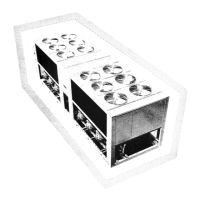
The Carrier 30GH 040-245 and 30GZ 040-245 are air-cooled liquid chillers designed for various applications, including air conditioning, industrial process cooling, and low-temperature operation. These units are built to provide efficient cooling and are suitable for outdoor installation. They operate on a 50 Hz power supply and are equipped with the REGULATION PRO-DIALOG PLUS control system, ensuring precise and stable operation.
The primary function of these chillers is to cool a liquid (typically water or brine) which is then circulated through a system to provide cooling. The units utilize a refrigeration circuit that includes compressors, an evaporator, and a condenser. The compressors, which are semi-hermetic with 4 or 6 cylinders, compress the refrigerant. The evaporator then transfers heat from the liquid to be chilled to the refrigerant, causing the liquid to cool down. The heated refrigerant then moves to the condenser, where it releases heat to the ambient air, facilitated by axial fans. The cooled refrigerant then returns to the evaporator to repeat the cycle.
The chillers are designed with either one or two refrigeration circuits, depending on the model, to enhance reliability and efficiency. The control system manages the capacity stages, optimizing performance based on the cooling demand. For models 30GH/GZ 170-245, there are two power connection points, indicating a larger capacity and potentially dual power feeds for enhanced operational stability.
Safety is a key aspect of the design, with various protection devices integrated into the system. High-pressure switches, low-pressure protection, and defrost protection mechanisms are in place to prevent damage and ensure safe operation. Compressor protection is handled by a dedicated circuit board (STARTERGUARD) that monitors the compressor's operating environment, including crankcase heaters, contactors, and control wiring. This board uses LED indicators to display the status of controlled components and will shut down the compressor if a fault is detected.
The chillers are designed for ease of use and integration into existing systems. Water connections are made via flat flanges, and the units are equipped with drain valves at low points and air purge valves at high points to facilitate maintenance and prevent issues like freezing. It is crucial to ensure proper water flow rates within the specified minimum and maximum values to maintain optimal performance and prevent evaporator damage. For stable operation and accurate temperature control, a minimum water loop volume is required, which may necessitate the addition of a buffer water reservoir.
The control system allows for precise temperature regulation, making these units adaptable to different cooling requirements. For installations where water temperatures below 5°C (for R-407C) or 4°C (for R-22) are likely, the addition of ethylene glycol is recommended to prevent freezing. The units are designed for outdoor use, but considerations for heavy snowfall or strong winds may require additional measures like raising the unit or installing baffles to ensure proper airflow and prevent snow accumulation.
The compressors are mounted on anti-vibration mountings to minimize noise and vibration during operation. For larger units (30GH/GZ 085-245), shipping wedges and retaining bolts must be removed during installation to allow these mountings to function correctly. The fan rotation is counter-clockwise when viewed from above, ensuring efficient air circulation through the condenser coils.
Regular maintenance is essential to ensure the longevity and efficient operation of the Carrier chillers. The manual provides detailed instructions for various maintenance tasks, emphasizing that only trained and qualified refrigeration engineers should perform installation, start-up, and servicing due to the inherent hazards of system pressures and electrical components.
Key maintenance aspects include:
Before any work on the machine, it is imperative to ensure that the power supply is switched off and locked out, and all isolators are tagged. If a refrigerant circuit is opened, it must be evacuated, recharged, and tested for leaks, and the filter-drier must be changed.
 General
| Model | 30GH 050 |
|---|---|
| Power Supply | 460V/3Ph/60Hz |
| Operating Temperature Range | 20°F to 115°F |
| Cooling Capacity | 50 tons |
| Type | Air-cooled |


 To Next Page