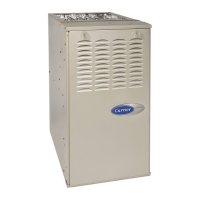
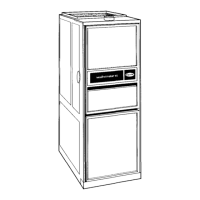
The Carrier 58SS/DH Induced-Combustion Gas-Fired Furnaces are designed for residential and light commercial heating applications, utilizing induced combustion to enhance efficiency and safety. These furnaces are engineered to address modern construction practices, which often result in tighter homes with reduced natural air infiltration, necessitating positive furnace air supply and updated installation guidelines.
Function Description:
These furnaces operate by drawing combustion air into a sealed combustion chamber using an induced-draft blower. This ensures a consistent and controlled air supply for combustion, independent of ambient room air pressure. The combustion gases are then safely vented to the outdoors. The induced-draft system helps maintain a negative pressure within the vent, preventing spillage of combustion products into the living space. A key safety feature is the draft safeguard switch, which monitors vent pressure and will shut down the furnace if a positive pressure condition (indicating a blocked flue) is detected, preventing unsafe operation. The furnace also incorporates a limit control safety check, which monitors the furnace temperature and energizes the circulating-air blower motor if the furnace overheats, or shuts off the combustion control system if necessary. A flow-sensing switch further ensures the proper operation of the draft inducer blower.
Important Technical Specifications:
- Venting Category: Category I, meaning it's a nonpositive venting system with static pressure in the vent less than atmospheric pressure and stack gas temperature at least 140 degrees F above the dew point.
- Combustion Air Requirements: Approximately 20 cubic feet of air for every 1000 Btuh of gas consumed. For a 100,000-Btuh furnace, this translates to 2000 cubic feet of air per hour or 33 cubic feet per minute.
- Gas Pipe Sizing: Refer to Table 1 in the manual for maximum capacity of gas pipe based on nominal iron pipe size, internal diameter, and length of pipe. For example, a 1/2-inch pipe (0.622 in. ID) can handle 175 cu ft/hr at 10 ft, while a 1 1/2-inch pipe (1.610 in. ID) can handle 2100 cu ft/hr at 10 ft. These figures are based on a gas pressure of 0.5 psig or less and a pressure drop of 0.5 in. wg.
- Vent Pipe Clearance: Single-wall vent pipes require 6 inches of clearance from combustible materials, while Type-B1 (double-wall) vents require 1 inch.
- Vent Pipe Slope: All horizontal runs of vent pipe must maintain a minimum upward slope of 1/4 inch per linear foot.
- Chimney/Gas Vent Height: Must extend at least 5 feet above the highest connected draft hood, 3 feet higher than the point of emergence through the roof, and at least 2 feet higher than any object within a 10-foot radius.
- Electrical Requirements: Voltage, frequency, and phase must match the furnace rating plate specifications. The service provided by the utility must be sufficient for the additional load.
- Grounding: The cabinet must have an uninterrupted or unbroken ground according to National Electrical Code, ANSI/NFPA 70-1984, and local codes. Gas piping should not be used as an electrical ground.
- High Altitude Derating: For altitudes over 2000 ft, ratings are reduced by 4% for each 1000 ft above sea level, requiring main burner orifice changes.
Usage Features:
- Installation Flexibility: Can be installed in confined spaces (e.g., closets) or unconfined spaces (e.g., basements, large equipment rooms). Specific guidelines are provided for combustion/ventilation air supply depending on the space type and whether air is drawn from inside the building or directly from outdoors.
- Air Supply for Confined Spaces (Inside Building): Requires two permanent openings (one within 12 inches of the top, one within 12 inches of the bottom) with a minimum free area of 1 sq in. per 1000 Btuh of total input rating (not less than 100 sq inches). If the building is unusually tight, an additional permanent opening communicating directly with outdoors (1 sq in. per 5000 Btuh) is required, with ducts connected to the cold air return of the heating system.
- Air Supply for Confined Spaces (Outdoors): Requires two permanent openings (one within 12 inches of the top, one within 12 inches of the bottom) communicating directly or by ducts with outdoors. Horizontal ducts require 1 sq in. per 2000 Btuh, while vertical ducts/openings with louvers/grilles require 1 sq in. per 4000 Btuh.
- Air Supply for Unconfined Spaces: If the unconfined space is in a tightly constructed building, a permanent opening (or openings) with a total free area of not less than 1 sq in. per 5000 Btuh of total input rating for all equipment must be provided from outdoors.
- Gas Piping: Requires a sediment trap in the riser leading to the furnace to collect dirt or condensate. An accessible manual shutoff valve must be installed upstream of the furnace gas controls and within 6 ft of the furnace. A 1/8-in. NPT plugged tapping for test gage connection is required upstream of the gas supply connection.
- Intermittent Ignition System: Features a reliable ignition system. The pilot flame can be adjusted to control the burner-on time delay.
- Temperature Rise Adjustment: Blower speed can be adjusted to control the air temperature rise across the furnace, ensuring it stays within the specified range on the unit rating plate.
- Common Venting: Can be connected to a common chimney or listed Type-B1 gas vent with other listed gas-fired appliances, provided the vent system remains at negative pressure during normal operation. Flow charts are provided for replacement installations on existing chimneys.
- Cooling Equipment Integration: Cooling coils must be installed parallel with or downstream of the furnace to prevent condensation in the heating element. Dampers or other means must prevent chilled air from entering the unit when heating, and vice versa.
- Special Locations: Specific guidelines for installation in residential garages (burners/ignition source 18 inches above floor, protected from physical damage) and public garages/airplane hangars (according to National Fire Protection Association requirements).
Maintenance Features:
- Accessibility: Ample space should be provided around the furnace for servicing and cleaning.
- Gas Leak Check: After all gas connections are made, lines must be purged and checked for leakage using a soap-and-water solution. Never use matches, candles, flame, or other ignition sources.
- Electrical Connection Check: All electrical connections (factory and field) should be checked for tightness, especially after the unit has reached operating temperatures or if aluminum conductors are used.
- Combustion Air Quality: Combustion air must not be contaminated by halogens (fluorides, chlorides, bromides, iodides) found in aerosols, detergents, bleaches, cleaning solvents, salts, and air fresheners, as these are highly corrosive to gas-fired furnaces. If contaminants are present, outside air must be ducted separately to the furnace room.
- Louver and Grille Maintenance: Louvers and grilles used for combustion and dilution air must be constructed so they cannot be closed, ensuring continuous air supply. Screens used must not be smaller than 1/4-inch mesh.
- Sediment Trap Cleaning: The sediment trap in the gas piping should be periodically checked and cleaned to prevent dirt or condensate from reaching the gas controls.
- Draft Safeguard Switch Reset: In case of a blocked flue condition and subsequent shutdown, the draft safeguard switch must be reset after the vent pipe is reconnected and the system has cooled.
- Vent System Inspection: The vent system should always be examined prior to installation of the furnace, and regularly inspected for restrictions or damage.
- Return Air Duct Integrity: All duct connections to the furnace must be airtight to avoid negative pressure conditions in the room, which can affect combustion. Return air should not be taken from the room unless an equal or greater amount of air is supplied to the room.

 Need help?

 To Next Page
 General