This document is a service manual for the QHC R32 Inverter Series air conditioners, manufactured by Carrier, a United Technologies company. The manual provides comprehensive information for the installation, operation, troubleshooting, and maintenance of these units.
Function Description
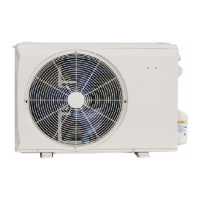
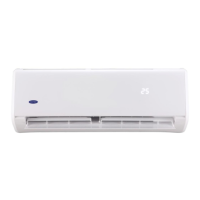
The QHC R32 Inverter Series air conditioners are designed for both cooling and heating operations, utilizing R32 refrigerant. These units feature inverter technology, which allows for variable compressor speed, leading to improved energy efficiency and more precise temperature control compared to conventional fixed-speed air conditioners. The system includes both indoor and outdoor units, with various capacities to suit different room sizes.
Key functional features include:
- Cooling Operation: Capable of cooling within an outdoor temperature range of 0°C to 50°C (32°F to 122°F) and an indoor room temperature range of 17°C to 32°C (62°F to 90°F). For models with low temperature cooling systems, the outdoor temperature range extends from -15°C to 50°C (5°F to 122°F).
- Heating Operation: Operates in heating mode with an outdoor temperature range of -15°C to 30°C (5°F to 86°F) and an indoor room temperature range of 0°C to 30°C (32°F to 86°F).
- Drying Operation: Features a drying mode that operates within an outdoor temperature range of 0°C to 50°C (32°F to 122°F) and an indoor room temperature range of 10°C to 32°C (50°F to 90°F).
- Refrigerant Leakage Detection: This new technology displays "EC" on the outdoor unit if refrigerant leakage is detected, enhancing safety and system integrity.
- Louvre Position Memory Function: The louvre automatically restores to its original angle after shutting down, or the user can set a preferred angle.
- Self Clean (optional): A function that runs in cooling or drying mode, followed by a fan-only mode to prevent breeding of mold.
- Follow Me (optional): The indoor PCB receives a signal from the remote controller, and the unit adjusts its operation based on the temperature at the remote controller's location.
- Silence Operation (optional): Reduces noise to the lowest level for a quiet and comfortable room environment.
- Auto-Restart Function: In case of a sudden power failure, the unit automatically restarts with the previous settings after 3 minutes when power returns.
- Defrosting Mode: Automatically activates based on the outdoor coil temperature (T3) and ambient temperature (T4) to prevent ice buildup on the outdoor unit during heating operation. The indoor unit displays "dF" during defrost.
- Optional Filters: Includes various optional filters such as Cold catalyst filter, Super Ionizer, Silver Ico Filter, Vitamin C Filter, 3M HAM Filter, Bio Filter, and Golden Fin.
- Self-cleaning (Optional): An additional feature for maintaining the cleanliness of the unit.
- Compressor Crankcase Heater (Optional): Ensures smooth startup in cold conditions.
Important Technical Specifications
The QHC R32 Inverter Series offers various capacities, with corresponding indoor and outdoor unit models:
| Capacity |
Indoor units |
Outdoor units |
| 9k |
42QHC009D8S |
38QHC009D8S |
| 12k |
42QHC012D8S |
38QHC012D8S |
| 18k |
42QHC018D8S |
38QHC018D8S |
| 25k |
42QHC024D8S |
38QHC024D8S |
Dimensions (Indoor Unit):
| Model |
W (mm) |
D (mm) |
H (mm) |
| 42QHC009 |
730 |
192 |
291 |
| 42QHC012 |
812 |
192 |
300 |
| 42QHC018 |
973 |
218 |
319 |
| 42QHC024 |
1082 |
225 |
338 |
Dimensions (Outdoor Unit):
| Outdoor Unit |
W (mm) |
H (mm) |
D (mm) |
A (mm) |
B (mm) |
| 38QHC009D8S |
700 |
550 |
275 |
460 |
276 |
| 38QHC012D8S |
770 |
555 |
300 |
487 |
298 |
| 38QHC018D8S |
800 |
554 |
333 |
514 |
340 |
| 38QHC024D8S |
845 |
702 |
363 |
540 |
376 |
Refrigerant: R32. The maximum refrigerant charge amount for R290 or R32 models is 305 grams.
Pipe Length and Elevation:
| Model |
Pipe size Gas |
Liquid |
Standard length (m) |
Max. Elevation B (m) |
Max. Length A (m) |
Additional refrigerant (g/m) |
| 42QHC009D8S+38QHC009D8S |
3/8" |
1/4" |
5 |
10 |
25 |
12 |
| 42QHC012D8S+38QHC012D8S |
(Φ9.52) |
(Φ6.35) |
|
|
|
|
| 42QHC018D8S+38QHC018D8S |
1/2" |
1/4" |
5 |
20 |
30 |
12 |
|
(Φ12.7) |
(Φ6.35) |
|
|
|
|
| 42QHC024D8S+38QHC024D8S |
5/8" |
3/8" |
5 |
25 |
50 |
24 |
|
(Φ15.9) |
(Φ9.52) |
|
|
|
|
Torque Specifications for Pipe Connections:
| Outside diameter |
inch |
Torque N.cm |
Additional tightening torque N.cm |
| Φ6.35 |
1/4 |
1500(153kgf.cm) |
1600(163kgf.cm) |
| Φ9.52 |
3/8 |
2500(255kgf.cm) |
2600(265kgf.cm) |
| Φ12.7 |
1/2 |
3500(357kgf.cm) |
3600(367kgf.cm) |
| Φ15.9 |
5/8 |
4500(459kgf.cm) |
4700(479kgf.cm) |
| Φ19 |
3/4 |
6500(663kgf.cm) |
6700(683kgf.cm) |
Usage Features
The QHC R32 Inverter Series is designed for user convenience and safety.
- Easy Installation: Detailed instructions are provided for pipe length, elevation, and connecting cables, ensuring proper setup.
- Digital Display: The indoor unit features a digital display that shows temperature settings, room temperature, and self-diagnostic codes.
- Error Codes: The system provides specific error codes (e.g., E0/F4 for EEPROM parameter error, E1 for communication error, E3/F5 for fan speed error, EC for refrigerant leakage, F0 for overload current protection, P0 for IPM malfunction, P1 for over/under voltage, P2 for high temperature protection of IPM module, P4 for inverter compressor drive error) to assist in troubleshooting.
- Remote Control: The unit is operated via a remote controller, allowing users to adjust settings, select modes, and activate functions like self-clean or silence mode.
- Operation Modes: Includes Cooling, Heating, Drying, Fan Only, and Auto-mode.
- Temperature Sensors: The system utilizes multiple temperature sensors (T1: room, T2: evaporator, T3: condenser, T4: outdoor ambient, T5: compressor discharge) for precise control and monitoring.
Maintenance Features
Regular maintenance is crucial for the longevity and efficient operation of the QHC R32 Inverter Series air conditioners. The manual outlines several maintenance procedures and troubleshooting steps.
- Precautionary Measures: Emphasizes safety during installation and maintenance, including warnings about electric shock, explosion, injury, and proper handling of flammable gas (R32 refrigerant).
- Installation Details: Provides guidelines for connecting cables, pipe length, and elevation, which are critical for optimal performance and safety.
- Refrigerant Cycle Diagram: Illustrates the flow of refrigerant within the system, aiding in understanding its operation and troubleshooting.
- Air Purging with Vacuum Pump: Detailed steps for evacuating the system to remove non-condensable gases and ensure proper refrigerant charge. This includes connecting a manifold valve and vacuum pump, and monitoring the vacuum level.
- Adding Refrigerant: Instructions for adding refrigerant to the system, including connecting charging hoses, purging air, and monitoring the charge using an electronic scale.
- Re-installation Procedures: Provides steps for re-installing the indoor and outdoor units, ensuring proper evacuation and refrigerant charging.
- Troubleshooting Guide: A comprehensive section with flowcharts and tables to diagnose and resolve common issues, such as EEPROM errors, communication errors, fan speed problems, refrigerant leakage, temperature sensor malfunctions, overload current, IPM malfunctions, and voltage protection issues.
- Temperature Sensor Checking: Instructions for disconnecting temperature sensors from the PCB and measuring their resistance values using a multimeter, with a table of expected resistance values at various temperatures.
- Compressor Checking: Guidelines for measuring the resistance value of each winding of the compressor using a tester, with expected resistance values for different compressor models.
- Electrolytic Capacitors: Warnings about high voltage in electrolytic capacitors and instructions for discharging them before maintenance to prevent electric shock.
- General Work Procedure: Advises that all maintenance staff and others working in the local area should be instructed on the nature of work being carried out. Work in confined spaces should be sectioned off, and adequate ventilation should be ensured.
- Checking for Presence of Refrigerant: Before opening the refrigerant circuit, the area must be checked with an appropriate refrigerant detector.
- Leak Detection Methods: Describes various methods for detecting refrigerant leaks, including electronic leak detectors, soap water, and visual inspection for oil stains.
- Charging Procedures: Instructions for adding refrigerant, ensuring that different refrigerants do not occur when using charging equipment.
- Decommissioning: Guidelines for safely recovering refrigerant and dismantling the unit.
The manual stresses the importance of qualified personnel performing installation and service to ensure safety and proper operation.

 Need help?
 General

 To Next Page