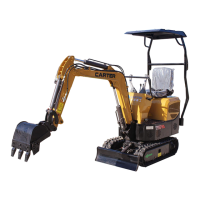
The CT06 Mini Crawler Excavator is a versatile piece of heavy machinery designed for a wide range of tasks, including excavating, crushing, ditch cleaning, drilling, and bulldozing. Its primary function is to convert the chemical energy of diesel fuel into mechanical energy, which is then transformed into hydraulic energy by a hydraulic gear pump. This hydraulic energy is distributed to various actuating elements like hydraulic cylinders, swing motors, and traveling motors, which in turn convert it back into mechanical energy to drive the work equipment and enable the machine's movement. The excavator is designed for ease of operation and transport, and its compact size allows for flexible work in narrow sites.
Important Technical Specifications:
The excavator has the following overall dimensions (Unit: mm):
- A Wheel track: 875
- B Overall length of track: 1150
- C Ground clearance of platform: 325
- D Distance from the center of rotation to the rear end: 758
- E Chassis width: 730
- F Crawler width: 150
- H Crawler height: 285
- I Transportation length: 2325
- J Overall height (Driving shed top): 1280
Its work range includes (Unit: mm):
- A Max. digging radius on ground: 2900
- B Max. digging depth: 1000
- C Max. digging height: 2512
- D Max. unloading height: 1613
- E Maximum excavation distance at ground level: 2860
- F Min. swing radius: 1483
- G Max. lifting height of dozer blade: 130
- H Max. digging depth of dozer blade: 116
Performance parameters:
- Weight of complete machine: 700 kg
- Standard bucket capacity: 0.016 m³
- Rated power: 7.0 kW
The hydraulic system includes a rotary motor and a main pump. The RMER-300Cycloid hydraulic motor (Product number: 186R3006) has the following specifications:
- Displacement: 300 cc/r
- Flow (L/min): Continuous work 80, Intermittent work 95
- Speed (RPM): Continuous work 250, Intermittent work 315
- Pressure (Mpa): Continuous work 20, Intermittent work 24
- Torque (Nm): Continuous work 810, Intermittent work 930
Usage Features:
The CT06 Mini Crawler Excavator is mainly applied in various sectors such as farming, landscaping, garden ditching and fertilization, vegetable greenhouse work, agricultural transformation, indoor demolition, small earthwork projects, civil engineering, road recovery, basement and indoor construction, concrete breaking, cable burying, water supply line laying, garden cultivation, and desilting.
The excavator is equipped with a diesel engine, domestic main pumps, rotary motors, and a traveling motor, ensuring durability and flexibility. It can be fitted with multiple work attachments, including a quick hitch, log grab, ripper, leveling bucket, auger, and narrow bucket, as well as optional roof and radiator, to meet diverse operational needs.
The basic movements of the excavator include bucket rotation, arm stretching/backing, boom lifting/lowering, and turntable swinging. These movements are controlled by a three-way axial slide valve, which regulates oil flow direction and work speed based on operator input. The control system is centralized in the driving area, designed for ergonomic comfort, with operational force on handles not exceeding 40-60 N and handle travel not exceeding 17 cm. The system ensures steady startup and stop, with controlled speed and strength, and maintains operational performance in temperatures ranging from -40°C to 50°C.
Maintenance Features:
The manual outlines a comprehensive maintenance schedule, including daily inspections, and periods for overhaul, medium, and minor repairs.
Daily Inspection and Maintenance (everyday):
- Check engine oil level in sump.
- Check hydraulic oil level in hydraulic oil tank.
- Check fuel level in tank.
- Check for fuel pipe leaks or cracks.
- Check work equipment pivots.
- Check for hydraulic hose and pipeline leaks.
- Check if bucket teeth are worn or loosened (2+2 quantity).
- Check bolts and nuts for tightening torque.
Periodic Maintenance (Intervals in hours):
- Greasing of slewing bearing: Every 20 hours.
- Greasing of slewing bearing gears: Every 100 hours.
- Change the engine oil: Every 100 hours (first inspection).
- Change the hydraulic oil: Every 1000 hours.
- Change the hydraulic oil filter elements: Every 500 hours.
- Check if the fuel pipe is cracked or bent: Every 500 hours.
- Check the defection of track: Every 500 hours.
- Check tensioner: Every 20 hours.
Lubrication of Work Equipment Pivots:
- Pivot at base of boom: Every 20 hours.
- Pivot at base of Stick: Every 20 hours.
- Pivots of bucket and connecting rod: Every 20 hours.
- Others (e.g., Pivot of Bulldozer cylinder, Boom cylinder, stick cylinder, bucket cylinder): Every 20 hours.
- Lubrication of slewing bearing: Every 100 hours.
- Lubrication of rotary motor gear: Every 100 hours.
- Lithium grease is recommended.
Engine Oil Maintenance:
- Inspection of engine oil level: Each day.
- Change of engine oil: Every 100 hours.
- Change the engine oil filter: Every 500 hours.
- Recommended engine oil brand: 15W-40.
Hydraulic System Maintenance:
- Check the hydraulic oil level: Each day.
- Change the hydraulic oil: Every 1000 hours (19.2L).
- Change the hydraulic oil filter elements: Every 500 hours.
- Check the hose and pipeline: Each day and every 250 hours.
- Important precautions: Cool down the machine before maintenance, release pressure from the hydraulic oil reservoir, and ensure cleanliness when connecting hoses and pipelines. Use the same grade of hydraulic oil.
Fuel System Maintenance:
- Drain dirt out of collector of fuel tank: Every 10 hours.
- Check the fuel hose for leakage, cracks, twists, or other damage: Every 10 hours.
- Capacity of fuel tank: 5.4L. Use quality diesel suitable for environmental temperature.
Electrical System - Battery:
- Check the battery electrolyte level and the terminals: Regular intervals.
- Safety precautions for battery handling are emphasized due to the risk of explosion and corrosive sulfuric acid.
- Check and replace the fuse: Every 3 years.
Other Maintenance:
- Check if the bucket teeth are worn or loosened: Each day. Replace if worn beyond service limit (new 190mm, service limit 130mm).
- Change the bucket: As needed.
- Replace the bucket and connect the new one to machine: As needed.
- Adjust the connecting rod of bucket: As needed.
- Take down the traveling lever: As needed.
- Check the track defection: Every 250 hours.
- Check tensioner: Every 250 hours.
- Check the fuel injection timing: As needed.
- Check the bolts and nuts for tightening torque: Every 250 hours (originally daily).
- Specific torque values are provided for various bolt sizes (M6 to M30) and main components (traveling motor, slewing bearing, swing mechanism).
Special Case Maintenance:
- Moor land, rainy or snowy conditions: Check drain plugs, clean machine, check bolts/nuts, lubricate parts.
- On beach: Clean machine thoroughly to remove salt, frequently maintain electrical system.
- Dusty environment: Periodically clean air filter, radiator, fuel system filter, and electrical devices.
- Stony roads: Careful operations, frequently check bolts/nuts, loosen track slightly, use reinforced bucket.
- Freezing cold: Use high fuel suitable for low temperatures, hydraulic oil and engine oil with low viscosity, keep battery fully charged, keep track clean, park on solid ground.
- Falling stone: Add protective cab roof if needed.
Storage of Machine:
- Repair worn/damaged parts.
- Clean primary air filter elements.
- Retract hydraulic cylinders or grease plungers.
- Lubricate grease points.
- Put track on solid, long pad.
- Clean machine, especially in winter.
- Store fully charged battery in dry, safe site or disconnect negative pole.
- Paint if needed to avoid rusting.
- Store machine in dry, safe site or cover with waterproof cloth outdoors.
- Run machine at least once a month if stored for a long time.
Troubleshooting:
The manual provides detailed troubleshooting guides for mechanical, hydraulic, and electrical systems, as well as the diesel engine. This includes symptoms, possible causes, and how to solve issues such as noisy structural components, bucket teeth dropping, tangled crawlers, the whole excavator not moving or moving slowly, unilateral crawler failure, deviation during traveling, rotation mechanism issues, abnormal noise/shakes, powerless oil cylinder/oil leak, engine startup failures, hard starting, and starter failures.

 Need help?
 General

 To Next Page