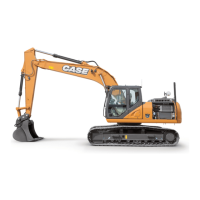
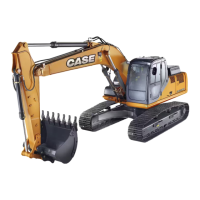
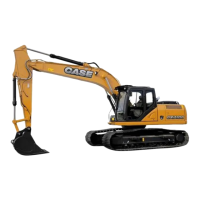
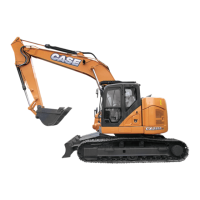
This document is a service manual for the CASE CX26B and CX30B Series 2 Mini Excavators. It provides comprehensive information for the repair and maintenance of these machines, covering various systems and components.
Function Description:
The CASE CX26B and CX30B Series 2 Mini Excavators are compact construction machines designed for excavation, digging, and other earthmoving tasks in confined spaces. They are equipped with a boom, dipper arm, and bucket for digging, and a dozer blade for backfilling and grading. The machines feature hydraulic systems for precise control of attachments and travel, and an engine for power generation.
Important Technical Specifications:
The manual includes detailed torque specifications for various fasteners and joints, which are critical for proper assembly and safe operation.
- Metric Coarse Thread Standard Tightening Torque Values: Tables are provided for 4.8T, 7T, and 10.9T classifications, specifying both lubricated and non-lubricated torque values for different nominal screw dimensions (M6x1 to M36x4). For example, an M6x1 (7T) fastener requires 8.6-10.6 N·m (6.34-7.82 lb ft) without lubrication and 7.3-8.9 N·m (5.38-6.56 lb ft) with lubrication.
- Torque Specifications for Joints and Hoses:
- Joints for Piping (with O-ring): Specifies tightening torque for nominal screw sizes (PF) from 1/8 to 1 inch. For instance, a 1/8 PF joint with a 14 mm wrench size requires 17 N·m (12.5 lb ft) ± 2 N·m (1.5 lb ft).
- Hydraulic Hose (30 °C flare type): Provides tightening torque for nominal screw sizes (PF) from 1/8 to 1 inch. For example, a 1/8 PF hose with a 17 mm wrench size requires 15 N·m (11.1 lb ft) ± 2.0 N·m (1.5 lb ft).
- Torque Specifications for Sleeve Type Tube Fitting: Details tightening torque for various tube sizes (outside diameter x thickness). For example, a 10 mm (0.4 in) x 1.5 mm (0.1 in) tube with a 19 mm wrench size requires 44 N·m (32.5 lb ft) ± 4.9 N·m (3.6 lb ft).
- Screw and Tool Sizes: Tables list nominal screw sizes (d) and corresponding tool sizes (B) for both edge bolts (M6 to M48) and capscrews (socket bolts) (M6 to M48).
Usage Features:
The manual outlines the various systems of the mini excavator:
- Engine: Covers components like the crankcase, pan and covers, valve drive and gears, cylinder heads, connecting rods and pistons, crankshaft and flywheel, fuel tanks, fuel injection system, air cleaners, turbocharger, intake and exhaust manifolds, engine cooling system, and engine lubrication system.
- Hydraulic Systems: Includes the reservoir, cooler, filters, variable displacement pump, main control valve, hydraulic hand and foot controls, hydraulic swing and travel systems, hydraulic central joint, and boom, dipper, excavator, backhoe, swing arm, and dozer blade hydraulic systems.
- Frames and Ballasting: Details the upper frame, swing ring assembly, ballasts, and supports.
- Tracks and Track Suspension: Describes the track frame, driving wheels, tracks, track tension units, and track rollers.
- Electrical Systems: Covers the overall electrical system, harnesses and connectors, engine control system, engine starting system, alternator, battery, fuel tank system, engine oil system, external lighting, and cab/platform harnesses and connectors.
- Booms, Dippers, and Buckets: Includes the boom pivoting support, boom, dipper arm, and bucket.
- Dozer Blade and Arm: Specifically addresses the dozer blade.
- Platform, Cab, Bodywork, and Decals: Covers the cab, operator platform, operator protections, machine shields, guards, and fenders.
Maintenance Features:
The service manual emphasizes safety and proper procedures for maintenance and repair.
- Safety Rules: Highlights the importance of safety alert symbols (DANGER, WARNING, CAUTION) and provides general personal safety precautions, such as wearing protective gear, disconnecting the battery, blocking the machine, relieving pressure in hydraulic systems, and using proper tools.
- General Precautions for Repairs:
- Preparation before Disassembling: Advises understanding operating procedures, cleaning machines, inspecting parts, recording information (date, model, hour meter, trouble condition, oil leakage, etc.), and arranging the service shop.
- Safety in Disassembling and Assembling: Recommends wearing appropriate clothing, suspending warning tags, stopping the engine, identifying first-aid kit location, choosing a safe work area, using lifting equipment for heavy parts (20 kg/44 lb or more), and supporting the machine when lifted.
- Disassembling and Assembling Hydraulic Equipment:
- Removing Hydraulic Equipment: Instructions include releasing hydraulic pressure, draining oil, plugging pipe ends, and cleaning equipment before disassembly.
- Disassembling Hydraulic Equipment: Emphasizes not modifying equipment without manufacturer permission, referring work to qualified personnel, providing matching marks, using special tools, investigating causes of difficulty, and organizing removed parts.
- Inspecting Parts: Advises checking for seizure, interference, uneven contact, measuring wear, and repairing/replacing defective parts.
- Reassembling Hydraulic Equipment: Recommends good ventilation, cleaning parts, applying clean hydraulic/gear oil, replacing O-rings, backup rings, and oil seals, degreasing surfaces for liquid gasket, removing rust preventive agent from new parts, fitting bearings/bushings/oil seals with special jigs, assembling with matching marks, and ensuring complete assembly.
- Installing Hydraulic Equipment: Instructions for supplying hydraulic oil/lubricant and performing air bleeding after specific maintenance tasks (e.g., hydraulic oil change, pump installation, cylinder installation).
- Electrical Equipment: Provides precautions for handling electrical components, such as not disassembling, handling carefully, turning the key off before connecting/disconnecting, and avoiding water splashes.
- Battery Electrolyte Safety: Warns about the hazardous nature of battery electrolyte (dilute sulfuric acid) and provides emergency measures for skin/eye exposure, spills, and ingestion.
- Hydraulic Parts: Guidelines for O-rings (elasticity, damage, appropriate type, distortion-free fitting) and flexible hoses (appropriate parts, specified torque, no kink/tension/interference/leakage).
- Welding Repair: Advises referring to qualified personnel, disconnecting the battery ground cable, moving flammable articles, and covering piston rod plated surfaces with flameproof sheets.
- Environmental Measures: Emphasizes running the engine in ventilated areas, proper disposal of industrial waste (oil, battery), and precautions for handling hydraulic oil (protective glasses, emergency measures for exposure).
- Screw Locking and Sealing Compounds: Specifies LOCTITE® products (242, 262, 271, 515) for low, middle, and high strength screw locking, and sealing applications.

 Need help?
 General

 To Next Page