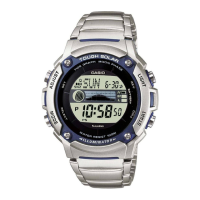
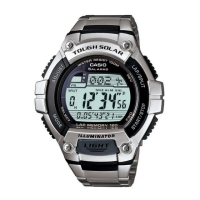
Operation Guide 3215 3222
MO1302-EB
E-1
Getting Acquainted
Congratulations upon your selection of this CASIO watch. To get the most out of your
purchase, be sure to read this manual carefully.
Warning!
• The measurement functions built into this watch are not intended for taking
measurements that require professional or industrial precision. Values produced
by this watch should be considered as reasonable representations only.
• The Moon phase indicator and tide graph data that appear on the display of this
watch are not intended for navigation purposes. Always use proper instruments
and resources to obtain data for navigation purposes.
• This watch is not an instrument for calculating low tide and high tide times. The
tide graph of this watch is intended to provide a reasonable approximation of
tidal movements only.
• Note that CASIO COMPUTER CO., LTD. assumes no responsibility for any
damage or loss suffered by you or any third party arising through the use of this
product or its malfunction.
E-2
Keep the watch exposed to bright light
The electricity generated by the solar cell of the watch is
stored by a rechargeable battery. Leaving or using the
watch where it is not exposed to light causes the battery
to run down. Make sure the watch is exposed to light as
much as possible.
• When you are not wearing the watch on your wrist,
position the face so it is pointed at a source of bright
light.
• You should try to keep the watch outside of your sleeve
as much as possible. Charging is reduced significantly if
the face is covered only partially.
l
l
l
l
l
l
l
l
l
l
l
Bright Light
Solar cell
E-3
Battery charges in the light. Battery discharges in the dark.
• The watch continues to operate, even when it is not exposed to light. Leaving the
watch in the dark can cause the battery to run down, which will result in some watch
functions to be disabled. If the battery goes dead, you will have to re-configure watch
settings after recharging. To ensure normal watch operation, be sure to keep it
exposed to light as much as possible.
All
functions
enabled
LEVEL 1
LEVEL 2
LEVEL 3
LEVEL 4
Charge
Rechargeable battery
Bright Light
Electrical
energy
Solar cell
(Converts light to
electrical power.)
Some or all
functions
disabled
LEVEL 1
LEVEL 2
LEVEL 3
LEVEL 4
Dis-
charge
E-4
• The actual level at which some functions are disabled depends on the watch model.
• Frequent display illumination can run down the battery quickly and require charging.
The following guidelines give an idea of the charging time required to recover from a
single illumination operation.
Approximately 5 minutes exposure to bright sunlight coming in through a window
Approximately about 8 hours exposure to indoor fluorescent lighting
• Be sure to read “Power Supply” (page E-59) for important information you
need to know when exposing the watch to bright light.
If the display of the watch is blank...
If the display of the watch is blank, it means that the watch’s Power Saving function
has turned off the display to conserve power.
• See “Power Saving Function” (page E-85) for more information.
E-5
About This Manual
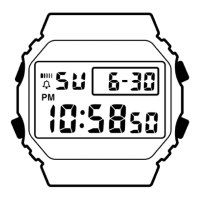
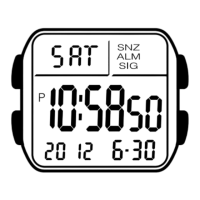
• Depending on the model of your watch, display text appears either as dark figures
on a light background (Module 3215), or light figures on a dark background (Module
3222). All of the illustrations in this manual show Module 3215.
• Button operations are indicated using the letters shown in the illustration.
• Each section of this manual provides you with the information you need to perform
operations in each mode. Further details and technical information can be found in
the “Reference” section.
Module 3215 Module 3222
E-6
Contents
General Guide ....................................................................................................... E-10
Radio-controlled Atomic Timekeeping ............................................................... E-12
Tide/Moon Data ..................................................................................................... E-34
World Time ............................................................................................................. E-41
Alarms .................................................................................................................... E-44
Stopwatch .............................................................................................................. E-49
Countdown Timer .................................................................................................. E-51
Illumination ............................................................................................................ E-55
Power Supply ........................................................................................................ E-59
Timekeeping .......................................................................................................... E-67
Tide Site Name ...................................................................................................... E-75
Reference .............................................................................................................. E-78
Specifications ....................................................................................................... E-93
E-7
Procedure Lookup
The following is a handy reference list of all the operational procedures contained in
this manual.
To specify your Home City ................................................................................... E-13
To perform manual receive .................................................................................. E-27
To turn auto receive on and off ........................................................................... E-29
To check the latest signal reception results ...................................................... E-30
To adjust the high tide time ................................................................................. E-38
To reverse the displayed Moon phase ................................................................ E-40
To view the time in another city ........................................................................... E-42
To toggle a city code time between Standard Time and
Daylight Saving Time ...................................................................................... E-43
E-8
To set an alarm time ............................................................................................. E-45
To test the alarm ................................................................................................... E-46
To turn an alarm on and off .................................................................................. E-47
To turn the Hourly Time Signal on and off .......................................................... E-48
To measure times with the stopwatch ................................................................ E-50
To configure the countdown timer ...................................................................... E-52
To use the countdown timer ................................................................................ E-54
To illuminate the display manually ...................................................................... E-55
To specify the illumination duration ................................................................... E-56
To turn the auto light switch on and off .............................................................. E-58
To set the time and date manually ...................................................................... E-68
E-9
To change the Daylight Saving Time (summer time) setting ............................ E-73
To configure tide site settings ............................................................................. E-75
To turn the button operation tone on and off ..................................................... E-84
To recover from the sleep state ........................................................................... E-86
To turn Power Saving on and off ......................................................................... E-86

 Need help?

 To Next Page
 General