Need help?
Do you have a question about the Casio DS-1L and is the answer not in the manual?
Details the functions of key buttons like Sign Change, Right Shift, Time Key, Rounding Selector, Decimal Place Selector.
Explains how to input time values and switch between decimal and sexagesimal formats.
Describes F (floating), CUT, UP, and 5/4 rounding methods for decimal places.
Specifies the number of decimal places for rounding, valid for CUT, UP, 5/4 settings.
Explains how to use the Grand Total Memory selector (ON/OFF) to add results to memory.
Details the various indicators and symbols shown on the calculator display.
Details the calculator's power source: solar cell and CR2025 lithium battery.
Advises on when and how to replace the battery, recommending authorized service.
Explains the automatic power-off feature to conserve battery life.
Methods for clearing current input, digit-by-digit shifts, and entire calculations.
Precautions against heat, cold, moisture, dust, dropping, bending, and improper cleaning.
Instructions on not disassembling, using sharp objects on keys, and cleaning procedures.
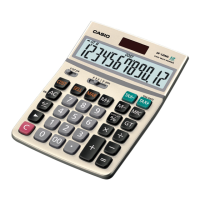
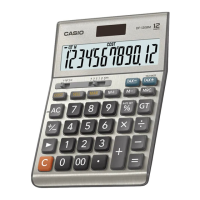
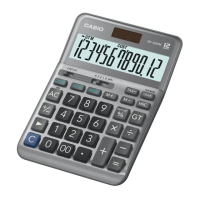
The Casio DS-1L/2L/3L is a robust desktop calculator designed for a variety of mathematical operations, featuring a two-way power system and a comprehensive set of functions for precise calculations. Its core functionality revolves around basic arithmetic, but it extends to more specialized features like rounding, time calculations, and memory functions, making it suitable for both general and professional use.
The calculator offers standard arithmetic operations (addition, subtraction, multiplication, division) and includes dedicated keys for efficiency. The "Sign Change Key" allows users to switch the sign of the displayed value between positive and negative, which is useful for calculations involving negative numbers or for correcting input. The "Right Shift Key" provides a convenient way to edit input by shifting the displayed value to the right and deleting the far-right digit, enabling quick corrections without re-entering the entire number.
A key feature is its "Rounding Selector," which offers multiple rounding systems. Users can choose between "Floating decimal point system" (F), which displays values without rounding, "CUT" (cuts off decimals), "UP" (rounds up decimals), and "5/4" (rounds off decimals). The "Decimal Place Selector" complements this by allowing users to specify the number of decimal places (0, 1, 2, 3, or 4) for rounding, providing precise control over the output format. This is particularly useful in financial or scientific contexts where specific decimal precision is required.
The "Add Mode" (ADD2) is a specialized feature that automatically adds a decimal point and two decimal places to all values, even if not explicitly input. This mode is highly beneficial for calculations involving currency or other monetary systems that typically require two decimal places. However, it's important to note that this mode does not apply if the decimal point key is pressed during input or for operations other than addition and subtraction.
The calculator also incorporates "Grand Total Memory" functionality, controlled by the GT-OFF/ON selector. When set to ON, the result of each calculation is automatically added to the grand total memory, facilitating cumulative calculations. When OFF, the result is not added to the grand total. This feature is useful for summing up multiple individual results without manual accumulation.
The display provides clear indicators for various statuses, including a 3-digit separator ('), a seconds indicator ("), and specific indicators for Grand Total (GT), Independent Memory (M), Error (E), Negative value (-), Constant calculation (K), and arithmetic operations (+, -, ×, ÷). These indicators help users monitor the calculator's state and the nature of the ongoing calculation.
Error handling is built into the system. An "E" indicator appears on the display if the integer part of an intermediate or final result exceeds the digit capacity (14 digits for DS-3L, 12 for DS-2L, 10 for DS-1L), if independent or grand total memory overflows, if division by zero is attempted, if profit in a mark-up calculation reaches 100%, or if a square root of a negative value is calculated. To clear an error, users can press C to clear the error and continue, or AC to clear the entire calculation.
The calculator is designed for user-friendly operation with clear key functions and display indicators. Correcting input errors is straightforward: pressing C clears the last input value, while the right shift key allows for digit-by-digit correction. For time calculations, if an incorrect hour, minute, or second is entered before pressing the HMS key, simply input the correct values. If an error occurs after pressing HMS, pressing C clears the time input, allowing the user to start over. Similarly, if a wrong arithmetic operation key is pressed, simply press the correct key before any further input.
Clearing calculations is managed by two main functions: AC clears the entire calculator (except independent memory), and MC clears only the independent memory. This distinction allows users to reset specific parts of the calculator without losing important stored values.
The Casio DS-1L/2L/3L features a "Two-Way Power System," utilizing both a solar cell and one CR2025 lithium battery. This ensures reliable operation under various lighting conditions. Unlike solar-only calculators, it can function even in dim light as long as there's enough light to read the display.
Battery replacement is recommended by an authorized CASIO dealer or service center, rather than attempting it oneself. The display becoming dim or difficult to read, or the calculator failing to power on (especially in dim lighting), indicates a need for battery replacement. It's advised to replace the battery at least once every seven years, regardless of usage frequency, as the factory-installed battery may discharge during shipment and storage, potentially requiring earlier replacement. A dead battery left in the compartment for extended periods can leak and damage the calculator. Even with a dead battery, the calculator can still operate on solar power, though memory contents will be cleared if available light drops below a certain level without battery power.
The calculator includes an "Auto Power Off Function" to conserve power. It automatically switches off approximately six minutes after the last key operation. To restore power, users simply press the ON key. Importantly, even if the auto power off function clears general memory, the contents of the independent memory are retained.
For cleaning, the exterior should be wiped with a soft cloth dampened in a weak solution of a mild neutral detergent and water. It's crucial to wring out any excess moisture from the cloth before wiping. Benzene, thinner, or other volatile agents should not be used, as they can damage the printed figures on the case or its finish.
Important precautions include avoiding direct flame, extreme temperatures (direct sunlight, near heaters), excessive moisture, dirt, and dust. Dropping, bending, twisting, or attempting to disassemble the calculator should be avoided. Users should also refrain from using sharp objects to press keys. These measures help ensure the longevity and proper functioning of the device.
 General
| Display | LCD |
|---|---|
| Display Digits | 8 digits |
| Type | Basic |
| Functions | Basic arithmetic, square root |
| Power Source | Solar and Battery |
| Key Features | large display, dual power |


 To Next Page