49
Another way to reduce vibration is with the Vibration Suppression Pads (#93503). These pads rest between the ground and
tripod feet. They reduce the vibration amplitude and vibration time.
CCD Imaging
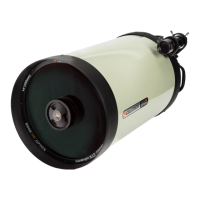
SCT telescope's versatility allows it to be used in many different f-number configurations for CCD imaging. It can be used
at f/6.3 (with the optional Reducer/Corrector), f/10, and f/20 (with the optional 2x Barlow) making it the most versatile
imaging system available today. This makes the system ideal for imaging deep-sky objects as well as planetary detail.
The key factors for good CCD imaging are; exposure time, field-of-view, image size, and pixel resolution. As the F/# goes
down (or gets faster), the exposure times needed decreases, the field-of-view-increases, but the image scale of the object gets
smaller. What is the difference between f/6.3 and f/10? F/6.3 has about 2/3 the focal length of f/10. That makes the exposure
time needed about 2.5 times shorter than at f/10, the field of view 50% larger compared to that of f/10. (see Table below)
Telescope
Model
Standard
Cassegrain f/10
With
Reducer/Corrector
f/6.3
Focal
Length &
Speed
C8
80" (2032mm) 50.4" (1280mm)
C9.25
93" (2350mm) 58" (1481mm)
C11
110" (2800mm) 69" (1764mm)
Auto Guiding
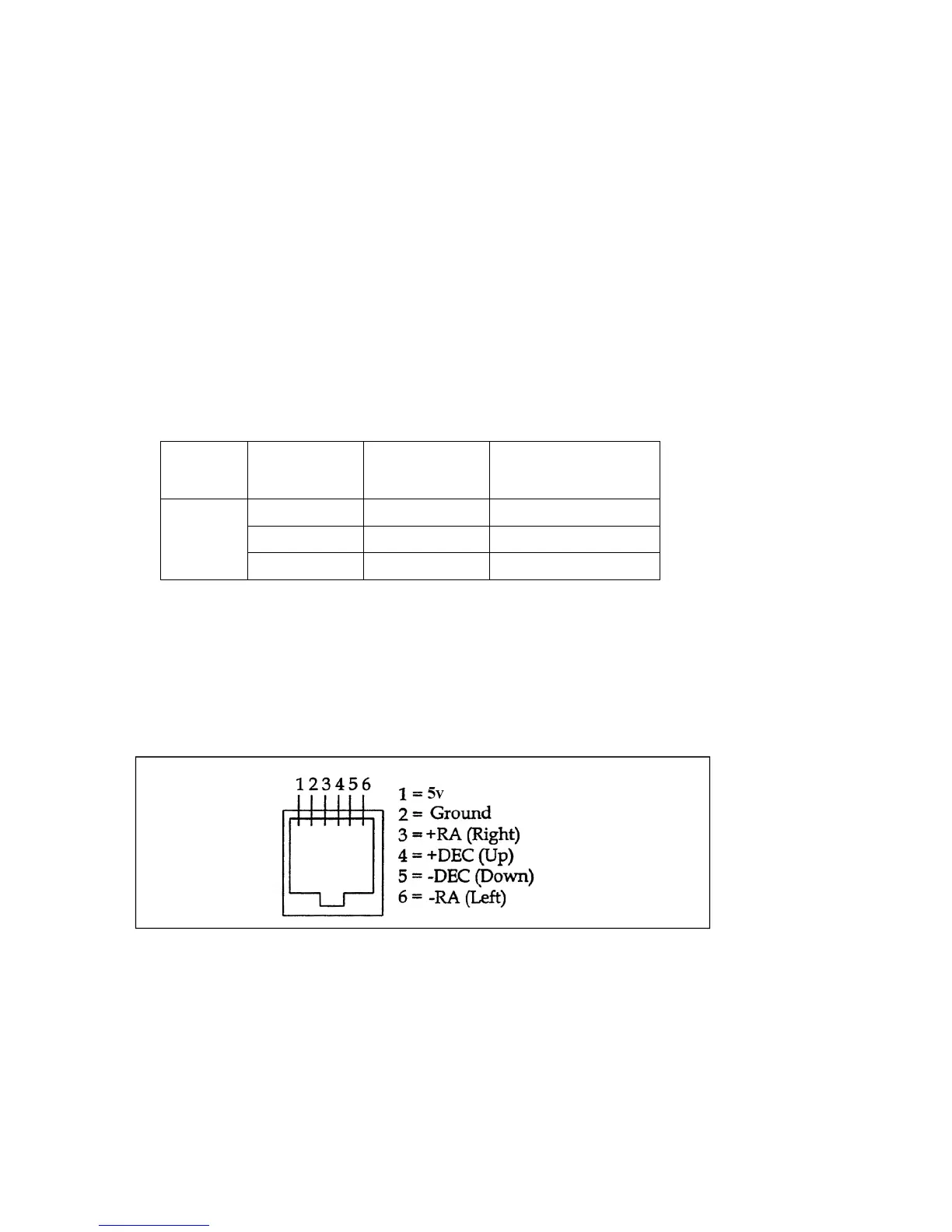
The CGEM mount has a designated auto guiding port for use with a CCD autoguider. The diagram below may be useful
when connecting the CCD camera cable to the telescope and calibrating the autoguider. Note that the four outputs are active-
low, with internal pull-ups and are capable of sinking 25 mA DC.
Table 7-3


 To Next Page