BIO X6 User Manual v. 1.0 54
This setup, is a general setup for all types of layers, but not for individual set of layers
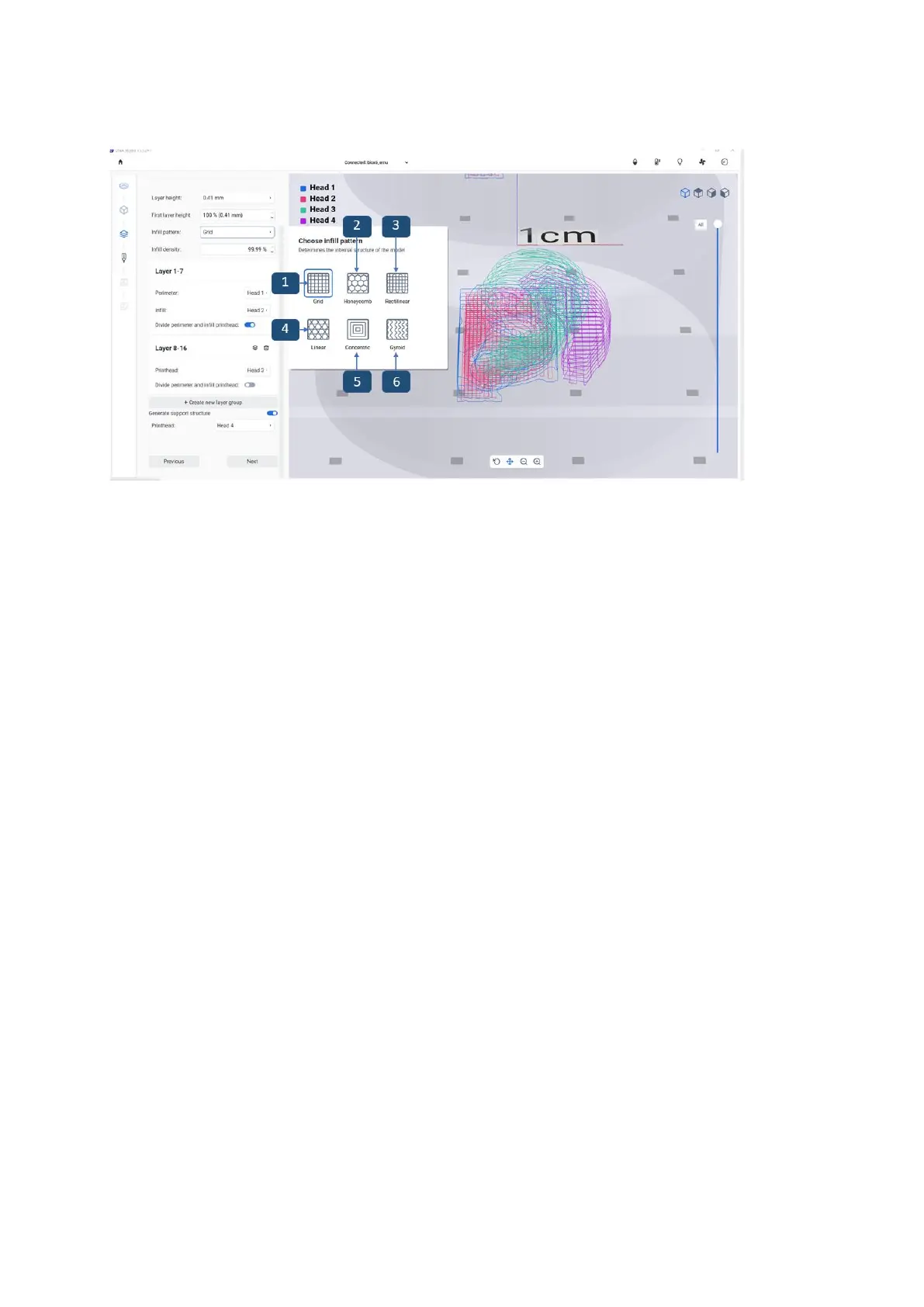
1. Grid: The grid pattern is a suitable infill for tissue constructs with isotropic mechanical
characteristics. This infill pattern is consistent across adjacent layers, resulting in solid
walls between the pores and good compressive strength. This pattern is most
applicable for tissues like bone and cartilage. It can also generate constructs with
porosity to allow diffusion of nutrients or filling with other bioinks or materials.
2. Honeycomb: The honeycomb pattern is suitable for constructs with isotropic
mechanical characteristics. This infill pattern is consistent across adjacent layers,
resulting in solid walls between the neighbouring pores with good compressive
strength. This pattern is most applicable for tissues like bone and cartilage. This
pattern can also generate constructs that contain porosity to allow diffusion of
nutrients or filling with other bioinks or materials.
3. Rectilinear: The rectilinear pattern is a suitable infill for tissue constructs with
isotropic mechanical characteristics. This pattern is most applicable for tissues like
skin, fascia, and cartilage. This infill pattern changes the fill angle by 90 degrees
based on the layer.
4. Linear: The linear pattern is similar to the rectilinear except shifted by 45 degrees
instead of 90 degrees from layer to layer. This pattern is suitable for fibers and
striated tissues. It can also generate constructs that contain porosity to allow diffusion
of nutrients or filling with other bioinks or materials.


 To Next Page
 Loading...