EasyManua.ls Logo

Cessna 152 - Page 127

Cessna 152
234 pages
Print Icon
To Next Page IconTo Next Page
To Previous Page IconTo Previous Page
Loading...
CESSNA
MODEL 152
SECTION7
AIRPLANE
&
SYSTEMS
DESCRIPTIONS
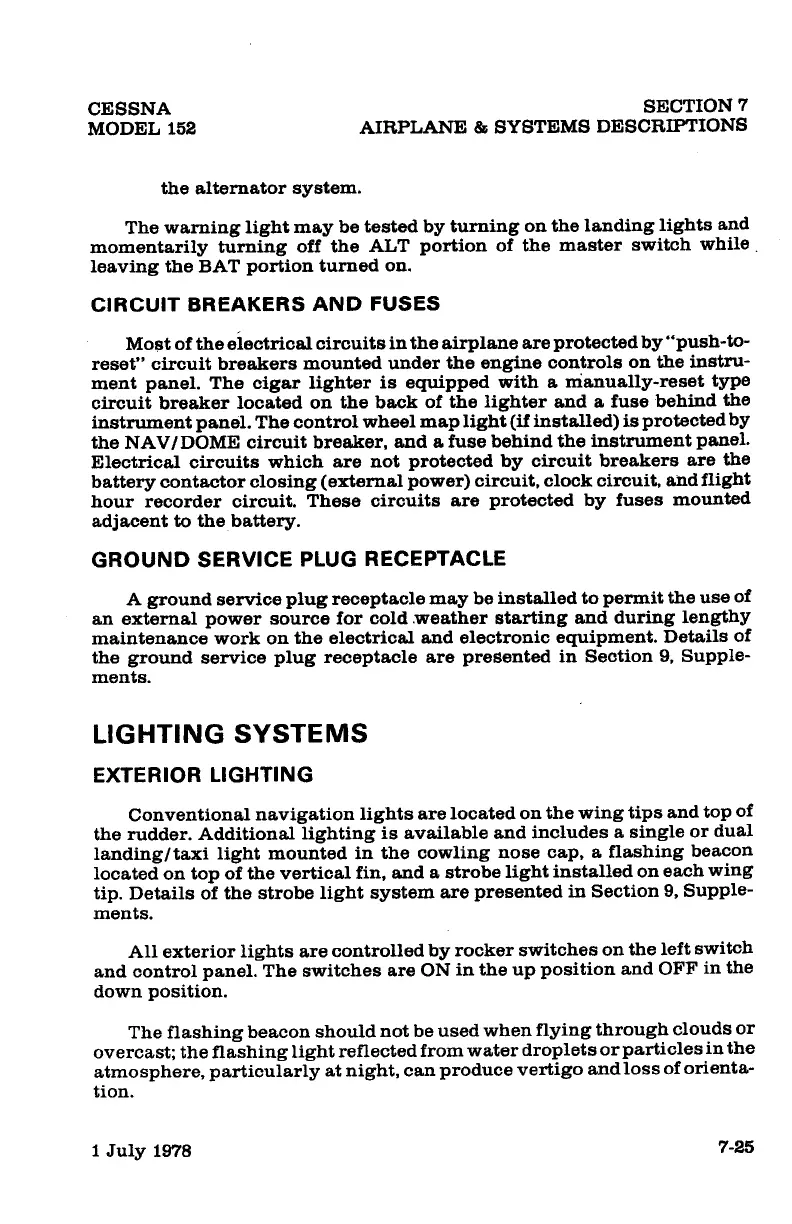
the
alternator
system.
The
warning
light
may
be
tested
by
turning
on
the
landing
lights
and
momentarily
turning
off
the
ALT
portion
of
the
master
switch
while.
leaving
the
BAT
portion
turned
on.
CIRCUIT BREAKERS
AND
FUSES
Most
of
the
electrica.l
circuits
in
the
airplane
are
protected
by
"push-to-
reset"
circuit
breakers
mounted
under
the
engine
controls
on
the
instru-
ment
panel.
The
cigar
lighter
is
equipped
with
a
manually-reset
type
circuit
breaker
located
on
the
back
of
the
lighter
and
a
fuse
behind
the
instrument
panel.
The
control
wheel
map
light
(if
insta.lled)
is
protected
by
the
NAV
/DOME
circuit
breaker,
and
a
fuse
behind
the
instrument
panel.
Electrica.l
circuits
which
are
not
protected
by
circuit
breakers
are
the
battery
contaotor
closing
(
externa.l
power)
circuit,
clock
circuit,
and
flight
hour
recorder
circuit.
These
circuits
are
protected
by
fuses
mounted
adjacent
to
the
battery.
GROUND
SERVICE PLUG RECEPTACLE
A
ground
service
plug
receptacle
may
be
insta.lled
to
permit
the
use
of
an
external
power
source
for
cold
.weather
starting
and
during
lengthy
maintenance
work
on
the
electrica.l
and
electronic
equipment.
Details
of
the
ground
service
plug
receptacle
are
presented
in
Section
9,
Supple-
ments.
LIGHTING
SYSTEMS
EXTERIOR LIGHTING
Conventional
navigation
lights
are
located
on
the
wing
tips
and
top
of
the
rudder.
Additional
lighting
is
available
and
includes
a
single
or
dual
landing/taxi
light
mounted
in
the
cowling
nose
cap,
a
flashing
beacon
located
on
top
of
the
vertical
fin,
and
a
strobe
light
installed
on
each
wing
tip.
Details
of
the
strobe
light
system
a.re
presented
in
Section
9,
Supple-
ments.
All
exterior
lights
are
controlled
by
rocker
switches
on
the
left
switch
and
control
panel.
The
switches
are
ON
in
the
up
position
and
OFF
in
the
down
position.
The
flashing
beacon
should
not
be
used
when
flying
through
clouds
or
overcast;
the
flashing
light
reflected
from
water
droplets
or
particles
in
the
atmosphere,
particularly
at
night,
can
produce
vertigo
and
loss
of
orienta-
tion.
1
July
1978
7-25

Other manuals for Cessna 152

Related product manuals