EasyManua.ls Logo

Cessna 152 - Page 54

Cessna 152
234 pages
Print Icon
To Next Page IconTo Next Page
To Previous Page IconTo Previous Page
Loading...
SECTION4
NORMAL
PROCEDURES
CESSNA
MODEL 152
within
a.
needle
width
of
its
initial
position
if
the
a.lterna.tor
and
alternator
control
unit
are
operating
properly.
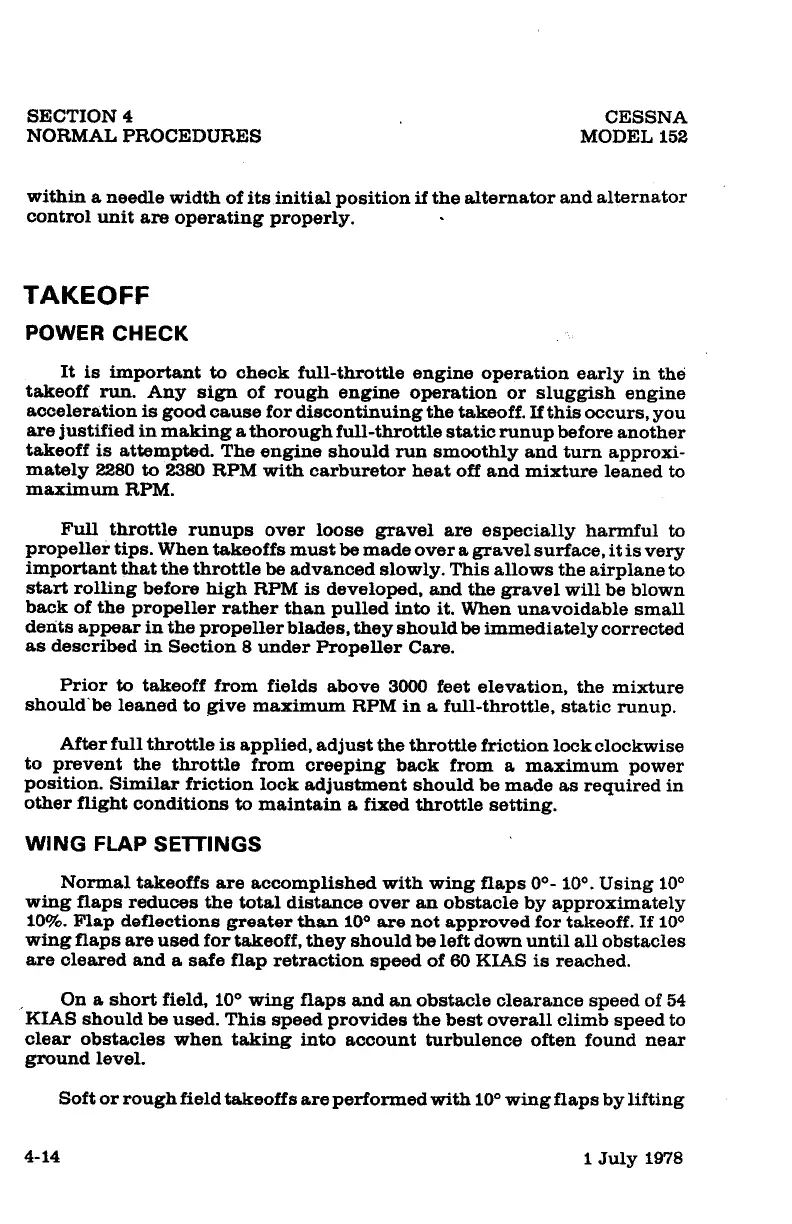
TAKEOFF
POWER CHECK
It
is
important
to
check
full-throttle
engine
operation
early
in
the
takeoff
run.
Any
sign
of
rough
engine
operation
or
sluggish
engine
a.ccelera.tion
is
good
ca.use
for
discontinuing
the
takeoff.
If
this
occurs,
you
a.re
justified
in
ma.king
a.
thorough
full-throttle
static
runup
before
another
takeoff
is
attempted.
The
engine
should
run
smoothly
and
turn
approxi-
mately
2280
to
2380
RPM
with
carburetor
heat
off
and
mixture
leaned
to
maximum
RPM.
Full
throttle
runups
over
loose
gravel
a.re
especially
harmful
to
propeller
tips.
When
takeoffs
must
be
ma.de
over
a.
gravel
surface,
it
is
very
important
that
the
throttle
be
advanced
slowly.
This
allows
the
airplane
to
start
rolling
before
high
RPM
is
developed,
and
the
gravel
will
be
blown
back
of
the
propeller
rather
than
pulled
into
it.
When
unavoidable
small
dents
appear
in
the
propeller
blades,
they
should
be
immediately
corrected
as
described
in
Section
8
under
Propeller
Ca.re.
Prior
to
takeoff
from
fields
above
3000
feet
elevation,
the
mixture
should'be
leaned
to
give
maximum
RPM
in
a.
full-throttle,
static
runup.
After
full
throttle
is
applied,
adjust
the
throttle
friction
lock
clockwise
to
prevent
the
throttle
from
creeping
back
from
a.
maximum
power
position.
Similar
friction
lock
adjustment
should
be
made
as
required
in
other
flight
conditions
to
maintain
a
fixed
throttle
setting.
WING FLAP SETTINGS
Normal
takeoffs
are
accomplished
with
wing
flaps
0°- 10°.
Using
10°
wing
flaps
reduces
the
total
distance
over
an
obstacle
by
approximately
10%.
Flap
deflections
greater
than
10° a.re
not
approved
for
takeoff.
If
10°
wing
flaps
are
used
for
takeoff,
they
should
be
left
down
until
all
obstacles
a.re
cleared
and
a
safe
flap
retraction
speed
of
60
KIAS
is
reached.
On
a
short
field, 10°
wing
flaps
and
an
obstacle
clearance
speed
of
54
KIAS
should
be
used.
This
speed
provides
the
best
overall
climb
speed
to
clear
obstacles
when
ta.king
into
account
turbulence
often
found
near
ground
level.
Soft
or
rough
field
takeoffs
are
performed
with
10°
wing
flaps
by
lifting
4-14
1
July
1978

Other manuals for Cessna 152

Related product manuals