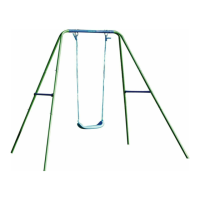
Chad Valley Multi-Stage Swing
The Chad Valley Multi-Stage Swing is a versatile and adaptable outdoor play equipment designed to grow with your child, accommodating ages from 9 months up to 5 years and beyond. This swing is intended for domestic and outdoor use, offering a safe and enjoyable swinging experience for various developmental stages.
Function Description
The Multi-Stage Swing is designed to provide a secure and comfortable swinging experience for children across four distinct stages, adapting to their size and developmental needs. The primary function is to allow children to swing safely, promoting physical activity and outdoor play. Its multi-stage design means that as a child grows, parts of the swing can be removed or adjusted to suit their increasing independence and size.
Stage 1: For ages 9-18 months. In this stage, the swing provides maximum support and security for infants, likely featuring a full enclosure and safety harness to keep the child safely contained.
Stage 2: For ages 18-36 months. As the child grows, the swing continues to offer significant support, but may allow for slightly more freedom of movement while still ensuring safety.
Stage 3: For ages 3-5 years. At this stage, the swing transitions to accommodate toddlers and preschoolers. The manual specifically mentions that for stages 3 or 4, disconnecting the "T-Bar" should only occur when the child is not seated, indicating that the T-Bar is a key safety feature for younger users.
Stage 4: For ages 5 years and up. This final stage provides a more open swing seat suitable for older children, offering a traditional swinging experience.
The swing's height is adjustable, allowing it to be set appropriately for the youngest user's dimensions and the specific installation environment.
Important Technical Specifications
- Age Range: 9+ months (specifically broken down into 9-18 months, 18-36 months, 3-5 years, and 5 years and up).
- Maximum Load: 30 kg.
- Suspension System: The swing is suspended by ropes that connect to a hanging point via a metal "8" buckle. The ropes form a double loop for adjustment.
- Swing Seat Dimensions (approximate):
- Width: 40 cm
- Depth: 31 cm
- Backrest Height: 45 cm
- Installation Requirements:
- Clearance: At least 2 meters from any structure or obstruction (fence, garage, house, overhanging branches, laundry lines, electrical wires).
- Minimum Clearance (multiple swings/adjacent structures): Not less than 30 cm.
- Minimum Clearance (swing/single suspension point members): Not less than 45 cm.
- Swing Base Height: Must be suspended at least 35 cm from ground level.
- Maximum Reachable Height of Structure: Should not exceed 2.5 meters from the ground.
- Recommended Height of Structure: 2.2 meters from the ground.
- Lateral Stability: The swing should be suspended at points separated by a minimum distance calculated as: (0.04 x the height of suspension from ground) + the width of suspension at the seat (37 cm).
- Ground Surface: Must be installed over soft ground (e.g., not concrete or tarmac).
- Safety Belt: Essential for stages 1, 2, and 3. The belt buckle must be carefully adjusted and locked, and its free end secured with the plastic ring.
- T-Bar: A safety feature for younger stages (3 and 4), which should only be disconnected when the child is not seated. Release levers must be fully locked when the child is seated.
Usage Features
Rope Adjustment:
The swing height is adjusted by changing the size of the rope's double loop. This is achieved by pulling the rope through the metal "8" buckle.
- To increase swing height (for a higher swing), the rope's double loop should be made as large as possible.
- To decrease swing height (for a low height), the rope should be pulled to make the double loop as small as possible.
- After adjustment, it is crucial to ensure the swing is leveled.
- Always set the swing's height according to the youngest user's dimensions.
Multi-Stage Adaptation:
The swing's design allows for easy adaptation between stages. The manual indicates that components like the "T-Bar" can be removed for older children. The release mechanism for certain parts involves pushing up and in, or pushing down and in, suggesting a secure yet user-friendly system for reconfiguring the swing.
Safety Precautions:
- Always ensure the swing is properly installed by an adult according to the instructions before use.
- Children should be dressed appropriately; avoid loose-fitting clothing like ponchos or scarves that could pose a hazard.
- Only one child should be on the Multi-Stage swing at a time.
- Never leave a child unattended while on the swing.
- For stages 3 or 4, the "T-Bar" should only be disconnected when the child is not seated. When the child is seated, ensure the release levers are fully locked.
- For stages 1, 2, and 3, carefully adjust and buckle the safety belt, securing the belt's free end with the plastic ring once locked.
Maintenance Features
Regular maintenance is crucial to ensure the safety and longevity of the Multi-Stage Swing.
- Seasonal Checks: At the beginning of each season, inspect the swing seat, ropes, and other attachment points for any signs of deterioration. This includes checking for wear, fraying, or damage that could compromise the swing's integrity.
- Fastener Checks: Regularly check all nuts and bolts for tightness. Loose fasteners can lead to instability or failure.
- Suspension Point Checks: Conduct regular checks of the main suspension points to ensure they are secure and free from damage.
- Covering Checks: Inspect all coverings for both bolts and sharp edges. Replace any coverings that are damaged or missing to prevent injuries.
- Modifications: Any changes to the original swing, such as adding an accessory, must be carried out strictly according to the instructions provided by the retailer or manufacturer. Unauthorized modifications could compromise the swing's safety and structural integrity.
- Part Replacement: Replace any worn or damaged parts as required, in accordance with the manufacturer's instructions, to maintain the swing's safety standards.
The product is produced for Chad Valley Toys, with its country of origin being Israel. For any assistance, damaged, or missing parts, customers are advised to contact the Customer Helpline at 01291 650581.

 Need help?
 General

 To Next Page