
 Need help?
Do you have a question about the Chaffoteaux & Maury System plus FF and is the answer not in the manual?
Detailed identification of boiler parts, heat exchangers, and control unit components.
Provides physical dimensions, weight, and packaging details of the boiler.
Details pressure available, minimum flow rate, and water content diagrams.
Outlines statutory requirements for private and public building installations.
Covers optimal boiler placement, wall mounting, and circuit design for DHW and heating.
Details coaxial outlet configurations, restrictor usage, and length limits.
Explains twin flow flue connections, assembly, and specific installation requirements.
Summarizes flue duct lengths, restrictor usage, and installation rules for various flue types.
Step-by-step guide for mounting and installing the boiler on the wall.
Instructions for cleaning the boiler after installation and maintaining system pH.
Covers regulatory requirements and placement for electrical connections and thermostats.
Illustrates wiring configurations for System and System Plus models, including programmer connection.
Guides on filling the heating circuit, checking gas lines, and pressurization.
Explains how to adjust various operating parameters and potentiometers for optimal performance.
Details the default settings for various operating parameters as configured from the factory.
Provides guidance on adjusting burner gas output for different boiler models.
Step-by-step instructions for attaching and securing the boiler casing, including locking screws.
Explains how to convert the boiler for different gas types and adjust the gas valve.
Details procedures for adjusting nominal and minimum gas outputs for various models.
Lists fault codes, their causes, and associated information for troubleshooting.
Illustrates the correct assembly direction for the by-pass valve.
Identifies and explains the functions of buttons, knobs, and indicators on the control panel.
Identifies and explains the function of various taps and valves on the boiler.
Guides on how to start, operate, and stop the boiler for heating and hot water.
Details the steps for safely shutting down the boiler completely.
Emphasizes the legal requirement for annual servicing by a qualified professional.
Explains the operation of the flue gas safety device and warnings against tampering.
Outlines warranty terms, installation requirements, and availability of a free first inspection.
Provides solutions for common operational issues like no start, red light, or system noises.
Comprehensive technical data including power, flow rates, electrical, and gas specifications.
This document describes the Mira System FF & System plus FF, which are combination boilers designed for both heating-only (system) and heating plus sanitary hot water (system plus) applications. These boilers feature a fanned flue system and are accompanied by an installation and operating manual.
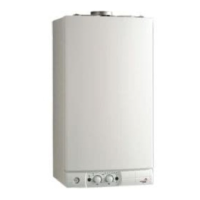
The boiler's construction includes a sheet steel frame with an expansion vessel, a sealed casing, and a hood with an extractor fan. At its core is a copper main heat exchanger and a combustion chamber housing a multigas burner. The burner assembly comprises a removable injector manifold, an ignition electrode, and a flame detection electrode. Gas flow is managed by a gas valve assembly, which includes two safety solenoid valves and a control solenoid valve. An automatic vent is integrated with the circulating pump. For temperature regulation, the boiler uses an overheat sensor, a main heat exchanger inlet thermistor, and a main heat exchanger outlet thermistor. An electronic control unit oversees the boiler's operations, while a flue gas pressure control switch ensures safety. Ignition is handled by an ignitor, and a central heating pressure relief valve is included for safety.
The control panel provides essential user interaction points. A heating circuit pressure gauge displays the system pressure. An ON/OFF push button with an indicator light controls the boiler's power. For sanitary hot water, a start button and tank temperature setting button are available. The heating function has its own ON/OFF control and a heating temperature adjustment knob. An indicator light displays heating temperature and operating faults, while an orange light indicates burner operation. A reset push button with a red locking indicator light is provided for fault clearance.
Installation requires careful attention to regulations and specific requirements. The boiler should be placed on a wall capable of supporting its weight (approximately 35 kg). It is crucial to ensure that the gas intake and exhaust passages are not blocked and that the exhaust gas ducts do not leak. The flue device must be fitted according to the chosen connection type, with options for coaxial or twin flow systems. For coaxial outlets, restrictors may be required depending on the boiler's power and the length of the duct. Twin flow systems involve an adaptor on the outlet header and specific assembly steps for the air intake tube. Electrical connections must comply with regulations, including the installation of an all-pole isolating device. A room thermostat can be connected, and the boiler is supplied with a shunt for operation without one.
Before operation, the heating circuit and tank must be pressurized. This involves opening cold water, heating flow, heating backflow, and tank backflow taps, then filling the system until the pressure gauge indicates the specified pressure. The gas circuit also needs to be flushed and checked for leaks. The boiler is supplied with factory settings, but adjustments can be made to the anti-cycle time, pump speed, heating temperature, and operating mode. Potentiometers are available for reducing heating power and adjusting ignition power.
For domestic hot water, the system plus model allows preheating the sanitary tank and adjusting its temperature. The heating function can be authorized and its temperature adjusted according to seasonal requirements. If a room thermostat is installed, it should be set to the desired indoor temperature. The orange indicator light illuminates when the burner ignites. To stop heating, the heating knob can be set to the OFF position, leaving the boiler to produce only hot water. The boiler can be completely turned off by pressing the ON/OFF button and shutting off the electricity and gas supplies.
Maintenance is crucial for the boiler's longevity and safe operation. Current legislation mandates an annual service by a qualified professional. The boiler is equipped with a flue gas extraction flow detection system, which shuts down the burner for safety if the flow is insufficient. This device should never be disconnected or tampered with, and only original parts should be used for replacement. The boiler also features a pump degumming system, which activates the circulating pump for one minute after 23 hours of inactivity to prevent sticking.
In freezing conditions, precautions are necessary. Options include draining the heating circuit, using an antifreeze product, or allowing the installation to run at low load with the room thermostat set to an antifreeze position (between 5 and 10°C). Leaving the power on also activates an antifreeze device that engages the circulation pump and burner.
Operating faults are indicated by flashing LEDs on the control panel. Common issues include overheating, ignition faults, water circulation problems, sensor failures, wiring faults, and extraction flow issues. If the boiler fails to start, checks should be made for gas, water, and electricity supply, as well as the room thermostat setting. If a red indicator light is on, pressing the reset button may clear the fault. Persistent issues or noises in the central heating system, such as air presence or insufficient pressure, require purging air from the system and re-establishing pressure. If these actions are unsuccessful, a qualified professional should be contacted.
 General
| Fuel Type | Gas |
|---|---|
| Mounting | Wall |
| Fuel | Natural gas / LPG |
| Output | 24 kW |
| Central Heating Flow Rate | Variable, depending on model and settings |


 To Next Page