Need help?
Do you have a question about the Challenge M1Q-DD7-65 and is the answer not in the manual?
Keep work area clean and well lit; do not operate in explosive atmospheres; keep bystanders away.
Match plugs to outlets, avoid body contact with grounded surfaces, do not expose to rain or wet conditions.
Stay alert, use PPE, prevent unintentional starting, remove adjusting keys, do not overreach, dress properly.
Do not force the tool, use correctly, disconnect before adjustments, store safely, maintain tools, keep cutting tools sharp.
Have tool serviced by qualified person, use identical replacement parts, ensure cord replacement avoids hazards.
Specific safety rules for operating the jigsaw, including PPE, work practices, electrical safety, and handling.
Always wear safety glasses, dust masks, and hearing protection as required.
Secure workpiece, keep hands clear, use sharp blades, disconnect power before adjustments, avoid side pressure.
Use correct extension cords, unwind them fully, and ensure mains voltage matches tool rating.
Hold by insulated surfaces, check for hidden wires, do not clamp the tool itself.
Check cutting lines for obstructions, check walls/floors for cables/pipes, hold blade foot firmly.
Withdraw blade only when stopped, clamp workpiece, avoid prolonged low-speed use if tool overheats.
Explanation of symbols related to manual reading, warnings, insulation, and PPE.
Identification of lock button, on/off switch, speed dial, and pendulum switch.
Identification of dust cover, saw blade, inclination guide, base plate, blade holder, dust outlet, and hex key.
Details voltage, power, speed, cutting capacity, bevel, pendulum position, and protection class.
Provides noise emission levels and measured vibration values, including warnings.
Lists included accessories and advises on purchasing quality accessories.
Details intended applications, fitting the saw blade, and setting the cutting angle.
Instructions for switching the tool on/off and adjusting the cutting speed using the dial.
Guide to pendulum settings and general operation for standard, bevel, and metal cuts.
Advice on preventing movement, using coolant, making test cuts, and positioning the tool.
Advice on sawing pressure, using guides, and cooling the motor when it overheats.
Safety precautions, cleaning steps, lubrication, and water contact warning.
Addresses no power, loose blade, and cutting straightness problems with suggested fixes.
Instructions for replacing the power tool's plug, including wire connection details.
Notes on safe disposal of moulded plugs and cable, and replacement of damaged supply cords.
Details proper disposal of electrical waste and the product's warranty terms.
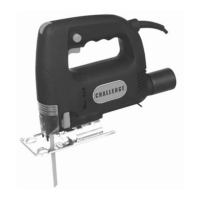
This document describes the Challenge 650W Jigsaw, model M1Q-DD7-65, providing comprehensive instructions for its safe operation, maintenance, and general use. The jigsaw is designed for sawing wood, plastic, metal, and building materials, offering versatility for both straight and curved cuts. It is a hand-held power tool, and users are explicitly warned against clamping it.
The Challenge 650W Jigsaw is an electric power tool primarily used for cutting various materials. Its core function involves a reciprocating saw blade that moves rapidly to create cuts. The device features a 650W motor, allowing it to handle a range of materials. Key components include an on/off switch, a lock button for continuous operation, a variable speed control dial, and a pendulum action switch. The pendulum action allows for optimal adaptation of cutting speed, capacity, and pattern to the material being sawed, with four distinct settings (0-3) ranging from no oscillation to large oscillation. This feature is particularly useful for achieving fine cuts in thin materials or aggressive cuts in soft materials and along the grain. The base plate can be adjusted to set different cutting angles (0°, 15°, 30°, 45° left/right), enabling bevel or angle cutting. A dust cover and a dust extraction outlet are integrated to manage sawdust and maintain a cleaner work area. The tool is double insulated, providing additional protection against electrical insulation failure.
Before operating the jigsaw, users must read all safety warnings and instructions to prevent electric shock, fire, or serious injury. The work area should be clean, well-lit, and free from children and bystanders. Personal protective equipment, including eye protection, hearing protection, and a dust mask, must always be worn.
To insert a saw blade, the plug must be disconnected from the power source. The supplied hexagon-socket spanner is used to loosen two screws on the ram, allowing the blade to slide into the guide slot and up to the stop between the piston rod and the retention clip. The screws are then tightened, ensuring the blade's teeth face the cutting direction and that it sits firmly. It is crucial to select a blade suited to the material and desired cutting quality.
For standard cutting, the base plate should be set at 0° so the saw blade is at a 90° angle to the base. The workpiece should be marked with the cutting line (good side down) and secured with clamps or another practical method to a stable platform. The jigsaw is then placed flat on the workpiece, plugged into a wall outlet, and switched on. Once the blade runs stably, the saw is guided slowly along the cutting line with light pressure. Users are advised not to force the jigsaw forward, as this can twist the blade and cause off-line cuts; instead, the tool should be allowed to do the work, maintaining contact between the blade and workpiece.
For bevel or angle cutting, the base plate is adjusted to the desired angle using the hexagon-socket spanner. The cutting line is marked on the workpiece (good side down), and the cutting process follows the same steps as standard cutting.
When cutting metal, coolant or lubricant should be applied along the cutting line to keep the blade cool. The variable speed control dial (9) allows users to adjust the blade stroke rate during operation, with settings from 0 (low stroke for steel) to 5 (high stroke for plastic and wood). The pendulum action switch (10) can also be adjusted during operation to optimize cutting performance based on the material.
Work hints include clamping wood on both sides of sheets to prevent springing up and down, applying coolant oil when cutting metal, and always performing a test cut on a scrap piece of material to determine the ideal speed and pendulum action settings. The jigsaw should be started with its front end on the material, then pressed down and guided along the cutting line. Excessive pressure should be avoided. For exact cuts, a timber batten or the parallel guide can be used. If the power tool overheats, especially at low speeds, it should be run at maximum speed without load for 2-3 minutes to cool the motor.
Regular maintenance is essential for the safety and longevity of the power tool. Before any maintenance work, the plug must be removed from the mains socket. The machine and its ventilation slots should always be kept clean. Users should regularly check for dust or foreign matter in the grills near the motor and around the trigger switch, using a soft brush for removal. Safety glasses should be worn during cleaning. The tool's body can be wiped with a soft, damp cloth and a mild detergent; alcohol, petrol, or other cleaning agents should not be used. Caustic agents should never be used on plastic parts. All moving parts should be lubricated at regular intervals. Crucially, water must never come into contact with the tool.
Troubleshooting guidance is provided for common issues:
The document also includes instructions for plug replacement, emphasizing the correct wiring code (Blue = Neutral, Brown = Live) and the need for a 13 AMP fuse if a 13 AMP (BS 1363/A) plug is used. Disposal instructions advise against disposing of electrical appliances with household waste, promoting recycling through local authorities or retailers. The product is guaranteed against manufacturing defects for 12 months for domestic use, provided it has not been misused, abused, or subject to unauthorized modifications.
 General
| Wattage | 650W |
|---|---|
| Chuck Size | 13mm |
| No Load Speed | 0-2800rpm |
| Drilling Capacity (Steel) | 13mm |
| Impact Rate | 0-44800bpm |
| Cable Length | 2m |
| Variable Speed | Yes |
| Reverse Function | Yes |
| Hammer Function | Yes |
| Power Source | Electric |

 To Next Page