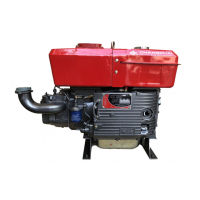
This document is an owner's manual for CHANGCHAI air-cooling diesel engines, covering various models including CC170FB, 173F, 178FA, 186FA, 188FA, and 192FA. It provides essential information for safe operation, maintenance, and storage of these engines.
Function Description:
The CHANGCHAI air-cooling diesel engine is a single-cylinder, vertical, four-stroke, direct injection engine designed for various applications. The manual outlines procedures for starting the engine (both recoil and electric start), running it, and stopping it, emphasizing safety precautions throughout. It also includes detailed instructions for installation and long-term storage.
Important Technical Specifications:
The manual provides a comprehensive table of principal technical specifications for the different engine models. Key specifications include:
- Type: Single-cylinder, vertical, four-stroke, air-cooled, direct injection.
- Bore × Stroke (mm): Ranges from 70×59 (CC170FB) to 92×75 (192FA).
- Displacement (L): Ranges from 0.227 (CC170FB) to 0.499 (192FA).
- Rated power/rated speed (kW/r/min): Ranges from 3.0/3000 (CC170FB) to 7.5/3000 (192FA) at 3000 r/min, and 3.5/3600 (CC170FB) to 8.2/3600 (192FA) at 3600 r/min.
- Maximum idle speed r/min: No more than 108% of rated speed.
- Minimum idle speed r/min: <1300.
- Fuel consumption/rated speed g/(kWh)r/min: Ranges from 280/3000 to 310/3000 at 3000 r/min, and 310/3600 to 330/3600 at 3600 r/min.
- Oil consumption g/(kWh): <4.0.
- Grade of fuel: NO.0, NO.-10, NO.-20.
- Grade of oil: CD Grade or SAE10W-30, SAE15W-40.
- Injection timing (Before T.D.C): 20° ±1° (CC170FB, 173F), 21° ±1° (178FA, 186FA, 188FA), 24° ±1° (192FA).
- Direction of rotation: Counterclockwise (face the output shaft).
- Valve clearance (cold) mm: 0.10~0.15.
- Starting method: Recoil start or electric start.
- Lubrication method: Pressure and splash.
- Lubricating oil capacity (L): Ranges from 0.75 (CC170FB) to 1.65 (186FA, 188FA, 192FA).
- Fuel tank capacity (L): Ranges from 2.5 (CC170FB) to 5.5 (186FA, 188FA, 192FA).
- Overall dimension (L×W×H) mm: Ranges from 335×380×415 (CC170FB) to 420×440×495 (186FA, 188FA, 192FA).
- Net weight kg: <27 (CC170FB) to <53 (186FA, 188FA, 192FA).
The manual notes that specifications may change due to engine improvements and are for reference only.
Usage Features:
The manual emphasizes safe and correct operation.
- Safety Precautions: Warnings are provided regarding fire prevention (fuel handling, battery charging), exhaust attention (operating in well-ventilated areas), prevention of entanglement with rotating parts, and caution against scalding from hot engine components. Users are advised not to operate the engine after drinking and to wear safety shoes and proper clothes.
- Installation: Proper installation is crucial to prevent vibration and damage. This includes ensuring a tight stationary foundation, correct alignment of the output shaft, and appropriate belt pulley size and tension. Specific V-belt types and quantities are listed for each model.
- Breaking-in Period: For new engines, a breaking-in period of the first 20 hours is recommended. During this time, the engine should be operated at low load and low speed after starting, avoiding no-load high speed or full-load operation. The engine can carry on breaking-in according to 3000r/min, about 50% of load.
- Fuel and Lube Oil: Detailed instructions are given for choosing and using fuel (light diesel fuel, ensuring cleanliness) and lube oil (special-purpose lube oil above CC grade, with specific SAE grades recommended based on ambient temperature). Users must check lube oil levels before starting and ensure it does not exceed the upper limit mark.
- Starting Procedures:
- Recoil Starting: Involves opening the fuel cock, setting the speed control lever to "START," pulling the recoil handle to feel resistance, pushing down the decompression lever, and then pulling the rope hard and fast. For cold weather, adding 2ml of lube oil to the cylinder head is suggested.
- Electric Starting: Involves opening the fuel cock, setting the speed control lever to "START," turning the electric starting switch to "START" clockwise, and releasing it once the engine starts. A waiting period of 15 seconds is advised if the engine doesn't start within 10 seconds to prevent battery drain and motor seizure.
- Running the Engine: The engine should be warmed up without load for 5 minutes. Continuous black exhaust smoke indicates overload, requiring adjustment of the engine or driven machine pulley. Regular checks during operation include listening for abnormal noise/vibration, checking exhaust noise, and observing exhaust gas color.
- Stopping the Engine: To prevent abnormal temperature rise and shorten engine life, the engine should not be stopped suddenly. The speed control lever should be moved to a low speed position for about 5 minutes without load, then set to "STOP." The fuel cock should be closed. For long-term storage, the recoil handle should be pulled slowly until pressure is felt (piston on compression stroke) to prevent rust. For electric-start models, the starter key is set to "OFF."
Maintenance Features:
The manual provides a periodic check and maintenance schedule, indicating tasks and their frequencies.
- Daily Checks: Check bolt and nuts of engine parts for tightness, and check and replenish lube oil.
- 20 Hours: Replace lube oil (1st time).
- 50 Hours: Clean oil filter.
- 100 Hours: Replace lube oil (2nd time).
- 200 Hours: Replace air filter element.
- 500 Hours: Clean and replace fuel filter, check fuel injection nozzle, check fuel injection pump, adjust clearance of intake and exhaust valves.
- 1000 Hours: Check clearance of intake and exhaust valves, replace piston rings.
- Monthly Checks: Check battery electrolyte and replenish with distilled water if necessary.
- Lube Oil Replacement: Drain old oil when the engine is warm and refill with recommended oil.
- Air Filter Element: The element must be replaced when output decreases or exhaust color is bad. A clogged element can lead to starting difficulties, reduced output, black smoke, and increased fuel/lube oil consumption. Never run the engine without the element or with a defective one.
- Oil Filter Cleaning: Loosen the bolt and pull out the oil filter for cleaning.
- Fuel Filter Cleaning and Replacement: Drain fuel from the tank, then loosen nuts to remove and clean the fuel filter.
- Cylinder Head Bolts: Tightening cylinder head bolts requires a special tool and should be done by a dealer.
- Injector and Injection Pump Adjustment/Piston Ring Replacement: These tasks require special tools and skills and should be performed by a dealer.
- Battery Maintenance: Check electrolyte levels monthly and replenish with distilled water to the upper limit mark.
Long-term Storage:
For long-term storage, the following steps are recommended:
- Run the engine at low speed for five minutes.
- Quickly drain old lubricating oil while warm and refill with new oil.
- Add about 2ml of lubricating oil to the cylinder head cover after removing the rubber plug.
- Push the decompression lever down and pull the recoil starting handle 2 or 3 times (without starting the engine).
- Pull the decompression lever up and position the engine on the compression stroke (intake and exhaust valves closed) to prevent moisture and rust in the chamber.
- Wipe dirt from the cylinder surface and store the engine in a dry place.

 Need help?

 To Next Page
 General