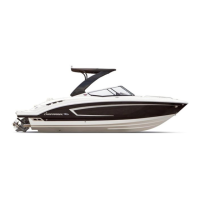
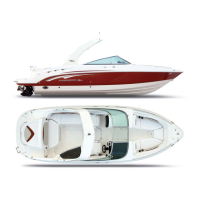
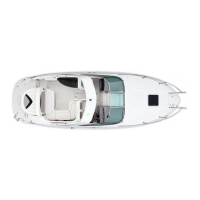
Bow The forward part or front of the boat.
Breakers Waves cresting as they reach shallow water,
as at or on a beach.
Breakwater A structure, usually stone or concrete, built to
create a harbor or improve an existing one.
Bulkhead Vertical partition in a boat.
BurdenedVessel Former term for the vessel which must stay
clear of vessels with the right-of-way.
Caulking Forcing filler material into the seams of the
planks in a boat’s deck or sides, to make
them watertight.
Camber The arch of a deck, sloping downward from
the center toward the sides.
Capsize To turn over.
CarburetorBackfire
FlameArrestor Required equipment on all motorboats except
outboards and diesels. Reduces chance of
fire caused by backfires in internal combus-
tion engines.
CardinalPoints The four main points of a compass; north,
east, south, and west.
Ceiling The inside lining of the hull.
Certificate Government paper, such as a boat’s license.
Chart A map of a body of water that contains pilot-
ing information.
Chine The intersection of sides and bottom of a
boat.
Cleat A piece of wood or metal with projecting ends
to which lines are made fast.
Clinker A method of planking in which the lower edge
of each strake overlaps the upper edge of the
strake next below. (Also called lapstrake.)
Coaming A raised edge, as around part or all of a cock-
pit, that prevents seawater from entering the
boat.
CoastGuard The federal marine law enforcement and res-
cue agency in the US.
Cockpit A well or sunken space in the afterdeck of a
small boat for the use of the helmsman and
crew.
Companionway A hatch or entrance, from deck to cabin.
Compass The instrument which shows the heading of a
vessel.
Cowls Hooded openings used for ventilation.
Cradle A frame used to support a vessel on land.
Current The movement of the water in a horizontal
direction.
Deadrise The rise of the bottom of a midships frame
from the keel to the bilge.
Deck Any permanent covering over a compartment.
Deep-six To discard or throw overboard.
10-2



 To Next Page