Liquid Nitrogen Safety
Liquid nitrogen (LN2) is used in Chart Cryogenic Freezers as a refrigerant. Understanding
potential hazards and following safety precautions is important when handling LN2 and these
freezers.
Nitrogen is a colorless, odorless, and tasteless gas that makes up approximately 78.1% of the
Earth’s atmosphere in its gaseous state. LN2 becomes vapor at temperatures greater than -320.8°F
(-196°C). In liquid state, nitrogen has a temperature range from -320.4°F to -346°F (-195.8°C to -
210°C).
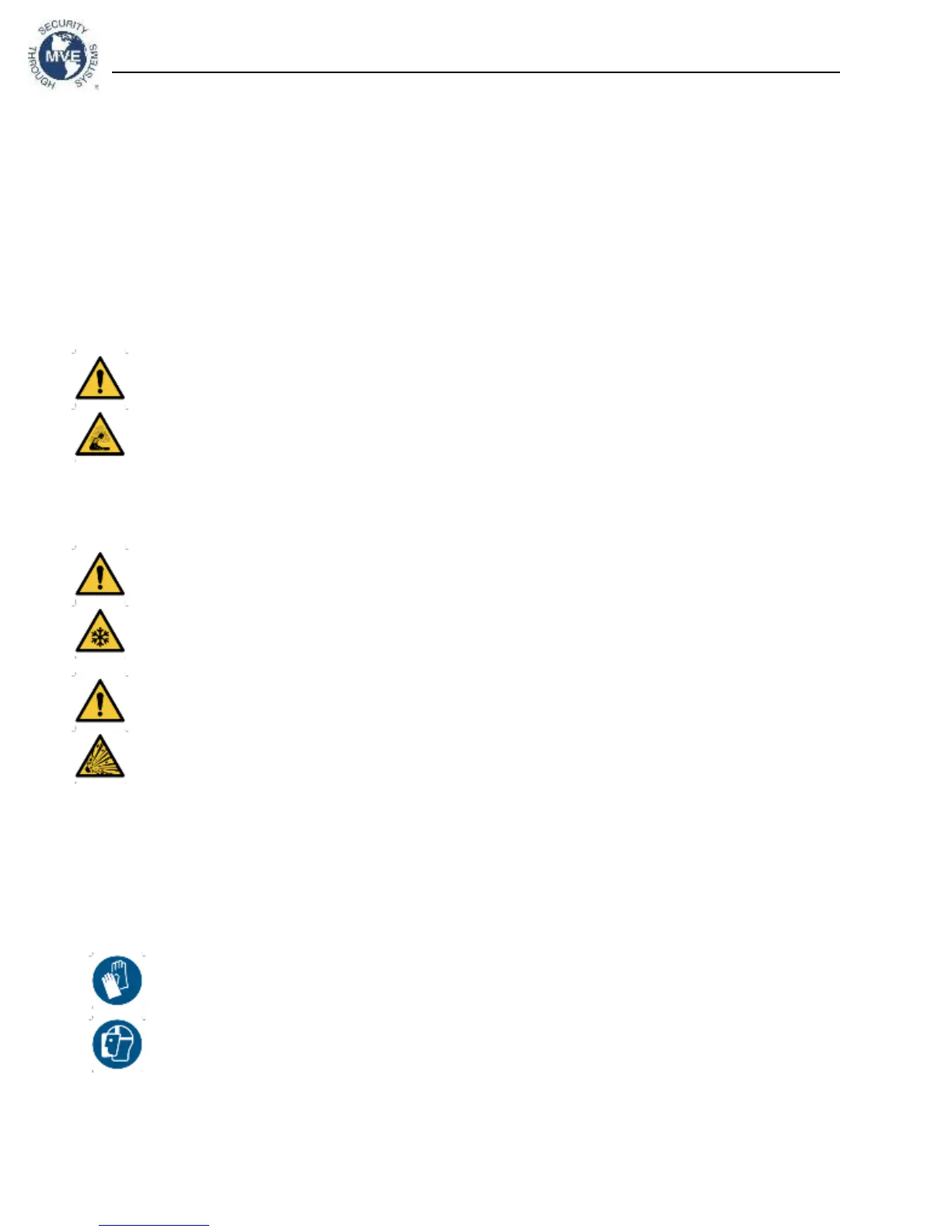
• Nitrogen vapor is a potential asphyxiant as it displaces Oxygen (O
2
) in confined
spaces. Rapid suffocation can occur without warning in an Oxygen-deficient
atmosphere (less than 19.5% O
2
). Chart Cryogenic Freezers must be installed
and operated in well-ventillated areas.
• DO NOT vent container in confined spaces.
• DO NOT enter confined spaces where excess nitrogen gas may be present.
• If exposure has occurred move to ventillated area or fresh air. If breathing is
difficult, supplement oxygen may be required. If not breathing, give artificial
respiration. SEEK IMMEDIATE MEDICAL ATTENTION.
• Contact with liquid nitrogen or uninsulated equipment containing nitrogen can
result in cold contact burns or tissue damage. Nitrogen vapor can cause
damage to skin or eyes.
• In case of frostbite, warm area with warm water not exceeding 105°F (40°C) and
SEEK IMMEDIATE MEDICAL ATTENTION.
• Never place LN2 in a sealed container without a pressure relief device. The
expansion ratio of liquid nitrogen to gaseous nitrogen is 1 to 700 (1 cubic foot of
liquid nitrogen becomes 700 cubit feet of gaseous nitrogen when evaporated).
Recommended protective clothing
• Cryogenic gloves (loose fitting)
• Full-face shield or chemical splash goggles
• Cryogenic apron
• Long sleeve shirt and cuffless pants
• Closed toe shoes (no sandals)



 To Next Page