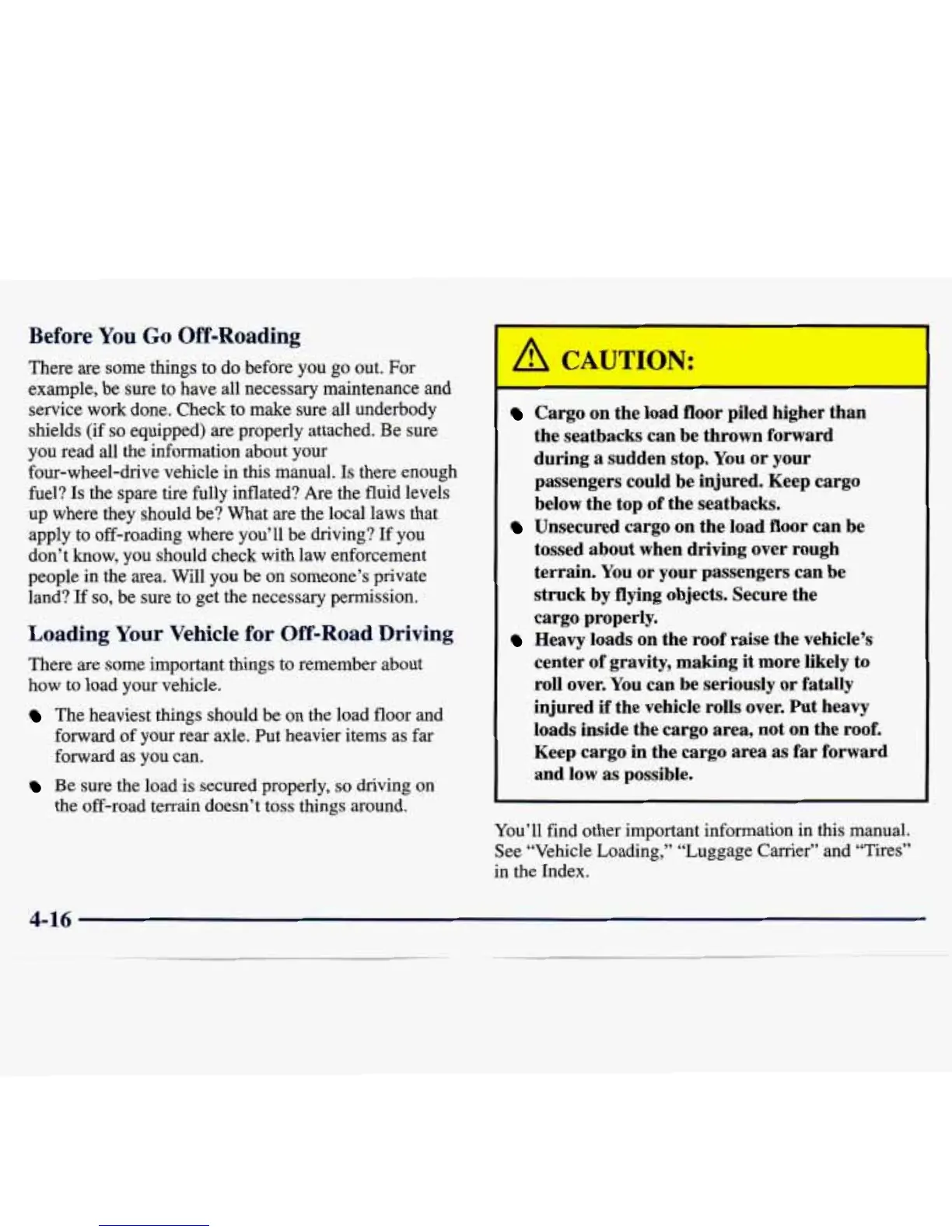
Before You
Go
Off-Roading
There are some things to do before you go out. For
example, be sure to have all necessary maintenance and
service work done. Check to make sure all underbody
shields (if
so
equipped) are properly attached. Be sure
you read all the information about your
four-wheel-drive vehicle in this manual. Is there enough
fuel?
Is
the spare tire fully inflated? Are the fluid levels
up where they should be? What are the local laws that
apply to off-roading where you’ll be driving? If you
don’t know, you should check with law enforcement
people in the area. Will you be on someone’s private
land? If
so,
be sure to get the necessary permission.
Loading Your Vehicle for Off-Road Driving
There are some important things to remember about
how
to
load your vehicle.
The heaviest things should be
on
the load floor and
forward of your rear axle. Put heavier items as far
forward as you can.
Be
sure the load
is
secured properly,
so
driving on
the off-road terrain doesn’t
toss
things around.
Cargo on the load
floor
piled higher than
the seatbacks can be thrown forward
during a sudden stop. You or your
passengers could be injured. Keep cargo
below the top of the seatbacks.
Unsecured cargo on the load floor can be
tossed about when driving over rough
terrain. You
or
your passengers can be
struck by flying objects. Secure the
cargo properly.
Heavy loads on the roof raise the vehicle’s
center of gravity, making
it
more likely to
roll over. You can be seriously or fatally
injured if the vehicle rolls over.
Put
heavy
loads inside the cargo area, not on the roof.
Keep cargo in the cargo area
as
far
forward
and low as possible.
You’ll find other important information in this manual.
See “Vehicle Loading,” “Luggage Carrier” and “Tires”
in the Index.





 To Next Page