--.
/-.
,
,
,
.
..,.,
:..“,>>.liii.
. ....
,
.,;,
.
.._
..,..,..,,...
.- .
,
,
,
.
.
.
.
.
.
.
.
. .
.
.
._”
..,....,
j..
..
.
..
.
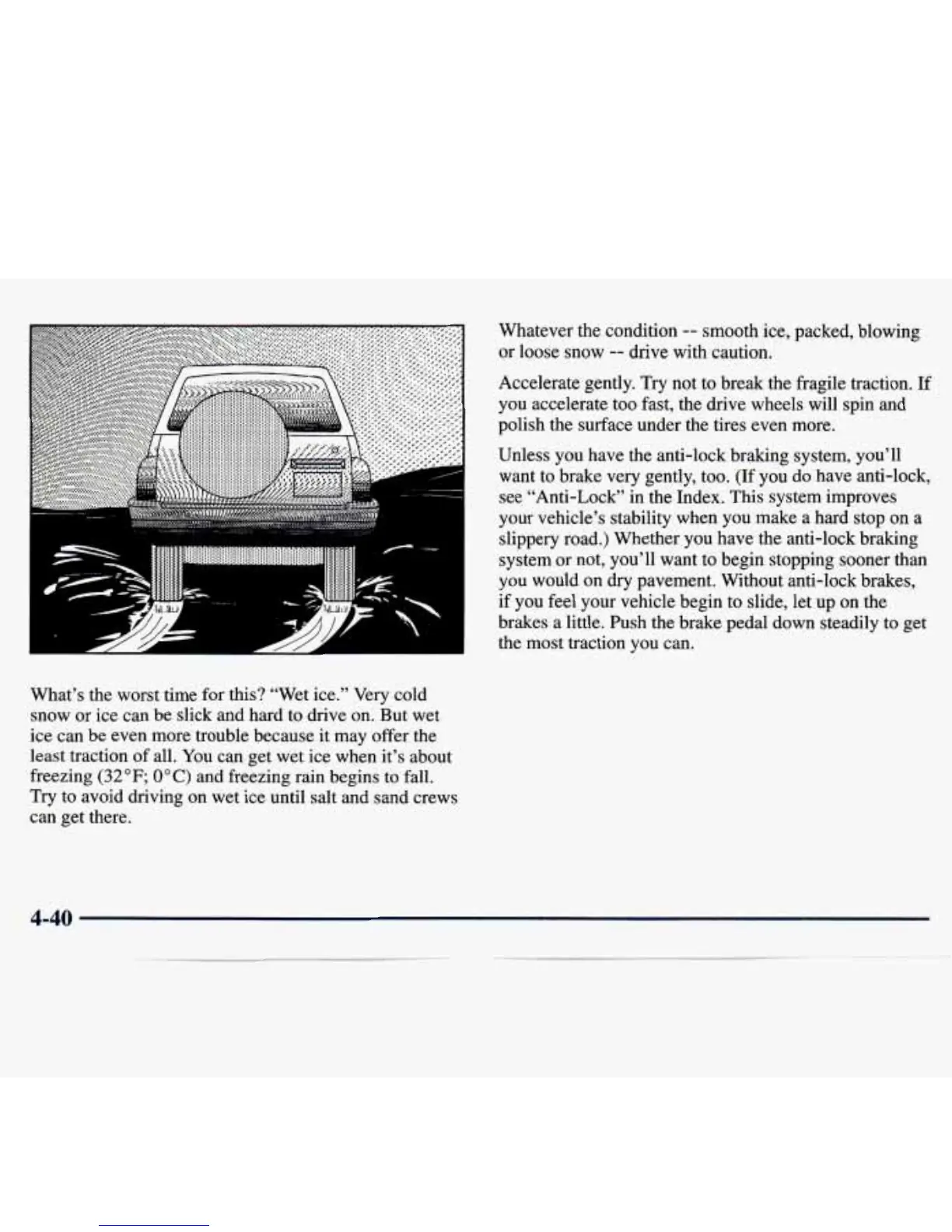
Whatever the condition
--
smooth ice, packed, blowing
or loose snow
--
drive with caution.
Accelerate gently. Try not to break the fragile traction.
If
you accelerate too fast, the drive wheels will spin and
polish the surface under the tires even more.
Unless you have the anti-lock braking system, you’ll
want
to
brake very gently, too. (If you do have anti-lock,
see “Anti-Lock‘’ in the Index. This system improves
your vehicle’s stability when you make
a
hard stop
on
a
slippery road.) Whether you have the anti-lock braking
system
or
not, you’ll want to begin stopping sooner than
you would on dry pavement. Without anti-lock brakes,
if you feel your vehicle begin
to
slide, let up on the
brakes a little. Push the brake pedal down steadily to get
the most traction you can.
What’s the worst time for this? “Wet ice.” Very cold
snow
or
ice can be slick and hard
to
drive on. But wet
ice can be even more trouble because it may offer the
least traction of all. You can get wet ice when it’s about
freezing
(32°F;
OOC)
and
freezing rain begins to fall.
Try
to avoid driving on wet ice until salt and sand crews
can get there.
4-40



 To Next Page