If
You
Do Decide
To
Pull
A
Trailer
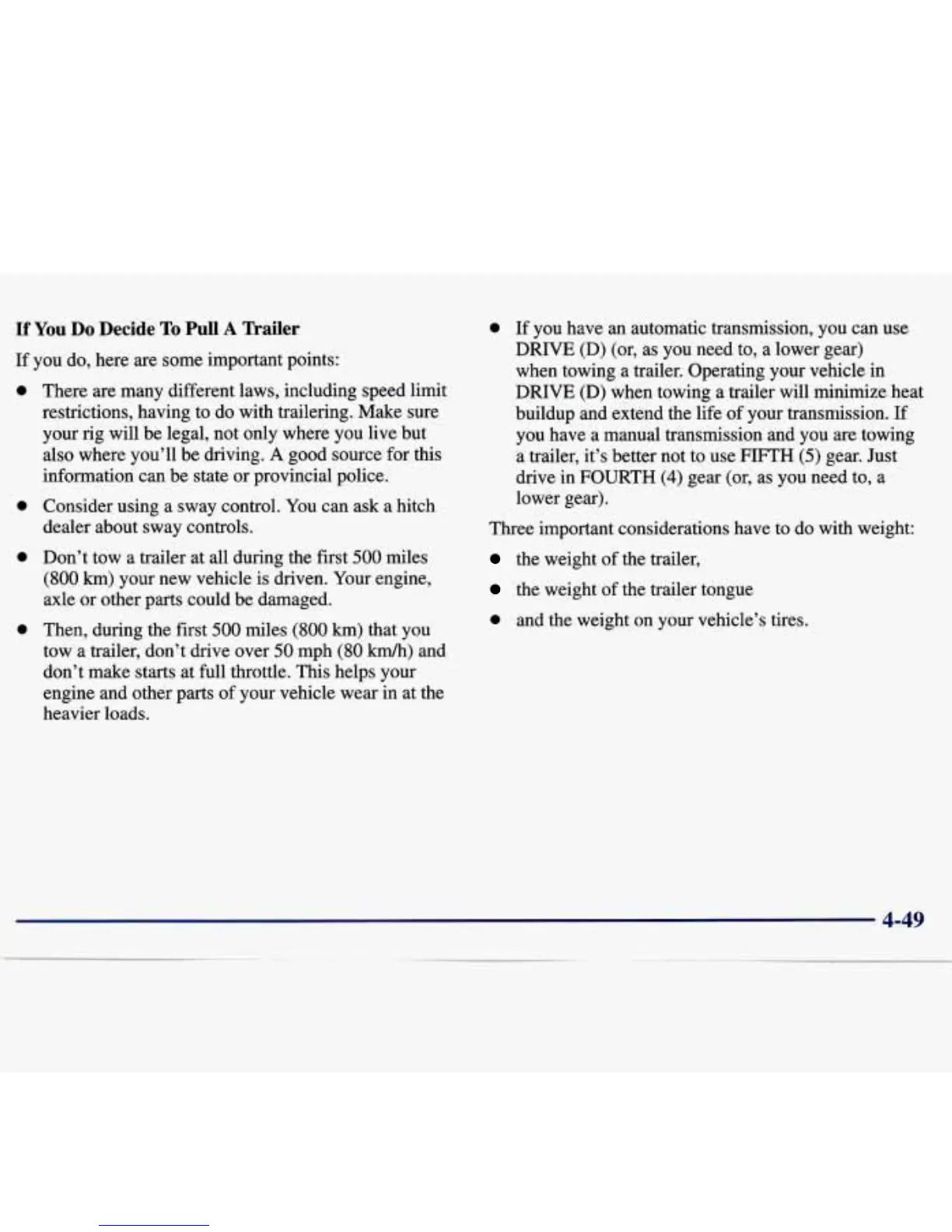
If you do, here are some important points:
0
0
0
0
There are many different laws, including speed limit
restrictions, having to do with trailering. Make sure
your rig will be legal, not only where you live but
also
where you’ll be driving.
A
good source for this
information can be state or provincial police.
Consider using a sway control.
You
can
ask
a hitch
dealer about sway controls.
Don’t tow a trailer at all during the first
500
miles
(800
km)
your new vehicle is driven.
Your
engine,
axle or other parts could be damaged.
Then, during the first
500
miles
(800
km)
that you
tow a trailer, don’t drive over
50
mph
(80
km/h)
and
don’t make starts at full throttle. This helps your
engine and other parts
of
your vehicle wear in at the
heavier loads.
0
If you have an automatic transmission, you can use
DRIVE
(D)
(or, as you need
to,
a lower gear)
when towing a trailer. Operating your vehicle in
DRIVE
(D)
when towing a trailer will minimize heat
buildup and extend the life of your transmission.
If
you have a manual transmission and you
are
towing
a trailer, it’s better not to use
FIFTH
(5)
gear. Just
drive in FOURTH
(4)
gear (or, as you need to, a
lower gear).
Three important considerations have to do with weight:
the weight of the trailer,
the weight of the trailer tongue
0
and the weight on your vehicle’s tires.
4-49
~


 To Next Page