Parking
on
Hills
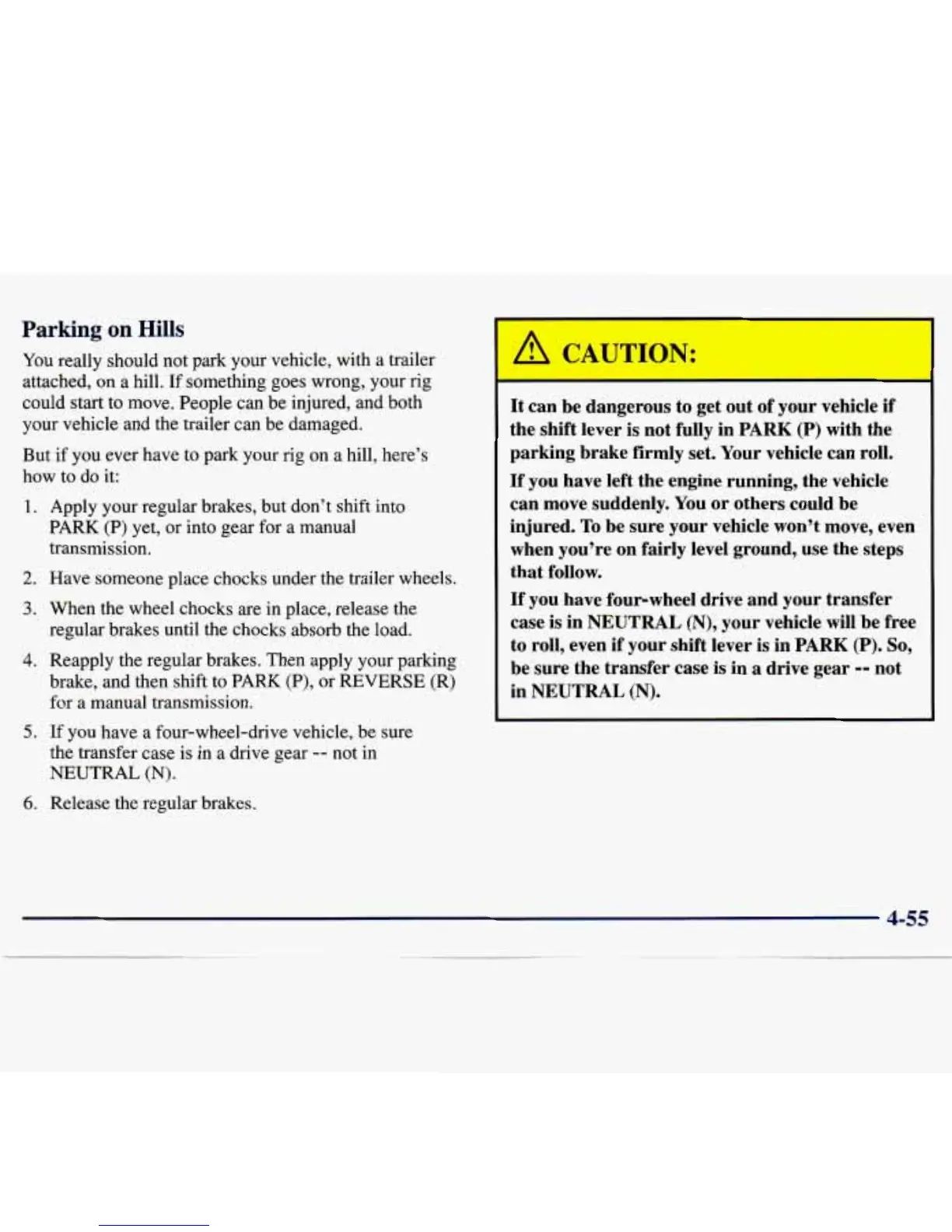
You really should not park your vehicle, with a trailer
attached, on a hill. If something goes wrong, your rig
could start to move. People can be injured, and both
your vehicle and the trailer can be damaged.
But if you ever have to park your
rig
on a hill, here’s
how to do it:
1.
Apply your regular brakes, but don’t shift into
PARK
(P)
yet, or into gear for a manual
transmission.
2.
Have someone place chocks under the trailer wheels.
3.
When the wheel chocks are
in
place, release the
regular brakes until the chocks absorb the load.
4.
Reapply the regular brakes. Then apply your parking
brake, and then shift to
PARK
(P),
or
REVERSE
(R)
for
a
manual transmission.
5.
If
you have a four-wheel-drive vehicle, be sure
the transfer case is in a drive gear
--
not
in
NEUTRAL
(N).
-
I_
A
CAUl
=ON:
It
can be dangerous
to
get out of your vehicle if
the shift lever is not fully in
PARK
(P)
with the
parking brake firmly
set.
Your vehicle can roll.
If
you have left the engine running, the vehicle
can move suddenly. You or others could be
injured.
To
be sure your vehicle won’t move, even
when you’re
on
fairly level ground, use the steps
that follow.
If
you have four-wheel drive and your transfer
case is in
NEUTRAL
(N),
your vehicle will be
free
to roll, even if your shift lever is in
PARK
(P).
So,
be sure the transfer case
is
in a drive gear
--
not
in
NEUTRAL
(N).
6.
Release
the
regular brakes.
4-55
~
-
.






 To Next Page