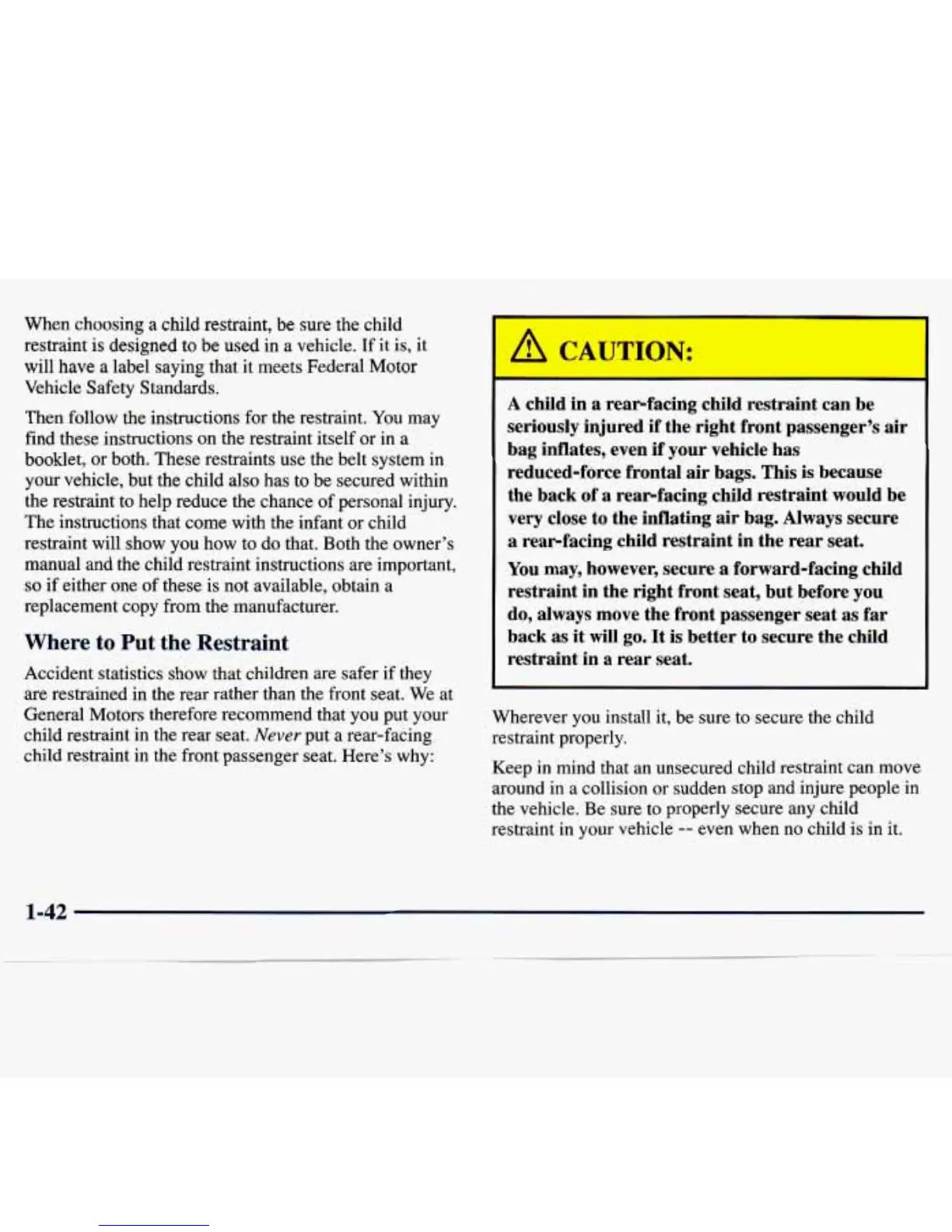
When choosing
a
child restraint, be sure the child
restraint
is
designed to be used in a vehicle.
If
it is, it
will
have
a
label saying that it meets Federal Motor
Vehicle Safety Standards.
Then follow the instructions for the restraint. You
may
find these instructions on the restraint itself or
in
a
booklet, or both. These restraints use the belt system in
your vehicle, but
the
child also has to be secured within
the restraint to help reduce the chance of personal injury.
The instructions that
come
with the infant or child
restraint will show you how
to
do that. Both the owner’s
manual and the child restraint instructions are important,
so
if either one
of
these
is
not available, obtain a
replacement copy from the manufacturer.
Where
to Put the Restraint
Accident statistics show that children are safer if they
are restrained in the rear rather than the front seat. We at
General Motors therefore recommend that you put your
child restraint in the rear seat.
Never
put a rear-facing
child restraint in the front passenger seat. Here’s why:
A
child in a rearfacing child restraint can be
seriously injured
if
the right front passenger’s
air
bag inflates, even
if
your vehicle has
reduced-force frontal
air
bags. This
is
because
the back
of
a rearfacing child restraint would be
very close to the inflating air bag. Always secure
a rearfacing child restraint in the rear seat.
You may, however, secure
a
forward-facing child
restraint in the right front seat, but before you
do, always move the front passenger seat as far
back as it will go.
It
is better to secure the child
restraint in
a
rear seat.
Wherever you install it, be sure to secure the child
restraint properly.
Keep
in
mind that an unsecured child restraint can move
around
in
a collision or sudden stop and injure people in
the vehicle. Be sure to properly secure any child
restraint
in
your vehicle
--
even when
no
child is in it.
1-42



 To Next Page