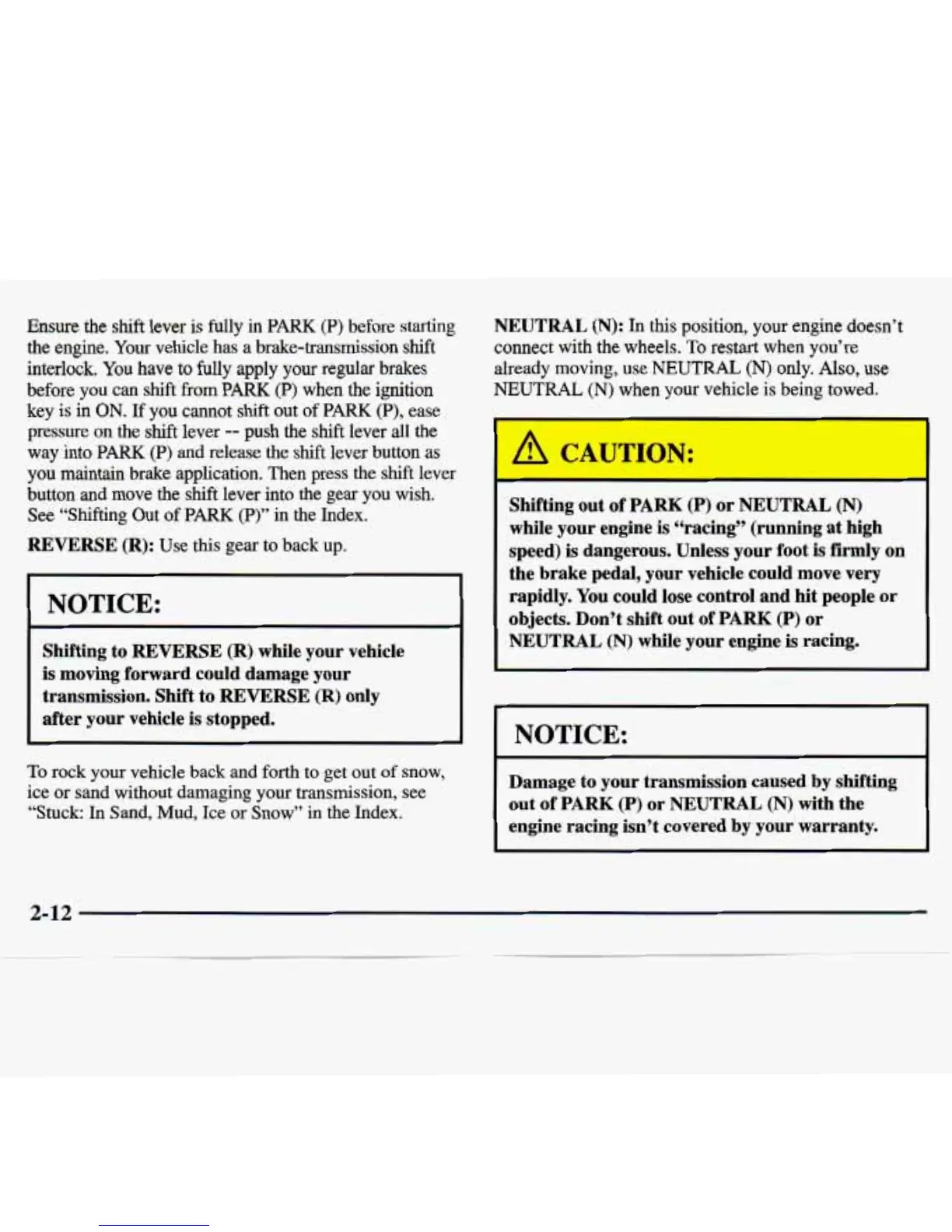
Ensure the
shift
lever
is
fully
in
PARK
(P)
before
starting
the
engine.
Your
vehicle
has
a brake-transmission shift
interlock. You
have
to fully apply your regular
brakes
before you can shift
from
PARK
(P)
when the ignition
key is in
ON.
If
you cannot
shift
out
of
PARK
(P),
ease
pressure on the shift lever
--
push the shift lever all
the
way into
PARK
(P)
and
release the shift lever button
as
you maintain brake application. Then press the shift lever
button
and
move the shift lever into the gear you wish.
See “Shifting Out of
PARK
(P)”
in
the Index.
REVERSE
(R):
Use this gear to back
up.
NOTICE:
Shifting
to
REVERSE (R) while your vehicle
is
moving forward could damage your
transmission. Shift to REVERSE (R) only
after your vehicle is stopped.
To
rock your vehicle back and
forth
to get out
of
snow,
ice or sand without damaging your transmission, see
“Stuck: In Sand, Mud, Ice or Snow” in the Index.
NEUTRAL
(N):
In this position, your engine doesn’t
connect with
the
wheels.
To
restart when you’re
already moving,
use
NEUTRAL
(N)
only.
Also,
use
NEUTRAL
(N)
when your vehicle
is
being towed.
Shifting out of
PARK
(P)
or NEUTRAL
(N)
while your engine
is
“racing” (running
at
high
speed)
is
dangerous. Unless your foot
is
firmly on
the brake pedal, your vehicle could move very
rapidly. You could lose control and hit people or
objects. Don’t shift out of
PARK
(P)
or
NEUTRAL
(N)
while your engine is racing.
I
NOTICE:
Damage to your transmission caused by shifting
out of PARK
(P)
or NEUTRAL
(N)
with
the
engine racing isn’t covered by your warranty.
1
2-12


 To Next Page