GENERAL INFORMATION AND MAINTENANCE 5
of water and baking soda and get medical at-
tention immediately.
• Do use safety stands for any undercar
service. Jacks are for raising vehicles; safety
stands are for making sure the vehicle stays
raised until you want it to come down.
Whenever the vehicle is raised, block the
wheels remaining on the ground and set the
parking brake.
• Do use adequate ventilation when work
ing with any chemicals. Like carbon monox
ide, the asbestos dust resulting from brake
lining wear can be poisonous in sufficient
quantities.
• Do disconnect the negative battery cable
when working on the electrical system. The
primary ignition system can contain up to
40,000 volts.
• Do follow manufacturer's directions
whenever working with potentially hazard
ous materials. Both brake fluid and antifreeze
are poisonous if taken internally.
• Do properly maintain your tools. Loose
hammerheads, mushroomed punches and
chisels, frayed or poorly grounded electrical
cords, excessively worn screwdrivers, spread
wrenches (open end), cracked sockets, slip
ping ratchets, or faulty droplight sockets can
cause accidents.
• Do use the proper size and type of tool
for the job being done.
• Do when possible, pull on a wrench han
dle rather than push on it, and adjust your
stance to prevent a fall.
• Do be sure that adjustable wrenches are
tightly adjusted on the nut or bolt and pulled
so that the face is on the side of the fixed jaw.
• Do select a wrench or socket that fits the
nut or bolt. The wrench or socket should sit
straight, not cocked.
• Do strike squarely with a hammer—avoid
glancing blows.
• Do set the parking brake and block the
drive wheels if the work requires that the en
gine be running.
Dont's
• Don't run an engine in a garage or any
where else without proper ventilation—
EVER! Carbon monoxide is poisonous; it
takes a long time to leave the human body
and you can build up a deadly supply of it in
your system by simply breathing in a little
every day. You may not realize you are slowly
poisoning yourself. Always use power vents,
windows, fans or open the garage doors.
• Don't work around moving parts while
wearing a necktie or other loose clothing.
Short sleeves are much safer than long, loose
sleeves and hard-toed shoes with neoprene
soles protect your toes and give a better grip
on slippery surfaces. Jewelry such as watches,
fancy belt buckles, beads or body adornment
or any kind is not safe working around a car.
Long hair should be hidden under a hat or
cap.
• Don't use pockets for toolboxes. A fall or
bump can drive a screwdriver deep into your
body. Even a wiping cloth hanging from the
back pocket can wrap around a spinning shaft
or fan.
• Don't smoke when working around gas
oline, cleaning solvent or other flammable
material.
• Don't smoke when working around the
battery. When the battery is being charged,
it gives off explosive hydrogen gas.
• Don't use gasoline to wash your hands;
there are excellent soaps available. Gasoline
may contain lead, and lead can enter the body
through a cut, accummulating in the body
until you are very ill. Gasoline also removes
all the natural oils from the skin so that bone
dry hands will suck up oil and grease.
• Don't service the air conditioning system
unless you are equipped with the necessary
tools and training. The refrigerant, R-12, is
extremely cold and when exposed to the air,
will instantly freeze any surface it comes in
contact with, including your eyes. Although
the refrigerant is normally non-toxic, R-12
becomes a deadly poisonous gas in the pres
ence of an open flame. One good whiff of the
vapors from burning refrigerant can be fatal.
HISTORY
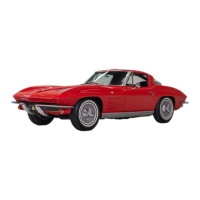
The 1963 Corvette Stingray is a complete de-
parture from the Corvettes which preceded
it. The body, frame, and front and rear sus-
pensions are all of new design. Engines and
transmissions are the only components that
were shared with the older models. Stingray
body styling evolved from the original Wil-
liam Mitchell Stingray sports/racing car which
competed in 1959-60. Fiberglass bodywork
was retained, but included a steel, reinforc-
ing framework around the passenger com-
partment. The convertible model, with or
without hardtop, was retained and a new body
style added, the fastback coupe. Retractable


 To Next Page
 Loading...