10-52 Vehicle Care
(6) Tire Ply Material: The type
of cord and number of plies in
the sidewall and under the tread.
(7) Single Tire Maximum
Load
: Maximum load that can
be carried and the maximum
pressure needed to support that
load when used as a single. For
information on recommended
tire pressure see Tire Pressure
on page 10-56 and Vehicle Load
Limits on page 9-10.
Tire Designations
Tire Size
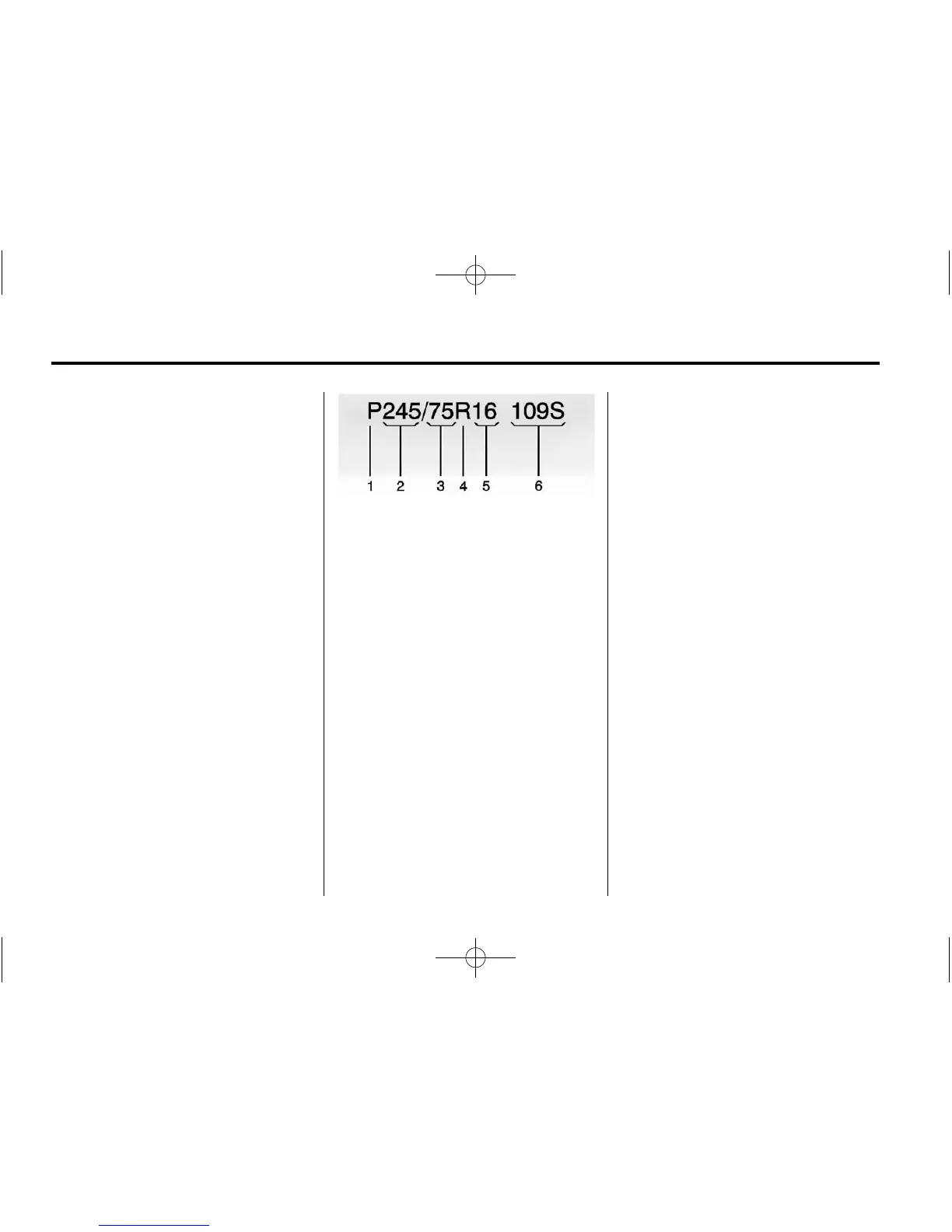
The following examples
show the different parts of a
tire size.
Passenger (P-Metric) Tire
(1) Passenger (P-Metric) Tire :
The United States version of a
metric tire sizing system. The
letter P as the first character in
the tire size means a passenger
vehicle tire engineered to
standards set by the U.S. Tire
and Rim Association.
(2) Tire Width
: The three-digit
number indicates the tire section
width in millimeters from
sidewall to sidewall.
(3) Aspect Ratio
: A two-digit
number that indicates the tire
height-to-width measurements.
For example, if the tire size
aspect ratio is 75, as shown in
item 3 of the illustration, it would
mean that the tire's sidewall is
75 percent as high as it is wide.
(4) Construction Code
: A letter
code is used to indicate the type
of ply construction in the tire.
The letter R means radial ply
construction; the letter D
means diagonal or bias ply
construction; and the letter B
means belted-bias ply
construction.
(5) Rim Diameter
: Diameter of
the wheel in inches.
(6) Service Description
: These
characters represent the load
index and speed rating of the
tire. The load index represents
the load carrying capacity a tire
is certified to carry. The speed
rating is the maximum speed a
tire is certified to carry a load.







 To Next Page