Need help?
Do you have a question about the CHICAGO 4095 and is the answer not in the manual?
Keep this manual for safety warnings, assembly, operating, and maintenance procedures.
Lists electrical requirements, speed, stroke, tilt, capacity, dimensions, and weight.
Keep work area clean, well-lit, and free of bystanders.
Use properly installed and grounded outlets.
Stay alert, don't use under influence, wear proper clothing, contain long hair.
Ensure trigger is off, remove wrenches, maintain footing and balance.
Use safety equipment, secure workpiece, don't force tool, check operation.
Disconnect power before adjustments, store tools safely, maintain tools, use recommended accessories.
Service by qualified personnel; use only identical replacement parts.
Hold by insulated grips, follow OSHA, maintain labels, use PPE, ensure safe workspace.
Maintain firm grip, prepare before starting, consult physician if pacemaker user.
Never lay tool down until stopped, never leave unattended when plugged in.
Check saw blade for damage; do not cut material thicker than blade length or attempt curves.
Ensure sufficient space under workpiece; avoid cutting electrical wires.
Never remove stuck material while tool is powered or plugged in.
Always unplug saw before performing any inspection, maintenance, or cleaning.
Be aware of chemicals in dust; use ventilation and dust masks.
Tools with three prong plugs must be connected to a properly grounded outlet.
Grounding prong connects via green wire to tool's grounding system.
Plug into an appropriate outlet installed and grounded per codes.
Tools marked 'Double Insulated' do not require grounding per OSHA standards.
Double insulated tools can be used in standard 120 volt outlets.
Grounded tools need three-wire; double insulated can use two or three-wire cords. Use heavier gauge for longer distances.
Smaller gauge number means greater capacity; check cord ratings for length and tools.
Ensure outdoor cords are marked 'W-A'/'W', properly wired, and protected.
Table showing minimum wire gauge based on amperage and cord length.
Explains symbols like Double Insulated, CSA, UL, Volts, Amperes, RPM.
Check tool for intactness and damage; contact for missing or broken parts.
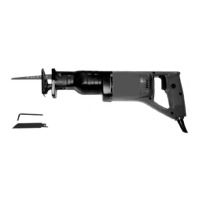
Instructions on selecting, loosening hex screw, sliding, and tightening blade.
Loosen hex screws, slide shoe plate, retighten screws to adjust cut depth.
How to engage and disengage the trigger lock for extended use.
Ensure trigger is not locked ON before plugging in.
Adjust speed based on material; faster for softer, slower for harder materials.
Hold firmly, squeeze trigger, place blade on material, press down gently.
Release trigger to stop; disengage trigger lock if used, then unplug.
Check for loose screws, misalignment, binding, damage, or abnormal noise.
Use a clean cloth or vacuum to remove dust and debris; do not use solvents.
Lists all parts with their corresponding numbers and descriptions.
Diagram showing the assembly of all parts with reference numbers.
Covers defects in materials/workmanship for 90 days; excludes misuse, accidents, lack of maintenance.
Return product with proof of purchase and complaint explanation for repair or replacement.

 To Next Page
 General