
 Need help?
Do you have a question about the Cicada Audio CH Series and is the answer not in the manual?
Information and diagram for the passive network included with the CoAx Horns.
Illustrates a typical passive system design using included passive crossovers.
Provides tips on preventing speaker blow-ups, focusing on amplifier clipping and high-passing.
Details the process of disassembling the tweeter to replace the diaphragm using the CHT14 kit.
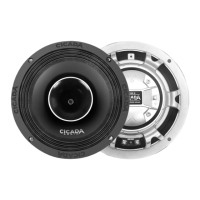
The Cicada Audio CH Series represents a line of high-performance, full-range co-axial horn speakers designed primarily for motorcycle audio applications, though their robust construction and efficient design make them suitable for a variety of other vehicles such as cars, trucks, boats, and UTVs. These speakers are engineered to deliver superior sound reproduction, leveraging advanced acoustic technology and innovative materials to provide an ultimate listening experience.
The core function of the CH Series speakers is to reproduce a full range of audio frequencies with high fidelity and significant sound pressure levels. As co-axial horn speakers, they integrate a midbass driver and a tweeter within a single unit, allowing for a more cohesive sound delivery and a compact design. The horn-loaded tweeter design enhances efficiency and directivity, projecting sound with greater clarity and impact, which is particularly beneficial in open-air environments like those encountered on a motorcycle. The full-range capability means these speakers are designed to handle a broad spectrum of audio, from lower midbass frequencies to crisp highs, without the need for separate dedicated drivers for each frequency band.
Each speaker pair includes a custom-tooled 12dB passive crossover network, which is crucial for properly distributing audio signals between the midbass and tweeter components. This crossover ensures that each driver receives the appropriate frequency range, preventing damage and optimizing sound quality. The speakers are designed to work effectively with both passive and active system designs, offering flexibility for various installation preferences and audio system complexities. For passive setups, the included crossover is highly recommended, especially when an active crossover set above 4kHz is not used. In more advanced "bi-amped" or "fully active" systems, external DSP processors or amplifiers with high-pass filters can be utilized to fine-tune the frequency distribution and achieve even greater control over the sound.
The CH Series speakers are built to withstand challenging environments. Their cones are made from water-repellent pressed paper with a treated cloth surround, making them UV and water-resistant. This durability ensures reliable performance in outdoor and marine applications where exposure to elements is common. The heavy-duty, high-temp cast aluminum basket provides a rigid and stable foundation for the drivers, minimizing resonance and contributing to overall sound integrity.
The CH Series speakers are designed for flexible installation across multiple locations, though optimal performance relies on proper acoustic isolation of the front and rear sound waves. This is achieved by securely mounting the speaker to a flat baffle and ensuring no air leaks around its frame. While the speakers are primarily intended for custom installations, their relatively shallow mounting depth and lightweight design make them adaptable to a wide range of applications beyond stock locations.
For enhanced sound quality, it is strongly recommended to apply sound deadening material to the mounting surface (e.g., door skin, fairing, or bag). A more damped environment significantly improves the overall audio performance. The speakers are available in different impedance options (2 Ohm and 4 Ohm) for the midbass driver, allowing installers to match them with various amplifier configurations. The tweeter, on the other hand, maintains an 8 Ohm impedance.
The manual provides detailed wiring diagrams for both passive and active system designs. For passive setups, the included 12dB passive crossover network is integral. The wiring is designed to be straightforward, often described as "plug and play" for basic installations, particularly when connecting to stock head unit wiring harnesses. The manual emphasizes correct polarity during connection to ensure optimal bass response, though it notes that incorrect polarity will not damage the speakers but will result in reduced bass.
For more advanced users or those seeking greater control, the speakers can be integrated into "bi-amped" or "fully active" systems. In a bi-amped passive setup, the front channels of a 4-channel amplifier can drive the midbass drivers, while the rear channels drive the tweeters, allowing for independent level adjustments. For fully active systems, a DSP processor (like Cicada Audio's DSP125.4D amplifier or DSP88 stand-alone processor) is recommended. A DSP provides extensive control over crossovers, slopes, and equalization, enabling precise tuning of the system to achieve the desired sound profile. The manual specifically highlights the benefit of a DSP in eliminating the need for additional low-pass filters (inductors) for the midbass in active setups.
The speakers are capable of producing sound pressure levels in excess of 100dB, and users are advised to exercise restraint to prevent permanent hearing loss. The high sensitivity ratings of these speakers (e.g., 96.4dB to 101dB average at 1W/1M) indicate that they can achieve significant volume with relatively little power, making them highly efficient.
A key maintenance feature highlighted in the manual is the user-replaceable tweeter diaphragm. This design choice simplifies repairs in the event of tweeter failure, which can occur from over-driving or improper crossover settings. The manual provides a detailed, step-by-step guide for replacing the tweeter diaphragm, emphasizing careful handling due to the fragility of the voice coil edges.
To replace the diaphragm, the back cover of the speaker needs to be removed by unscrewing 5mm HEX machine screws. The manual advises careful, straight upward lifting of the back cover to avoid rubbing the voice coil on the gap. The replacement kit (CHT14 - CH SERIES DIAPHRAGM KIT) integrates the tweeter diaphragm directly into the back cover, eliminating the need for soldering and simplifying the process significantly. The manual also suggests using "dowels" or wooden sticks through the screw mount holes to align the back cover and diaphragm assembly during reinstallation, ensuring a parallel fit to the magnet.
Before attempting a tweeter diaphragm replacement, users are instructed to double-check with a voltmeter to confirm the tweeter is indeed non-functional. This prevents unnecessary replacement. The manual also serves as a reminder for users to ensure proper crossover settings (either the included passive crossover or an active crossover set above 4kHz) are engaged before operating the system or during tuning, as incorrect settings are a common cause of tweeter damage.
Additionally, the manual includes an "optional" tweeter attenuation feature, providing 4 Ohm resistors that can be wired in line with the tweeter output of the crossover. This allows users to attenuate the tweeter's output by approximately 3dB if they find the horns to be "too bright," offering a simple way to customize the sound balance without complex adjustments.
The overall design philosophy of the CH Series, with its robust construction and user-serviceable components like the tweeter diaphragm, aims to provide a long-lasting and enjoyable listening experience, backed by practical maintenance options.
 General
| Frequency Response | 60Hz - 20kHz |
|---|---|
| Type | Coaxial |
| Woofer Size | 6.5 inches |
| Tweeter Size | 1" |
| Impedance | 4Ω |

 To Next Page