
 Need help?
Do you have a question about the Cimbali FAEMA MD3000 and is the answer not in the manual?
Identifies the intended user group or market segment.
Explains the critical role of coffee grind for espresso quality.
Details how too coarse or too fine grinds lead to poor espresso.
Discusses the empiricism and difficulties in manual grind adjustments.
Highlights automation as the optimal solution for consistent coffee quality.
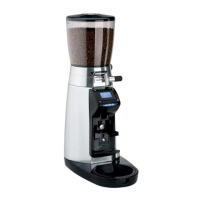
Features a high-gloss, clear finish for aesthetics and durability.
Constructed with a high-gloss finish for stability and appearance.
Branding element applied to the exterior of the grinder.
Made of glossy black, impact-resistant plastic for controls.
Provides intuitive and rapid operation for the grinder functions.
An elegant visual indicator on the grinder's interface.
Used to initiate the grinding process.
Features a safety switch for secure operation.
Allows filter holder support without direct touch.
A detachable part for collecting ground coffee.
Covers the internal motor component of the grinder.
Details the availability of the flat, 64 mm diameter grinder version only.
Lists width, depth, height, and weight of the grinder.
Specifies output rates for different coffee types.
Details motor speed and burr size.
Information on voltage, frequency, and power consumption.
Specifies bean storage size and minimum burr gap.
Enables wireless 2.45 GHz data exchange between grinder and coffee machine.
PGS verifies extraction and automatically corrects grind and dose.
Describes the Bluetooth communication hardware and antenna on the CPU card.
Uses motorized worm screw and magnetic sensor for precise grind adjustments.
Highlights the ability to adjust grind at 0.005mm increments for precision.
Lists Faema coffee machines that are compatible with the PGS system.
Details necessary software and hardware updates for machine communication.
Lists and describes all components included in the Bluetooth connectivity kit.
Step-by-step guide for updating coffee machine software via card reader.
Details the items included in the update kit and its specific order number.
Explains how the flow rate (Q) is used as a control parameter during operation.
Current software monitors double espressos; single espresso monitoring is in progress.
Emphasizes precise calibration of grind levels and quantities during installation.
Process to determine reference flow rate by averaging initial dispenses.
Technician's ability to manually input the reference flow rate.
Algorithm constantly calculates average flow rate for queues of dispenses.
Machine communicates for adjustment if flow rate deviates from reference.
Algorithm allows defining correction extent to speed up adjustments.
System adjusts grind after periods of inactivity based on usage patterns.
Dose is automatically adjusted based on technician-set percentages after grind adjustments.
Failure to auto-adjust affects grind quantity and flow rate parameters.
Lists specific scenarios where the flow rate calculation is not performed.
Details the blue-backlit LCD and touch screen dimensions for operation.
Guides on adjusting grind via technical menu and dedicated buttons.
Highlights that grinders are adjusted in 0.005 mm increments.
Specifies the available travel distance for filter holders.
Holders can accommodate filters with over 20 gr. capacity.
Support at an 8° angle for filter holders without touching.
Details dose selection, continual supply, and third dose programming.
Flashing key indicates preselected or activated dose.
Instructions for initiating grinder start-up using the switch.
Pressure on switch activates photocell sensor, resistant to wear.
Made of heavy-duty, 100% recyclable cardboard.
Specifies the Length, Height, and Depth of the package.
Provides the European product code, description, and target markets.
Tool for applying consistent force to ground coffee for optimal espresso.
Used as a reference for correct dose measurement.
Ensures uniformity and prevents coffee evaporation.
Includes instruction booklet and warranty information.
Lists accessories for resting filter holders and tampers, available for purchase.
Explains D, CE, UL-EU, and RoHS compliance markings.
Details the role of TIFQ and Cimbali's unique certification status for machinery.
Guides on accessing internal parts after removing the hopper.
Instructions for removing and replacing the grinder burrs, emphasizing cleaning.
How to access the movement system for motor or sensor replacement.
Guides on removing display, filter holder support, and instrument panel.
Highlights consistent quality, perfect grind size, simplicity, and precision.
Emphasizes wireless system benefits for cleaning and overall product innovation.
Automation reduces service calls, leading to significant cost savings for the roaster.
Reinforces the direct link between grind consistency and the final beverage quality.
 General
| Brand | Cimbali |
|---|---|
| Model | FAEMA MD3000 |
| Category | Coffee Grinder |
| Language | English |

 To Next Page