EasyManua.ls Logo

Cincinnati 1a lo - Page 13

Default Icon
108 pages
Print Icon
To Next Page IconTo Next Page
To Previous Page IconTo Previous Page
Loading...
SERVICE
MANUAL
AND
PARTS
LIST
CATALOG
ADJUSTMENTS
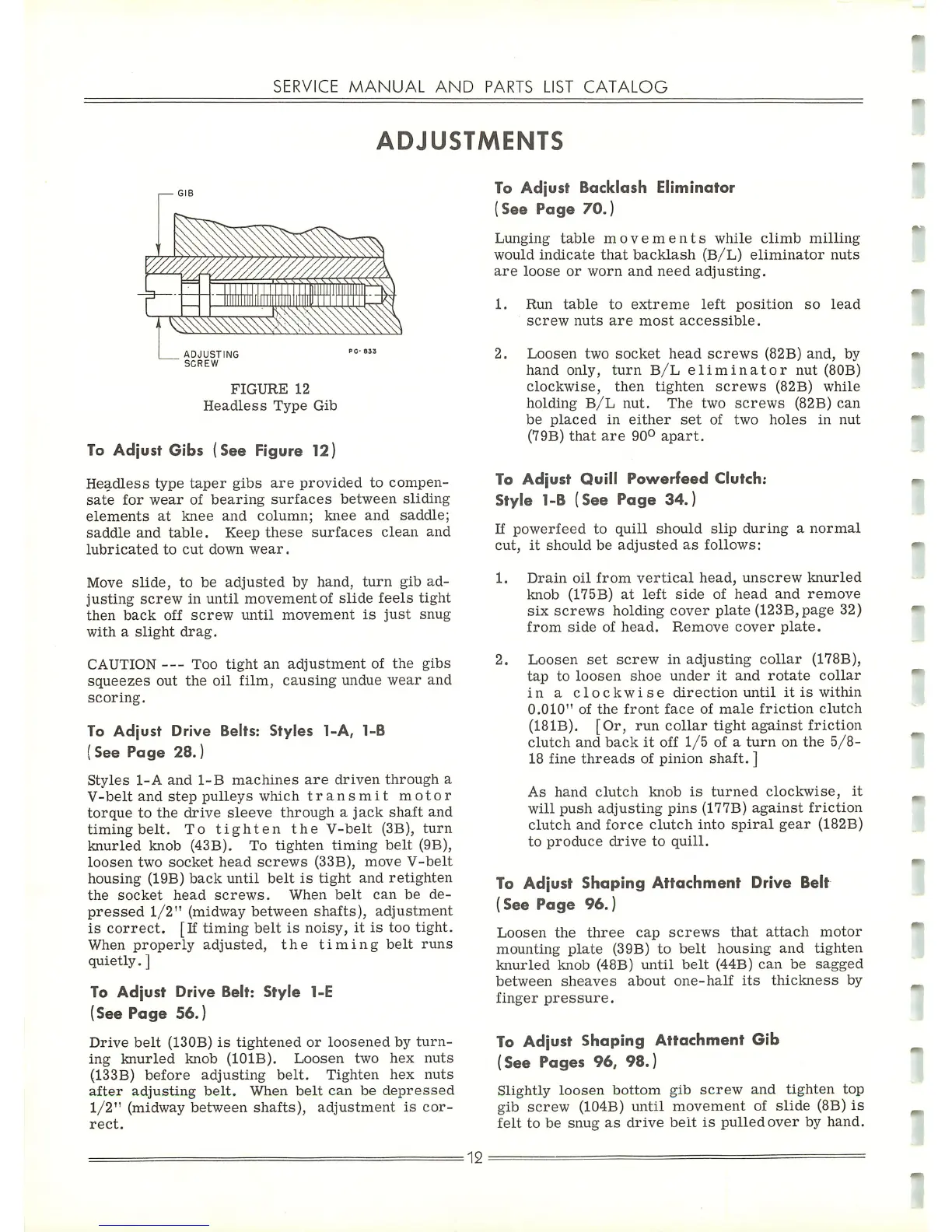
FIGURE
12
Headless
Type
Gib
To
Adjust
Gibs
(See
Figure 12)
Headless
type
taper
gibs
are
provided
to
compen
sate
for
wear
of
bearing
surfaces
between
sliding
elements
at
knee
and
column;
knee
and
saddle;
saddle
and
table.
Keep
these
surfaces
clean
and
lubricated
to
cut
down
wear.
Move
slide,
to
be
adjusted
by
hand,
turn
gib
ad
justing
screw
in
until
movement
of
slide
feels
tight
then
back
off
screw
until
movement
is
just
snug
with
a
slight
drag.
CAUTION
Too
tight
an
adjustment
of
the
gibs
squeezes
out
the
oil
film,
causing
undue
wear
and
scoring.
To
Adjust
Drive Belts: Styles 1-A, 1-B
(See
Page
28.)
Styles
1-A
and
1-B
machines
are
driven
through
a
V-belt
and
step
pulleys
which
transmit
motor
torque
to
the
drive
sleeve
through
a
jack
shaft
and
timing
belt.
To
tighten
the
V-belt
(3B),
turn
knurled
knob (43B). To
tighten
timing
belt
(9B),
loosen
two
socket
head
screws
(33B),
move
V-belt
housing
(19B)
back
until
belt
is
tight
and
retighten
the
socket
head
screws.
When
belt
can
be
de
pressed
1/2"
(midway
between
shafts),
adjustment
is
correct.
[If
timing
belt
is
noisy,
it
is too tight.
When
properly
adjusted,
the
timing
belt
runs
quietly.]
To
Adjust
Drive Belt:
Style
1-E
(See Page 56.)
Drive
belt
(130B)
is
tightened
or
loosened
by
turn
ing
knurled
knob
(101B).
Loosen
two
hex
nuts
(133B)
before
adjusting
belt.
Tighten
hex
nuts
after
adjusting
belt.
When
belt
can
be
depressed
1/2"
(midway
between
shafts),
adjustment
is
cor
rect.
To
Adjust
Backlash Eliminator
(See Page 70.)
Lunging
table
movements
while
climb
milling
would
indicate
that
backlash
(B/L)
eliminator
nuts
are
loose
or
worn
and
need
adjusting.
1.
Run
table
to
extreme
left
position
so
lead
screw
nuts
are
most
accessible.
2.
Loosen
two
socket
head
screws
(82B)
and,
by
hand
only,
turn
B/L
eliminator
nut
(80B)
clockwise,
then
tighten
screws
(82B)
while
holding
B/L
nut.
The
two
screws
(82B)
can
be
placed
in
either
set
of
two
holes
in
nut
(79B)
that
are
90°
apart.
To
Adjust
Quill
Powerfeed
Clutch:
Style 1-B (See Page 34.)
If
powerfeed
to
quill
should
slip
during
a
normal
cut,
it
should
be
adjusted
as
follows:
1.
Drain
oil
from
vertical
head,
unscrew
knurled
knob
(175B)
at
left
side
of
head
and
remove
six
screws
holding
cover
plate
(123B,page
32)
from
side
of
head.
Remove
cover
plate.
2.
Loosen
set
screw
in
adjusting
collar
(178B),
tap
to
loosen
shoe
under
it
and
rotate
collar
in
a
clockwise
direction
until
it
is
within
0.010"
of
the
front
face
of
male
friction
clutch
(181B).
[Or,
run
collar
tight
against
friction
clutch
and
back
it
off
1/5
of a
turn
on
the
5/8-
18 fine
threads
of pinion
shaft.
]
As
hand
clutch
knob
is
turned
clockwise,
it
will
push
adjusting
pins
(177B)
against
friction
clutch
and
force
clutch
into
spiral
gear
(182B)
to
produce
drive
to
quill.
To Adjust Shaping
Attachment
Drive Belt
(See Page
96.)
Loosen
the
three
cap
screws
that
attach
motor
mounting
plate
(39B)
to
belt
housing
and
tighten
knurled
knob
(48B)
until
belt
(44B)
can
be
sagged
between
sheaves
about
one-half
its
thickness
by
finger
pressure.
To Adjust Shaping Attachment Gib
(See Pages 96, 98.)
Slightly
loosen
bottom
gib
screw
and
tighten
top
gib
screw
(104B) until movement of slide (8B)
is
felt
to
be
snug
as
drive
belt
is
pulled
over
by
hand.
=
12

Related product manuals