How to Perform Planned Maintenance 7-15
Section 7. Planned Maintenance and Lubrication
A
0% of "A" is
ax. wear
llowed
1.5% is max.
height di eren
wear, rust, corrosion, cracked or broken links, stretching, etc. Check
that the lift and carriage chains are correctly adjusted to have equal
tension. Check that the lift chain anchor fasteners and locking means
are in place and tight. Inspect all lift line hydraulic connections for
leaks.
Uprights and lift chains require special attention and
maintenance to remain in safe operating condition. Refer
to “Lift Chain Maintenance” in this Section for additional
information.
Forks
Inspect the load forks for cracks, breaks,
bending, and wear. The fork top surfaces
should be level and even with each other.
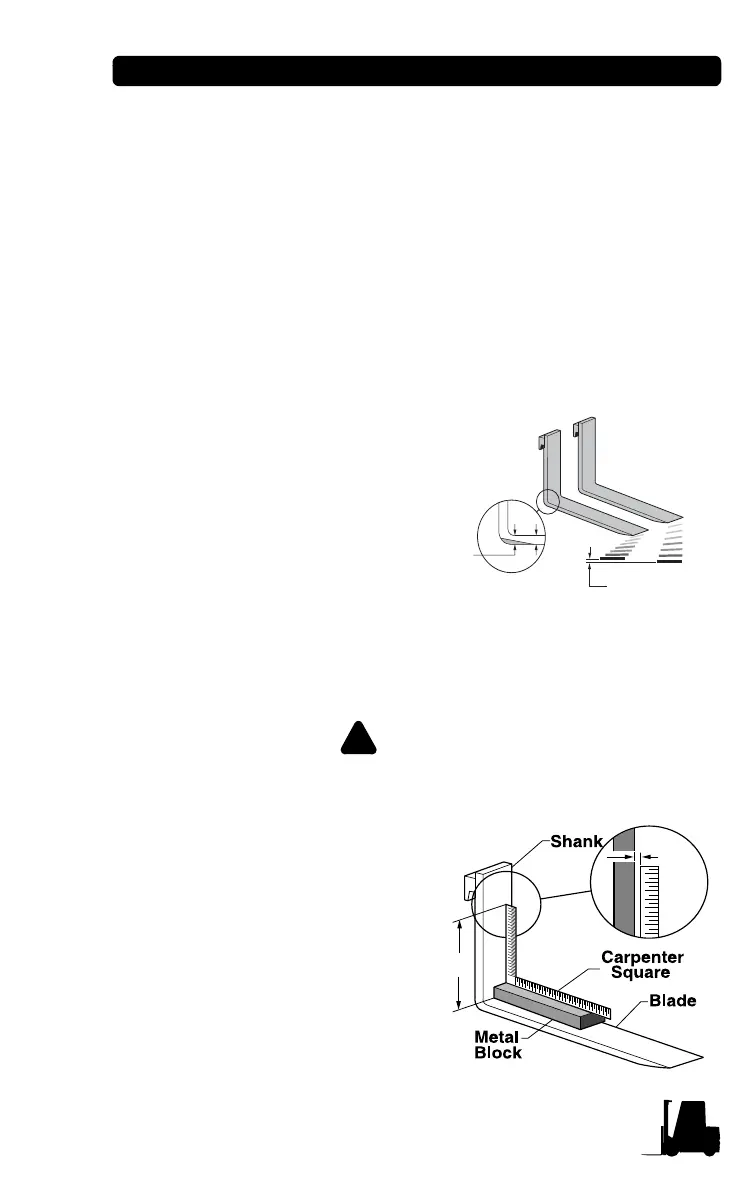
The height difference between both fork
tips should be no more than
1.5% of the blade lenght.
If the fork blade at the heel is worn down by more than 10
%, the load capacity is reduced and the fork must be
replaced.
I
nspect the forks for twists and
bends. Put a 2"-thick metal block, at
least 4" wide by 24" long with parellel
sides, on the blade of the fork with
the 4" surface against the blade. Put
a 24" carpenter's square on the top
of the block and against the shank.
Check the fork 20" above the blade
to make sure it is not bent more than
1" maximum.


 To Next Page