
 Need help?
Do you have a question about the Clarke SPP07 and is the answer not in the manual?
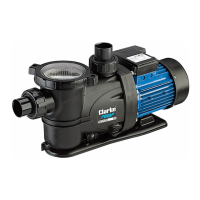
This document provides operating and maintenance instructions for CLARKE Swimming Pool Pumps, specifically models SPP07, SPP10, and SPP15 (Part Nos: 7175025, 7175030, and 7175035).
These CLARKE swimming pool pumps are self-priming, centrifugal pumps designed for the filtration of small to medium-sized swimming pools. They are intended for pumping clean water only, and operation with contaminated or salt water should be avoided. When permanently installed, the pump should be fixed in a horizontal position. The use of a non-return valve is recommended to facilitate immediate priming. The pump's inlet is positioned higher than the impeller inlet, allowing it to start operating when only the pump body is filled with water.
The manual details three models: SPP07, SPP10, and SPP15, each with varying specifications:
Pump Type: All models are Centrifugal.
Weight:
Dimensions (L x W x H):
Max Flow:
Max Head:
Operating Temperature: All models operate at 35°C.
Water Classification: All models are suitable for Swimming Pools/Clean Water.
Return Valve Type: All models feature a Flap type at the outlet.
Inlet & Outlet Size: All models have an inlet/outlet size of 50 l/d / 56 o/d (mm).
Power Supply: All models require 220-240V @ 50Hz.
Output Power:
Sound Pressure Level:
Sound Power Level:
Guaranteed Sound Power Level:
The product is designed to operate on 230VAC 50Hz. It must be connected to an earthed power supply via a Residual Current Device (RCD). The power cable wiring code is Blue = Neutral, Brown = Live, and Yellow & Green = Earth. A 13 Amp fuse (BS1363/A approved) should always be fitted.
Installation: The pump should be installed in a horizontal position with the outlet port facing vertically upwards. Fixing holes in the base are provided for secure mounting. It is recommended to mount the pump on raised blocks or a purpose-built platform to protect it from flooding. Adequate air circulation around the motor is essential, and the transparent filter cover must be accessible for cleaning. The pump should be installed in a dry, well-ventilated enclosure, sheltered from rain, such as a dedicated pump room. It is typically positioned between the pool skimmer and the pool filter, as close to the pool water level as possible.
Electrical Connection: The pump should be located at a safe distance (usually 2 meters) from the pool, with the power supply at least 3.5 meters away. It is crucial to avoid situations where the pump could become drenched with water, as neither the motor nor the terminal box are waterproof. The pump and its cable should not create a safety hazard.
Pipe/Hose Connections: The pump inlet connects to the pool skimmer and/or pool drain, while the discharge outlet connects to the water filter. The supplied inlet and outlet adaptors have an inner bore diameter of 50 mm and are designed for rigid pipe-work, which should be secured with a proprietary adhesive/sealant suitable for pressurized applications. Alternatively, 50 mm I/D hoses secured with worm drive clips can be used. All connections must be air-tight. Short flexible hose sections are recommended between rigid pipework and the pump to reduce vibration and strain. Air leaks in the suction line will inhibit priming and reduce pump capacity. The diameter of the inlet pipe significantly affects pump performance; a diameter at least equal to or greater than the pump connections (50 mm) is recommended. Hoses and pipes should be adequately supported to prevent strain or distortion. Suction and delivery isolation valves are suggested for pump isolation, and a gate valve on the delivery side can regulate water flow and assist priming. Protection from freezing with suitable lagging is necessary to prevent damage.
Operation:
Safety Precautions:
Regular Inspection: The primary maintenance involves regular inspection to ensure that debris is not blocking the water passage through the pump.
Filter Basket Cleaning: The filter basket should be cleaned periodically. This involves closing inlet and delivery valves, removing the filter cover with the provided wrench, lifting out the basket, and cleaning it in water. The cover O-ring should be checked for good condition before reassembly.
Blockage Clearing: If the pump is suspected to be blocked by silt or leaf debris, disconnect it from the mains supply and backflush to clear the blockage through the drain plug. This requires disconnecting the outlet hose and removing the non-return valve.
General Condition Check: Keep the pump clean and regularly check for loose bolts or a damaged power cable.
Post-Use Care (Seasonal/Freezing Conditions): After use, especially before winter or when there is a danger of freezing, always drain the pump body. If the pump has been used with contaminated or salty water, it should be thoroughly flushed with clean water, both inside and out, before draining and replacing the drain plug. Store the pump covered in a clean, dry, weather-sheltered environment. Remember to re-prime the pump when returning it to service.
Seal Inspection: Do not allow the pump to run dry, as this can damage the seal between the pump and motor. A leak at this point indicates a worn seal that needs replacement.
Contaminant Flushing: If contaminants come into contact with the pump, flush it with cold water as soon as possible to prevent damage. Do NOT use for pumping chemicals or other corrosive liquids (other than pool purification chemicals in their correct mix ratio).
Professional Overhaul: In the event that dismantling and overhaul of the pump are necessary, contact the CLARKE International Service Department.
Environmental Recycling Policy: Customers are obligated to dispose of the product in accordance with WEEE regulations. It must not be disposed of with general household waste but at a recognized disposal facility for Waste Electrical and Electronic Equipment (WEEE).
 General
| Brand | Clarke |
|---|---|
| Model | SPP07 |
| Category | Pool pumps |
| Language | English |

 To Next Page