Need help?
Do you have a question about the Clarke Start N Charge WIBC200 and is the answer not in the manual?
Explains the different readouts available via the DISPLAY button: Voltage, Battery %, and Alternator %.
Guides on selecting battery type, charging rate, and initiating the charging function.
Specifies optimal placement of the charger for safe and effective operation, emphasizing ventilation.
Details the procedure for connecting the charger to a battery that remains installed in a vehicle.
Provides clear, step-by-step instructions for safely and correctly replacing the charger's fuse.
Gives instructions on how to properly store the charger and its leads when not in use.
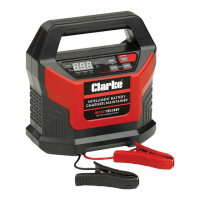
The Clarke WIBC200 is an intelligent battery charger-starter designed for a variety of battery types and applications, offering both charging and engine starting capabilities. It is suitable for use with 12V and 24V WET, MF, EFB, STD, GEL, and AGM batteries, making it a versatile tool for automotive and commercial use.
The primary function of the WIBC200 is to charge and maintain lead-acid batteries and to provide a boost start for vehicles with low batteries. It incorporates an advanced multi-stage charging process to ensure optimal battery health and longevity. This includes stages like analyzing battery connection, desulphation (pulsing charging to remove sulphate), soft start (gradually increasing charging current), controlled current charge (intelligently adjusting current), a second analysis to test charge absorption, constant output charge (constant voltage, compensating for fake full charge), recovery cycle charge (absorbing more charge and compensating for reduced current effects), absorption (constant trickle current for maximum voltage), a third analysis to test charge retention, and a maintenance mode (continuously monitoring and trickle charging when voltage drops).
Beyond charging, the device offers an engine start (boost) function, allowing it to provide a high current to help start an engine with a discharged battery. It also includes an alternator check feature to assess the vehicle's charging system. A "Repair Function" is available for recovering old, idle, stratified, or sulfated batteries, utilizing a high charging voltage.
The device is equipped with a 50A safety fuse to protect against overload, short circuits, and prolonged starting attempts.
The WIBC200 features a display and control panel with several buttons and LEDs for easy operation.
For connecting to a battery, the charger has separate connectors on the rear for 12V and 24V batteries. Safety precautions emphasize connecting leads only after switching off the charger to prevent sparking, especially with highly inflammable hydrogen gas released during charging. When connecting to a battery installed in a vehicle, users must identify the battery's voltage and polarity, connect the positive (RED) lead to the appropriate terminal on the charger and battery, and then connect the negative (BLACK) lead to the vehicle frame or engine block away from the battery (for negative earth vehicles). For positive earth vehicles, the negative (BLACK) lead connects to the battery's negative terminal, and the positive (RED) lead to the vehicle frame or engine block. It is recommended to disconnect the non-earthed lead on the battery before charging to protect vehicle electronics.
When using the engine start (boost) function, the charger goes through three states:
The repair function is an advanced recovery mode for specific battery issues, but it's advised to disconnect the battery from the vehicle before use due to high charging voltages that might affect some electronics or cause water loss in WET cell batteries.
The WIBC200 requires minimal maintenance.
The manual also provides a comprehensive list of error messages and troubleshooting steps for common issues like lack of AC input power, faulty battery connections, wrong charge voltage selection, low battery voltage, or charging a very cold battery.
 General
| Brand | Clarke |
|---|---|
| Model | Start N Charge WIBC200 |
| Category | Battery Charger |
| Language | English |

 To Next Page