3
contribute to the conditions. Any user suffering prolonged
symptoms of tingling, numbness, blanching of fingers, clum-
siness or weakened grip, nocturnal pain in the hand, or any
other disorder of the shoulders, arms, wrists, or fingers is
advised to consult a physician. If it is determined that the
symptoms are job related or aggravated by movements and
postures dictated by the job design, it may be necessary for
the employer to take steps to prevent further occurrences.
These steps might include, but are not limited to, reposition-
ing the workpiece or redesigning the workstation, reassigning
workers to other jobs, rotating jobs, changing work pace, and/
or changing the type of tool used so as to minimize stress on
the operator. Some tasks may require more than one type of
tool to obtain the optimum operator/tool/task relationship.
• Tasks should be performed in such a manner
that the wrists are maintained in a neutral
position, which is not flexed, hyperextended,
or turned side to side.
• Stressful postures should be avoided. Select
a tool appropriate for the job and work
location.
Work gloves with vibration reducing liners and wrist supports
are available from some manufacturers of industrial work
gloves. Tool wraps and grips are also available from a
number of different manufacturers. These gloves, wraps, and
wrist supports are designed to reduce and moderate the
effects of extended vibration exposure and repetitive wrist
trauma. Since they vary widely in design, material, thickness,
vibration reduction, and wrist support qualities, it is recom-
mended that the glove, tool wrap, or wrist support manufac-
turer be consulted for items designed for your specific appli-
cation. Proper fit of gloves is important. Improperly fitted
gloves may restrict blood flow to the fingers and can
substantially reduce grip strength.
This information is a compilation of general safety practices
obtained from various sources available at the date of pro-
duction. However, our company does not represent that
every acceptable safety practice is considered herein, or that
abnormal or unusual circumstances may not warrant or
require additional procedures. Your work may require addi-
tional specific safety procedures. Follow these procedures as
required by your company. For more information, see the
latest edition of ANSI B186.1, Safety Code for Portable Air
Tools, available from the American National Standards Insti-
tute, Inc., 11 West 42nd Street, New York, NY 10036.
the throttle is accidently engaged. Use of a self-relieving
valve within reach of the user of the tool is highly recom-
mended.
Do not operate or trigger any percussion tool unless the
chisel, scaling tool, rivet set, or other implement is in the tool
and in contact with the workpiece or worksurface. Never point
any percussion tool in the direction of another person or
yourself, or deliberately eject a chisel. Failure to do so can
cause serious injury and/or damage the tool.
Chisel or rivet set retainers are recommended and furnished
as standard equipment. Periodic inspection of the retainer
for wear or damage is recommended since these devices
can receive heavy abuse, particularly if the tool is run off
the workpiece. Damaged retainers are dangerous, and
can allow the ejection of a chisel or other implement.
They must be replaced as necessary. Only use safety
retainer type chisels, as shown in the operating instruc-
tions and service manual. Also, it is good safety practice to
erect suitable barriers to protect persons in surrounding or
lower work areas from possible ejected tools.
Some individuals
may be suscep-
tible to disorders
of the hands and
arms when per-
forming tasks
consisting of
highly repetitive
motions and/or
exposure to ex-
tended vibration.
Cumulative
trauma disorders
such as carpal tunnel syndrome and tendonitis may be
caused or aggravated by repetitious, forceful exertions of the
hands and arms. Vibration may contribute to a condition
called Raynaud’s Syndrome. These disorders develop gradu-
ally over periods of weeks, months, and years. It is presently
unknown to what extent exposure to vibrations or repetitive
motions may contribute to the disorders. Hereditary factors,
vasculatory or circulatory problems, exposure to cold and
dampness, diet, smoking and work practices are thought to
Safety Recommendations
Repetitive work motions and/or vibration
may cause injury to hands and arms.
Use minimum hand grip force.
Keep body and hands warm and dry.
Avoid anything that inhibits blood circulation.
Avoid continuous vibration exposure.
Keep wrists straight.
Avoid repeated bending of wrists and hands.
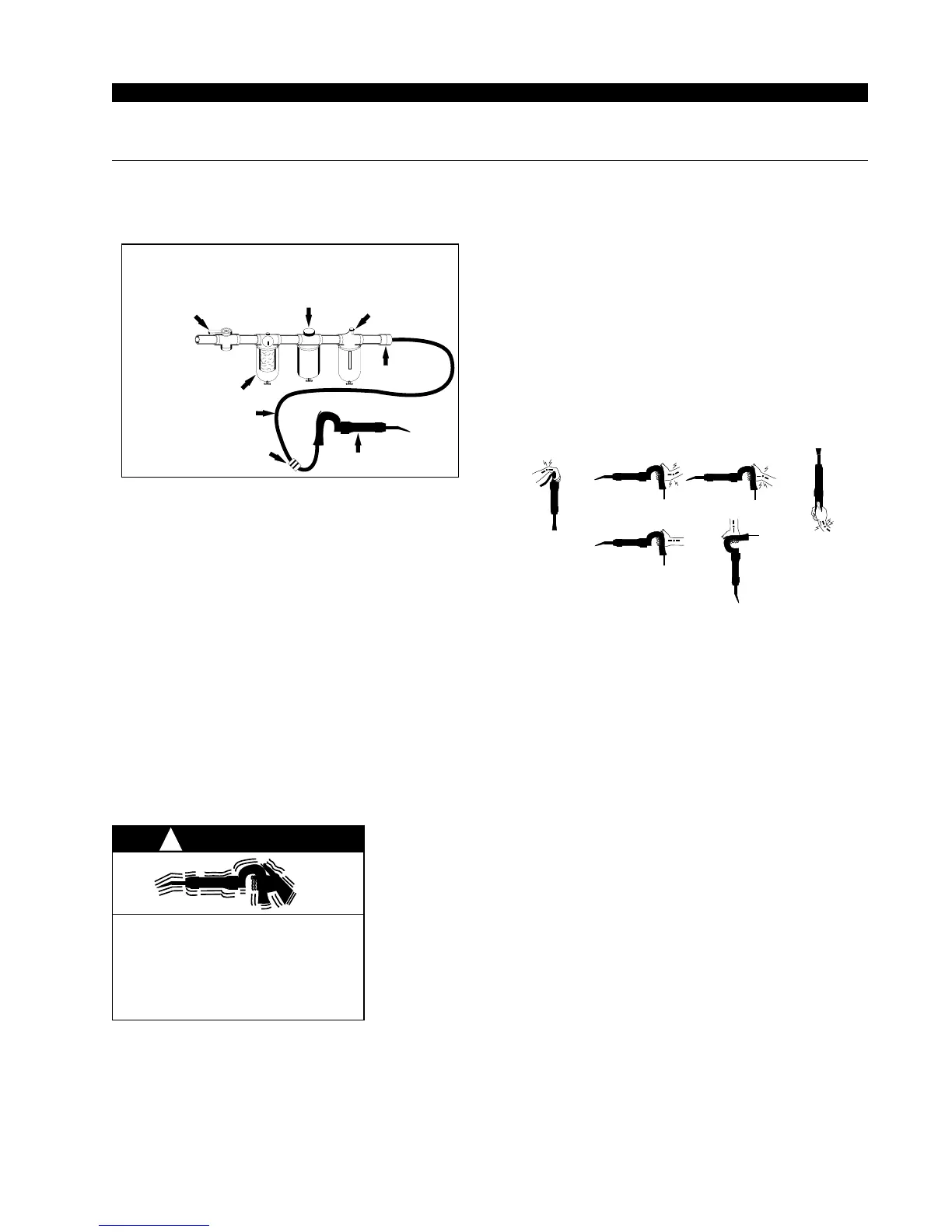
WARNING!
BAD POSTURE
GOOD POSTURE
0
90
45
Self-Relieving
Valve
Filter
Regulator
Lubricator
Tool
Hose
Coupling
INDIVIDUAL WORK STATION
Quick Disconnect
Coupling


 To Next Page
 Loading...