Mantenere asciutto
CAUTION
Use of glycol
Glycol use for installations with a domestic hot water tank: Only propylene glycol having a toxicity rating or class of 1, as listed in
"Clinical Toxicology of Commercial Products, 5th edition" may be used. The maximum allowed water volume is then reduced
according to the figure on page 45.
If there is too much pressure when using glycol, connect the safety valve to a drain pan to recover the glycol.
NOTE
Be aware of the hygroscopic property of glycol. It absorbs moisture from the environ-ment.
Leaving the cap off the glycol container causes the concentration of water to increase. The glycol concentration is then lower and
the water could freeze.
Preventive actions must be taken to ensure minimal exposure of the glycol to air.
NOTE
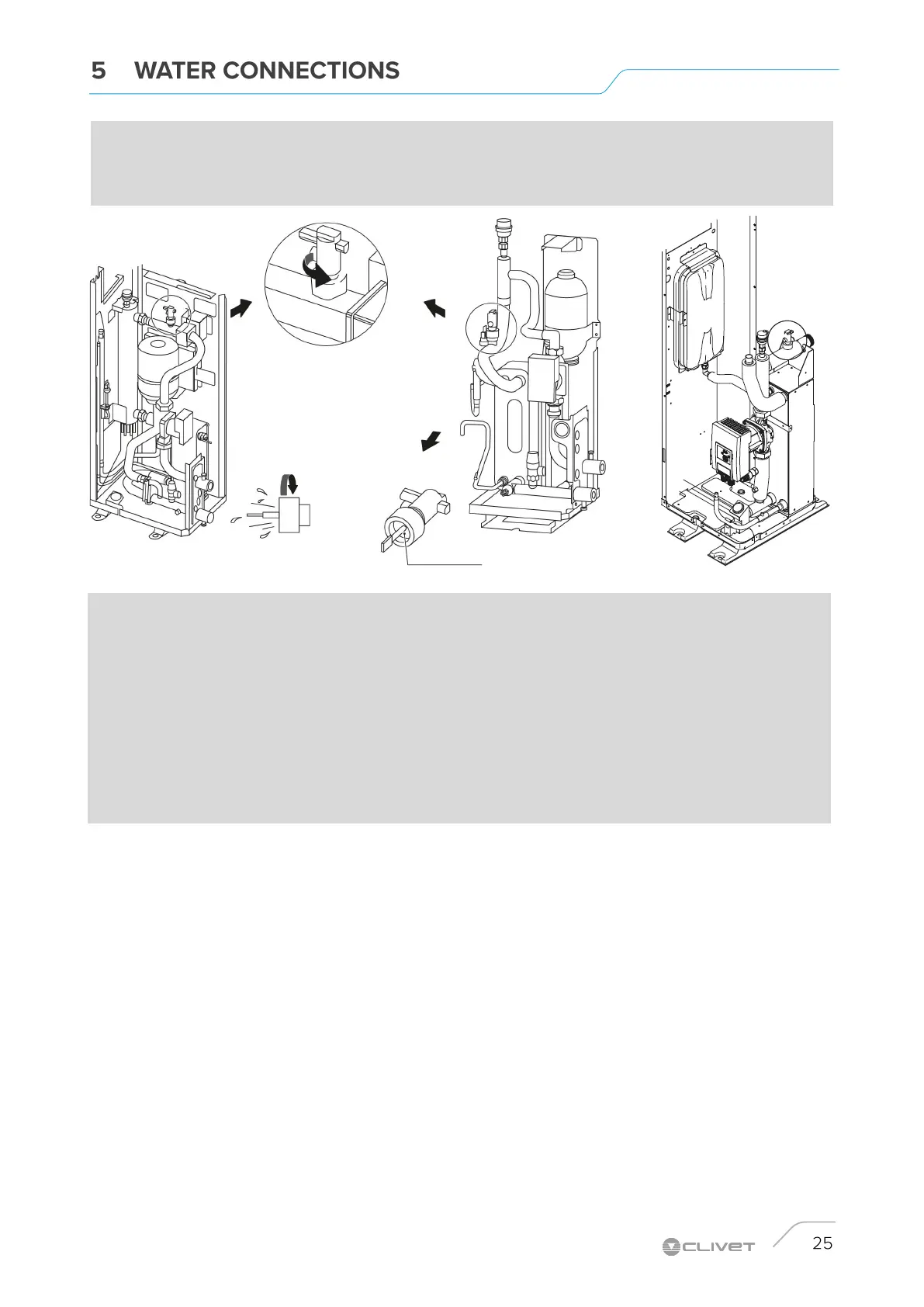
CounterclockWise rotation, remove the flow switch.
Drying the flow switch completely.
Corrosion in the system due to glycol
Uninhibited glycol will turn acidic under the influence of oxygen. This process is accelerated by presence of copper and at higher
temperatures. The acidic uninhibited glycol attacks metal surfaces and forms galvanic corrosion cells that cause severe damage to the
system.
It is of extreme importance:
That the water treatment is correctly executed by a qualified water specialist.
That a glycol with corrosion inhibitors is selected to counteract acids formed by the oxidation of glycols.
That in case of an installation with a domestic hot water tank, only the use of propylene glycol is allowed. In other installations the
use of ethylene glycol is fine.
That no automotive glycol is used because their corrosion inhibitors have a limited lifetime and contain silicates that can foul or
plug the system.
That galvanized piping is not used in glycol systems since it may lead to the precipitation of certain elements in the glycol’s
corrosion inhibitor.
To ensure that the glycol is compatible with the materials used in the system.


 To Next Page
 Loading...