This document describes the Hermle 791.081, an 8-day spring-wound movement designed for pendulum clocks, featuring a half-hour strike mechanism. The movement is engineered to strike a brass bell located on top, producing an audible chime for each half-hour and hour.
Function Description
The Hermle 791.081 movement is the heart of a pendulum clock, responsible for accurate timekeeping and striking functions. It operates on an 8-day cycle, meaning it requires winding approximately once a week. The movement utilizes a spring-wound mechanism to power its gears, escapement, and strike train.
The timekeeping function is regulated by a pendulum, which swings back and forth, interacting with the escapement to control the release of energy from the mainspring. This interaction produces the characteristic "TIC TOC" sound of a mechanical clock. The pendulum's length is crucial for accurate timekeeping; a longer pendulum results in a slower clock, while a shorter one makes it faster.
The strike mechanism is designed to sound a brass bell. It activates every half-hour and on the hour. The hammer, which strikes the bell, is carefully positioned to ensure a clear, resonant tone. The synchronization of the strike with the time display is automatic, requiring the movement to run for a minimum period after any manual adjustments to fully synchronize.
Usage Features
The Hermle 791.081 movement is designed for integration into a clock case, with the dial and hands providing the visual time display.
- Installation: Before final installation into a timber case, it is recommended to assemble and adjust the movement using a timber blank. This allows for checking clearances, operation, and hand installation. The movement should be securely fixed in position, and the pendulum correctly fitted.
- Adjusting Pendulum Length (Timekeeping): At the base of the pendulum, there is an adjustable nut on a long thread. Turning this nut allows for varying the pendulum's length, which directly impacts the clock's speed. Small adjustments (a few turns) are recommended initially, gradually refining the accuracy from minutes to hours and then to days or weeks. Seasonal temperature changes may necessitate periodic adjustments to maintain accurate timekeeping.
- Automatic Beat Adjustment: To achieve a balanced "TIC TOC" sound (50% Tic - 50% Toc), the pendulum should be swung wider than its normal working distance. This action causes the pallet (on top of the movement) to slip on its shaft. As the exaggerated swing reduces, the pallet ceases to slip, settling into a new centrally fixed position. This process ensures a balanced period of time, with the distance from the center to the "TIC" being the same as the distance to the "TOC."
- Manual Beat Adjustment: If the pendulum's swing is restricted, manual adjustment of the anchor lever is necessary. The anchor lever is attached to the shaft holding the pallet, both held by a friction bush. By holding the pallet still, the anchor lever's position on the shaft can be adjusted. This requires many small adjustments over time until the anchor lever swings continuously with an even beat, producing a smooth and continuous sound.
- Adjusting the Strike Hammer: The strike hammer's position and angle are critical for a quality resonant tone. Care must be taken to ensure the hammer does not interfere with the crutch, pendulum, or post, either at rest or during its strike action. The hammer head should rest approximately 2-3mm above the gong to prevent unwanted damping of sound. Bending the strike arm can change the hammer's angle, and tools are recommended for precise shaping.
- Automatic Synchronization: The movement automatically determines the striking of the hour and half-hour. After any manual adjustments or stoppages, the movement must run for at least one hour for the synchronization to complete. It is advisable to let the movement run for a few hours and count the strikes to confirm proper synchronization.
- Adjusting Hand Position: The hour hand has a round bush and is a push fit onto the movement, allowing it to be adjusted to any position on the dial. The minute hand has a square bush and can only be installed in one of four correct positions (¼, ½, ¾, or 1 hour). After the movement has run for up to two hours, the next hour to be struck should be noted, and both hands repositioned accordingly. It is crucial that the movement is running and chiming correctly before attempting to install the hands.
Maintenance Features
Proper maintenance ensures the longevity and accurate operation of the Hermle 791.081 movement.
- Oiling: The movement comes with a small bottle of special High Grade Superfine Synthetic Clock Oil. Oiling is a straightforward process but requires removing the dial and taking the movement out of its case. Every pinion hole must receive one drop of oil, and any excess oil should be wiped away.
- Cleaning and Servicing: It is recommended that the movement be oiled and, if necessary, cleaned every 4-5 years. In coastal areas, where salt buildup and corrosion are more prevalent, more frequent servicing may be required. Regular servicing ensures the movement functions perfectly for many years.
- Regular Inspection: Periodically check the operation of the timepiece. Inspect all surfaces and pinion bearings for any signs of dust, dirt, corrosion, or wear. This proactive approach helps identify and address potential issues before they become significant problems.

 Need help?
 General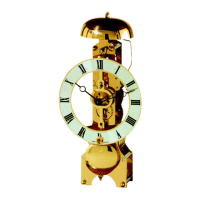

 To Next Page