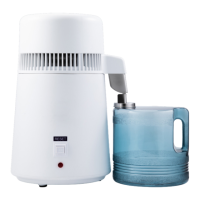
The Water Distiller is a household appliance designed to purify water by heating it into vapor and then cooling it back into liquid form, effectively removing impurities. This process ensures that the collected water is free from contaminants, making it suitable for various uses where pure water is desired.
Function Description:
The distiller operates on a simple yet effective principle of distillation. Water is poured into the main tank, where a heating element raises its temperature until it vaporizes. This hot air, or steam, then rises into a cooling system. Within the cooling system, the steam condenses back into liquid water. As the water condenses, it leaves behind impurities, heavy metals, and other contaminants that do not vaporize at the same temperature. The purified water then flows through an output nozzle, passing through an activated charcoal filter for additional purification, before being collected in a separate collection bottle. The activated charcoal filter is crucial for absorbing smaller impurities that might not be eliminated through the initial distillation process, ensuring a higher quality of distilled water. The device is equipped with a temperature safety cutoff to prevent overheating and ensure safe operation.
Usage Features:
To use the distiller, first ensure it is placed on a stable surface and connected to a compatible power source. The collection bottle needs to be assembled by twisting the collection cap clockwise onto its top. For the distiller itself, the silicone seal, which prevents water from escaping, must be correctly positioned with its rounded side facing up. The activated charcoal packet should be inserted into the outlet nozzle, which is then reattached to the distiller's lid. The collection cap should be aligned with the distiller's spout to direct the distilled water into the bottle. Alternatively, a provided silicone tube can be used to connect the spout to another receptacle.
Once set up, the distiller is ready for operation. The user opens the distiller, fills the main tank with water up to the maximum level line, and then securely replaces the lid. After plugging in the power cord, pressing the "Reset" button initiates the distillation cycle. Water will begin to pour out after approximately 30 minutes, with a full distillation cycle taking about 4 hours to complete. It is important to wait 10 minutes between cycles before adding more water for a new batch. After the distillation cycle ends, a waiting period of 15 minutes is recommended before removing the lid cover. When opening the lid, it should be lifted to the side to avoid escaping steam, as the water vapor is extremely hot and can cause instant scalding. The device should not be operated by children or persons with impaired physical or mental capacities without strict supervision. It is also crucial to avoid using the device if its outer casing is wet or if the power cables are damaged. The collection bottle should not be placed into a cold environment immediately after being filled with hot distilled water, as this could cause it to crack or shatter.
Maintenance Features:
Regular maintenance is essential to ensure the longevity and efficient operation of the water distiller. Before any cleaning, maintenance, or repair, the distiller must be disconnected from its power source and allowed to cool completely.
The tank should be rinsed and wiped daily with clean water, ensuring it is dry when not in use. Calcium deposits and other residues can accumulate on the stainless-steel lining over time, so monthly cleanings are recommended. To clean the tank, hot water should be poured in until all residue is covered, followed by 1-4 teaspoons of the provided chamber cleaning powder, depending on the amount of residue. The inside of the distiller's cap should be washed with a soft cloth. All these components should then be rinsed with clean water, taking care not to get any electrical components wet. If any residue remains, the process can be repeated. Corrosive agents or steel cleaning instruments should not be used, as they can damage the stainless-steel lining.
The collection bottle should be cleaned with warm soapy water. It is important never to alternate between hot and cold water when cleaning the bottle, as this can cause damage. The silicone seal should also be removed and cleaned monthly, ensuring that when it is placed back onto the distiller's cap, the rounded side of the ring faces up.
Troubleshooting tips are provided for common issues. If insufficient water comes out, the tank should be filled to the line, and the silicone seal checked for wear or misplacement. The alignment of the spout and bottle should also be corrected, or the provided tube used. If the machine becomes jittery, the silicone seal should be checked, and the filter alignment confirmed. If distilled water has an odd odor, the distillation process should be halted 10-15 minutes before its regular end point to prevent it from running dry and burning residual minerals. If black debris is present in the distilled water, the damaged charcoal filter should be removed, the nozzle cleaned, and a new charcoal packet inserted. If the reset button malfunctions, connecting the distiller to a surge protector and cycling its power using the surge protector's switch is recommended.


 To Next Page
 General